Monday, May 22, 2024

EU WEEE Rule Adds DPP and Recyclability Filings
by
Published
Views:
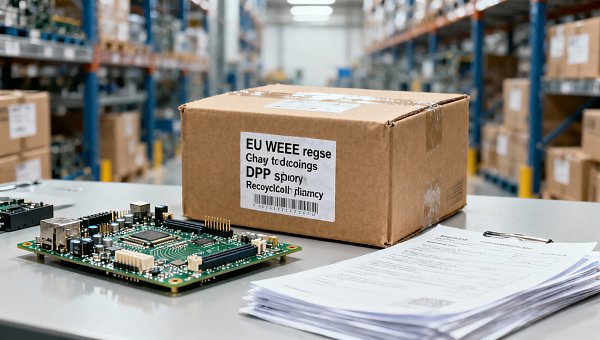
On July 18, 2026, the revised EU Waste Electrical and Electronic Equipment Directive (WEEE) took effect for PCB and PCBA exports, adding two concrete compliance requirements: a recyclability technical declaration aligned with EN 50625-2-2:2025 and a machine-readable Digital Product Passport (DPP). For SMT precision manufacturers and PCB/PCBA fabrication suppliers, this is not just a documentation update. It affects how export compliance is prepared, how shipment files are assembled, and how customs timing may be influenced when required technical information is missing or inconsistent.
What the rule now requires for PCB and PCBA shipments
The confirmed facts are limited but clear. From July 18, 2026, the revised WEEE framework formally applies a new requirement to all PCB and PCBA components exported to the EU. These products must be accompanied by a recyclability technical declaration that complies with EN 50625-2-2:2025. They must also carry a machine-readable Digital Product Passport (DPP) containing material composition, solder type, and coating information. According to the provided event summary, the immediate area of impact is the export compliance pathway and customs clearance efficiency of SMT precision manufacturing and PCB/PCBA fabrication suppliers.
Where the pressure is likely to appear across the supply chain
Export-facing manufacturers will feel the first compliance shift
Analysis shows that PCB and PCBA manufacturers shipping into the EU are the most directly exposed group because the new requirement attaches to export activity itself. The practical pressure point is likely to be the pre-shipment stage, where technical declarations and machine-readable product records must be available in a usable form. What deserves closer attention is whether internal product data, process data, and export files are currently organized well enough to support these two new submission elements without delaying release.
Procurement and material control functions may need tighter data discipline
From an industry perspective, teams responsible for material sourcing and engineering change control may also be affected because the DPP must include material composition, solder type, and coating information. That means procurement records, approved material lists, and version control over production inputs become more relevant to export readiness. The rule change does not by itself describe a new purchasing regime, but it does increase the importance of traceable upstream information when preparing compliance documents for EU-bound orders.
Supply chain and delivery management may face timing risks
Observably, logistics coordination and order delivery could also come under pressure where export files are completed late or where technical data is fragmented across departments or suppliers. The event summary specifically points to customs clearance timeliness, which suggests that document completeness and consistency may become part of delivery risk management for affected exporters. For companies shipping on tight customer schedules, the operational issue may be less about the existence of the rule and more about whether shipment-ready compliance files can be produced reliably.
Buyers and qualification teams may raise documentation expectations
It is more appropriate to understand this as a signal that procurement-side review may become more document-sensitive for EU-bound business involving PCB and PCBA components. Buyers, sourcing managers, and supplier qualification teams may need to check whether suppliers can provide a recyclability declaration aligned with EN 50625-2-2:2025 and a machine-readable DPP with the required data fields. While the input does not provide confirmed changes to tender language or supplier approval procedures, those areas are reasonable points to watch.
What companies should watch in day-to-day execution
Check whether compliance files are shipment-ready
Analysis shows that companies should pay close attention to whether export documentation packages now include a recyclability technical declaration and a machine-readable DPP for relevant PCB and PCBA products. The key issue is not only whether the information exists somewhere internally, but whether it can be assembled in a form suitable for export and customs handling.
Review the quality of product data used in DPP preparation
What deserves closer attention is the reliability of the product information feeding the DPP, especially material composition, solder type, and coating information. If these data points are held across engineering, procurement, and manufacturing records, companies may need to review whether inconsistencies could create compliance questions during shipment preparation or post-shipment traceability checks.
Watch for changes in customer documentation requests
Observably, customer-side document requests may become a practical indicator of how the rule is being implemented in the market. Exporters and suppliers should monitor whether buyers begin requesting updated technical files, compliance declarations, or DPP-related information earlier in the order cycle. The provided information does not confirm a uniform market practice yet, so this remains an area to track rather than a settled outcome.
Build more time into orders where compliance review is still maturing
From an industry perspective, delivery planning may need more caution during the early execution phase of the rule. Because the summary explicitly links the new requirement to customs clearance efficiency, companies should pay attention to whether documentation review adds time to release, booking, or border processing. This should be treated as a practical risk signal, not as proof of a fixed delay pattern.
Why this looks like an execution-stage signal
Analysis shows that this development is better understood as a rule that has already entered the implementation stage, not as a distant policy discussion. The effective date is defined, the affected product scope in the provided summary is concrete, and the required compliance elements are specific. At the same time, Observably, many of the operational consequences still depend on how documentation checks, customs handling, supplier qualification, and customer requests are applied in practice. That is why the market should treat this both as a landed compliance change and as an area requiring continued observation.
How the market should read this update now
At this stage, the most balanced reading is that the revised WEEE requirement creates a more document-intensive export pathway for PCB and PCBA shipments into the EU. The change is already meaningful because it adds a recyclability declaration and a machine-readable DPP to the compliance picture. Still, it would be premature to turn that into broad conclusions about market outcomes beyond the confirmed effect on compliance preparation and customs timing. It is more appropriate to understand this as a live compliance requirement with operational implications that will become clearer through actual execution.
Basis of this article and what still needs verification
This article is based on the user-provided news title, event date, and event summary. For developments of this kind, source types typically relevant to verification include official announcements, regulatory publications, customs or trade authority information, industry association notices, standards organization documents, and reporting by established trade media. No specific official source link was provided in the input, so the exact official reference still needs to be verified on an ongoing basis. What also remains worth tracking is the detailed execution approach, compliance interpretation, tender document changes, market feedback, and how affected companies are handling implementation in practice.
The Archive Newsletter
Critical industrial intelligence delivered every Tuesday. Peer-reviewed summaries of the week's most impactful logistics and market shifts.