Monday, May 22, 2024

PCB Dielectric Constant Benchmark Data: How to Compare Materials
by
Published
Views:
PCB Dielectric Constant Benchmark Data: How to Compare Materials
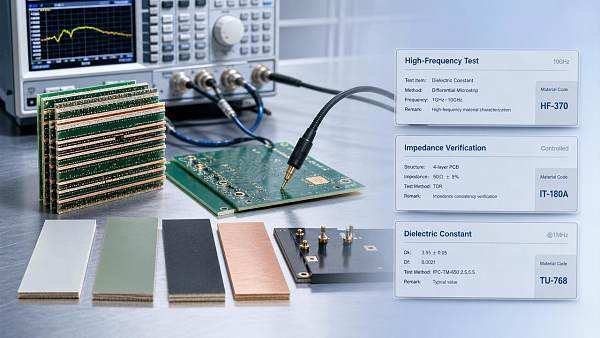
Selecting the right laminate starts with reliable pcb dielectric constant benchmark data.
For technical evaluation, small Dk shifts can change impedance, delay, and RF loss behavior.
That is why comparison must go beyond a single datasheet number.
A useful review checks test frequency, resin system, glass style, copper profile, and process stability.
In practice, the same material family may show different dielectric values under different methods.
This makes pcb dielectric constant benchmark data essential for design validation and sourcing decisions.
Global Industrial Matrix supports this work by aligning cross-sector benchmark logic with IPC, ISO, and IATF-oriented evaluation habits.
The goal is simple: compare materials on a like-for-like basis, then reduce technical and commercial risk.
Why dielectric constant benchmark data matters
Dielectric constant, often called Dk or Er, describes how a material stores electrical energy.
For PCB design, it directly affects trace impedance and signal propagation speed.
A higher Dk usually reduces signal velocity and changes field distribution.
That may be acceptable for low-speed control boards, but risky for high-speed serial links.
In RF layouts, the tolerance band often matters more than the nominal number.
A material quoted at 3.48 can behave differently from one quoted at 3.48 under another test condition.
This is the first reason pcb dielectric constant benchmark data should be normalized before use.
- Impedance control depends on stable Dk across frequency and temperature.
- Timing margins depend on predictable propagation delay.
- RF matching depends on dielectric uniformity, not only average values.
- Procurement risk rises when benchmark data ignores fabrication variation.
So the benchmark question is not just, “Which Dk is lower?”
A better question is, “Which material delivers the most consistent electrical behavior for the target stack-up?”
What makes pcb dielectric constant benchmark data comparable
This is where many teams lose time.
Datasheets may list dielectric constant, yet the numbers are not always directly comparable.
Key variables to align
- Test method, such as IPC-TM-650, clamped stripline, or split post dielectric resonator.
- Frequency point, because Dk often drops as frequency increases.
- Material condition, including dry, conditioned, or processed laminate.
- Resin content and glass weave, which influence local dielectric uniformity.
- Copper foil type and roughness, which can alter effective electrical performance.
From a benchmarking view, the cleanest comparison uses the same frequency and the same test method.
If that is not possible, note the conversion risk clearly.
More importantly, separate nominal Dk from design Dk.
Nominal Dk comes from the supplier sheet.
Design Dk is the value verified through coupon testing, modeling, or field experience.
That gap is often where project delays begin.
Benchmark ranges across common PCB material groups
The following benchmark ranges help frame first-pass comparisons.
They are directional, not a substitute for qualified source data.
These ranges make pcb dielectric constant benchmark data easier to screen during early sourcing.
Still, broad ranges can hide critical details.
For example, two FR-4 variants may sit close on paper but diverge in loss, weave effect, or thickness tolerance.
How to compare materials for RF, high-speed, and standard designs
A practical benchmark should start from the application, not the catalog.
For RF and microwave boards
Focus on Dk stability across frequency, plus dissipation factor and moisture behavior.
Low nominal Dk helps, but flat performance is often more valuable.
For high-speed digital boards
Look at effective Dk in the relevant frequency band.
Then match it with insertion loss, skew control, and fabrication repeatability.
For standard industrial control boards
Cost, availability, and process yield usually carry more weight than chasing the lowest Dk.
That said, stable pcb dielectric constant benchmark data still improves impedance planning for mixed-signal layouts.
- Define the operating frequency window and critical nets.
- Collect supplier dielectric data with method and condition notes.
- Group candidate materials by laminate family, not marketing label.
- Compare nominal Dk, tolerance, Df, and process capability together.
- Validate the short list with stack-up modeling or coupon data.
This sequence keeps benchmark work grounded in real design constraints.
Common mistakes when reading pcb dielectric constant benchmark data
One common mistake is treating all dielectric values as fixed constants.
In reality, Dk is condition-dependent and often frequency-dependent.
Another mistake is ignoring laminate construction details.
Glass weave, resin content, and prepreg style can shift effective behavior inside the same product family.
A third mistake is overvaluing the lowest number.
Lower Dk may increase cost, complicate drilling, or reduce supplier flexibility.
- Do not compare 1 GHz data with 10 GHz data without context.
- Do not ignore tolerance bands and process variation.
- Do not separate dielectric review from loss and thermal behavior.
- Do not assume one approved stack-up fits every fab site.
These issues matter even more when qualifying second sources.
A second-source material can look equivalent in brochure language but fail in controlled impedance production.
A practical benchmark workflow for sourcing and validation
The most reliable workflow combines data screening, engineering review, and manufacturing feedback.
That is the point where pcb dielectric constant benchmark data becomes decision-ready.
Recommended checklist
- Request dielectric data by frequency, condition, and test method.
- Ask for laminate construction options and copper foil details.
- Map each candidate to impedance targets and layer count needs.
- Review availability across regions to reduce supply chain concentration.
- Run a pilot build before locking a global release.
In actual operations, this benchmark discipline speeds up both qualification and negotiation.
It also supports cleaner communication between design teams, sourcing teams, and fabricators.
For organizations managing electronics within broader industrial programs, that cross-functional clarity is a real advantage.
Reliable pcb dielectric constant benchmark data is not just a material metric.
It is a control point for performance, qualification speed, and sourcing resilience.
When comparisons stay aligned to standards, application conditions, and build reality, material selection becomes faster, safer, and far more defensible.

The Archive Newsletter
Critical industrial intelligence delivered every Tuesday. Peer-reviewed summaries of the week's most impactful logistics and market shifts.