Monday, May 22, 2024

PCB Dielectric Constant Benchmark Data for Material Comparison
by
Published
Views:
Selecting the right PCB material starts with reliable pcb dielectric constant benchmark data. For researchers, engineers, and sourcing teams comparing laminates across frequency, thermal, and manufacturing requirements, this guide provides a clear benchmark-driven view of dielectric performance. Built for informed material evaluation, it helps readers identify how dielectric constant differences affect signal integrity, design stability, and cross-supplier decision-making in modern electronics applications.
When people search for pcb dielectric constant benchmark data, they usually want a practical comparison tool, not a textbook definition. They need to know which materials behave similarly, where values shift with frequency, and how to compare supplier claims without making risky assumptions.
The short answer is that dielectric constant data is only useful when it is benchmarked by test method, frequency range, resin system, and process condition. A single Dk number on a datasheet rarely tells the full story for high-speed, RF, power, or multi-layer PCB decisions.
For information researchers and technical sourcing teams, the most valuable approach is to compare materials in bands rather than chase one isolated nominal value. Low-Dk, mid-Dk, and conventional FR-4-class materials each serve different electrical and manufacturing priorities, and benchmark context matters more than marketing labels.
What decision-makers really need from pcb dielectric constant benchmark data
The main search intent behind this topic is comparative evaluation. Readers want to screen PCB materials efficiently, understand performance trade-offs, and identify whether one laminate is a realistic substitute for another in existing or future designs.
They also want to reduce uncertainty. In real procurement and engineering workflows, teams are comparing multiple laminate families, supplier regions, and qualification routes. They need benchmark data that supports cross-vendor alignment, not just isolated product promotion.
For this audience, the biggest questions are straightforward. Is the dielectric constant stable enough for the target frequency? Will impedance targets remain predictable? Can the material be sourced from more than one supplier? What hidden qualification risks sit behind the headline Dk value?
That means the article should focus less on generic PCB theory and more on how dielectric constant data is interpreted in practice. Readers benefit most from benchmark ranges, comparison logic, application fit, and warning signs that often distort material selection decisions.
Why dielectric constant matters in material comparison
Dielectric constant, often shown as Dk or Er, influences how electromagnetic fields propagate through PCB substrate materials. In practical terms, it affects controlled impedance, signal delay, coupling behavior, and how consistently a design performs across operating conditions.
A lower dielectric constant generally supports faster signal propagation and can help reduce capacitance-related effects in high-speed or RF layouts. However, lower is not automatically better. The best material is the one that matches the electrical architecture, stack-up constraints, and manufacturing reality.
Material comparison becomes more important as systems move into tighter tolerances. In high-speed digital interconnects, mmWave modules, ADAS electronics, industrial controls, and power-dense designs, small Dk differences can translate into measurable design and qualification consequences.
For sourcing teams, dielectric constant is also a substitution variable. If one supplier faces lead-time volatility or regional availability issues, benchmarked Dk data helps determine whether an alternate material is electrically close enough to support redesign minimization or controlled requalification.
Benchmark ranges: how PCB materials are commonly grouped
Useful pcb dielectric constant benchmark data is often easier to interpret when organized into practical performance bands. These bands do not replace supplier data, but they help researchers quickly understand where a material family sits in the broader laminate landscape.
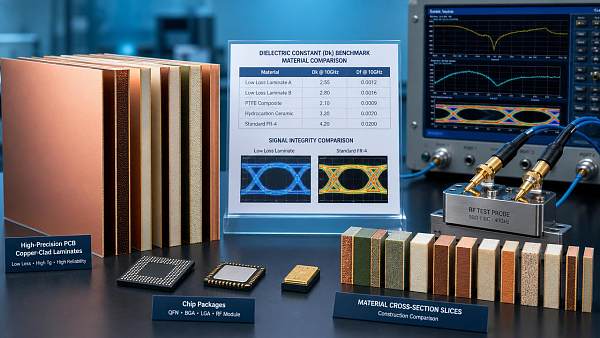
Conventional FR-4-class materials often fall around the mid-4 range, though actual values vary by resin content, glass style, cure state, and test frequency. These materials remain common because they balance cost, manufacturability, and acceptable electrical performance for many mainstream products.
Enhanced high-speed epoxy systems often move downward into the upper-3 to low-4 range. They are frequently selected when designers need better signal integrity than standard FR-4 can offer, but still want familiar processing behavior and a manageable qualification path.
Very low-loss or RF-oriented materials may sit in the low-3 range or below, depending on chemistry. PTFE-based, hydrocarbon ceramic, and advanced thermoset systems are often chosen for microwave, antenna, radar, or ultra-high-speed channels where Dk stability and loss behavior are critical.
These ranges are only directional. A benchmark table becomes meaningful when every entry is tied to test method, frequency, and temperature. Without that discipline, comparing one supplier’s 1 GHz value to another supplier’s 10 GHz value can produce misleading conclusions.
Representative dielectric constant benchmark view for comparison
Below is a practical comparison model that reflects how many teams interpret pcb dielectric constant benchmark data during early-stage research. It is not a qualification substitute, but it helps structure material screening before deeper electrical and reliability review.
Standard FR-4 materials are commonly referenced around Dk 4.2 to 4.8 at lower frequency test points. High-speed epoxy laminates often benchmark around Dk 3.6 to 4.2. Advanced low-loss materials may range near 3.0 to 3.7, while some RF-focused systems trend even lower.
What matters is not only the absolute number, but also the spread and stability. A material with a slightly higher nominal Dk may still be the better choice if it shows tighter frequency consistency, better process repeatability, and a stronger supply base.
Researchers should also note whether values are reported in the z-axis or in-plane direction, and whether the measurement reflects resin-rich structures or glass-influenced composite behavior. In woven-glass laminates, local dielectric variation can affect real channel performance beyond the nominal datasheet average.
What can distort dielectric constant comparisons
One of the most common mistakes is treating dielectric constant as a fixed material identity. In reality, Dk changes with frequency, temperature, moisture absorption, and in some cases copper surface treatment or laminate construction style.
Test methodology is another major source of confusion. IPC test methods, clamped stripline methods, split-post dielectric resonator approaches, and other techniques can generate different values. Benchmark data must always be interpreted alongside the measurement method used.
Supplier datasheets can also differ in how they present values. Some publish typical numbers, others publish design values, and some cite laboratory values under highly specific conditions. A sourcing team comparing alternatives should normalize these differences before drawing conclusions.
Laminate thickness and resin content can further complicate interpretation. Two materials sold under the same family name may show different effective behavior depending on construction. For multilayer boards, prepreg combinations and stack-up architecture often matter as much as the core laminate label.
Another distortion comes from focusing on Dk alone. In high-speed designs, dielectric loss, copper roughness interaction, thermal expansion, CAF resistance, drillability, and plating compatibility often shape total performance more than a small nominal Dk difference.
How to use benchmark data for real material screening
For information researchers, the most effective workflow starts with application filtering. First define whether the target use case is standard digital, high-speed computing, RF front-end, automotive control, power electronics, or another mixed-demand environment.
Next, build a shortlist based on Dk range compatibility rather than exact match claims. This narrows the field quickly. A design built around conventional FR-4 assumptions should not automatically substitute into a very low-Dk system without checking impedance, loss, and fabrication implications.
Then compare data quality. Stronger material candidates provide dielectric constant values across multiple frequencies, along with dissipation factor, Tg, Td, CTE, moisture absorption, and processing notes. Benchmark depth is often a sign of supplier maturity and qualification readiness.
After that, assess supply chain resilience. A technically suitable laminate with weak regional availability or inconsistent converter support may create more operational risk than a slightly less optimized but widely qualified alternative. Benchmarking should support continuity, not only performance ambition.
Finally, map the material to the board architecture. Controlled impedance layers, insertion loss budget, via density, thermal load, and assembly profile all influence whether a dielectric constant benchmark translates into actual product value.
Application-specific guidance: when different Dk bands make sense
For mainstream industrial electronics, power control boards, and many embedded products, mid-range Dk materials often remain the practical choice. They provide broad manufacturability, lower relative cost, and a larger pool of fabricators familiar with the process window.
For data-rate-sensitive digital systems, improved high-speed epoxy materials often offer the best balance. They reduce electrical compromise compared with basic FR-4 while avoiding some of the handling, cost, or qualification complexity associated with specialized RF laminates.
For RF modules, antenna boards, radar electronics, and high-frequency sensing, lower and more stable dielectric constant performance becomes much more important. In these cases, variation across frequency and temperature may matter more than the nominal room-temperature value itself.
For automotive, aerospace, and infrastructure applications, material selection should also consider environmental stability and long-term consistency. A benchmark table is helpful, but durability under thermal cycling, moisture, vibration, and manufacturing repetition should carry equal weight.
What researchers and sourcing teams should ask suppliers
To turn pcb dielectric constant benchmark data into a reliable decision input, teams should ask suppliers for the exact test method, test frequency, sample construction, and whether the value is typical, minimum, maximum, or design-target based.
They should also request data across operating frequency bands relevant to the intended application. A single 1 MHz or 1 GHz figure may not help much if the final product works in multi-gigahertz signaling or RF transmission conditions.
Additional questions should cover dielectric loss, moisture sensitivity, thermal expansion, laminate thickness availability, copper foil options, and regional supply support. These factors often determine whether a nominally attractive material can actually be adopted at scale.
If substitution is the goal, ask whether the supplier has benchmarked the proposed alternative against known industry materials. Comparative data, even if partial, can save significant time in equivalency analysis and reduce unnecessary qualification loops.
How benchmark-driven comparison supports better business decisions
For organizations operating across electronics and broader industrial manufacturing, benchmarked dielectric constant data supports more than engineering optimization. It improves sourcing discipline, accelerates early-stage material screening, and helps teams communicate with suppliers using a common evaluation framework.
This is especially valuable when product portfolios span different performance classes. A company may need standard control boards, high-speed communication modules, and harsh-environment power systems at the same time. Consistent benchmark logic helps prevent fragmented material decisions.
It also reduces the risk of over-specification. Some teams jump to expensive low-Dk materials when the application does not need them. Others stay with familiar FR-4-class laminates too long and create signal integrity or reliability issues later in development.
A benchmark-driven approach creates a middle path. It allows technical and procurement stakeholders to identify where premium materials truly add value, where conventional materials remain sufficient, and where substitution risk is acceptable or unacceptable.
Conclusion: what good pcb dielectric constant benchmark data should tell you
The most useful pcb dielectric constant benchmark data does not simply list numbers. It helps readers compare material families, understand measurement conditions, and judge whether a laminate is suitable for a specific electrical, thermal, and sourcing context.
For information researchers, the key takeaway is clear: never compare Dk values in isolation. Compare them within the same testing framework, frequency range, and construction logic, then connect that data to signal integrity needs, manufacturing constraints, and supply continuity.
In practical terms, standard FR-4, enhanced high-speed epoxy, and advanced low-Dk materials all have legitimate roles. The right choice depends on stability, application fit, and qualification confidence, not just the lowest published dielectric constant on a datasheet.
When benchmark data is structured properly, it becomes a decision tool rather than a marketing reference. That is what enables more reliable material comparison, better cross-supplier evaluation, and more resilient electronics development in modern global manufacturing environments.
The Archive Newsletter
Critical industrial intelligence delivered every Tuesday. Peer-reviewed summaries of the week's most impactful logistics and market shifts.