Monday, May 22, 2024

PCB Fabrication Standards Compared: IPC Classes and Tolerance Limits
by
Published
Views:
For technical evaluators comparing board quality across suppliers, understanding PCB fabrication standards is essential to controlling risk, cost, and performance.
This article examines how IPC classes differ in quality expectations, reliability thresholds, and tolerance limits.
It also shows how PCB fabrication standards support consistent benchmarking across electronics, automotive systems, industrial controls, sensing equipment, and environmental infrastructure.
Within cross-sector manufacturing, board quality is never isolated.
It affects power integrity, lifecycle stability, field maintenance, certification readiness, and total operational risk.
PCB fabrication standards in practical definition
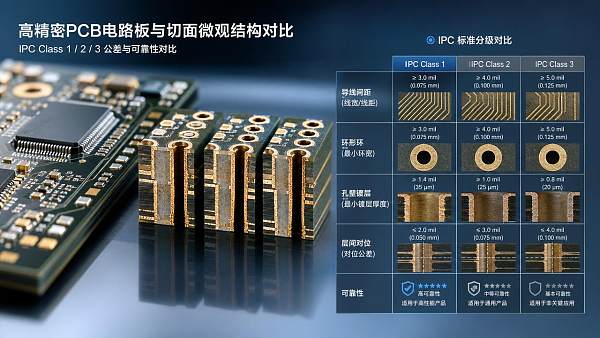
PCB fabrication standards define measurable requirements for how a printed circuit board should be built, inspected, and accepted.
They create a common language for base material quality, copper geometry, hole integrity, solderability, cleanliness, registration, and cosmetic limits.
Among these standards, IPC documents are the most widely referenced for fabrication quality assessment.
The most familiar benchmark is IPC-A-600, which defines acceptability for printed boards through class-based criteria.
Related specifications, including IPC-6012, add performance requirements for qualification and production consistency.
When teams compare suppliers, PCB fabrication standards help distinguish a capable process from a merely acceptable sample lot.
The three IPC product classes
IPC classes are not marketing labels.
They represent intended end-use conditions and expected consequences of failure.
- Class 1: General electronic products with basic functional expectations and limited service-critical exposure.
- Class 2: Dedicated service electronic products requiring extended reliability and stable performance.
- Class 3: High-performance electronic products where continued operation is critical and failure consequences are severe.
This hierarchy matters because tolerance limits, defect acceptance, and documentation depth usually tighten as class level increases.
How tolerance limits change across IPC classes
Comparing PCB fabrication standards requires more than reading class names.
The useful comparison comes from specific tolerance categories that influence manufacturability and field performance.
Typical quality categories
Actual numeric thresholds depend on board type, material system, and referenced IPC document revision.
Still, the trend is clear.
Higher classes accept less variation because reliability margins shrink in critical operating environments.
Why tolerance interpretation matters
Two suppliers may both claim compliance with PCB fabrication standards while controlling process spread very differently.
One may build close to nominal dimensions.
Another may only pass because it remains barely inside acceptance limits.
That difference becomes visible during thermal cycling, vibration, high-current loading, or long service intervals.
Industry signals shaping board quality evaluation
Cross-industry manufacturing has raised expectations for traceability, repeatability, and objective quality evidence.
As systems integrate sensors, power electronics, and communication layers, PCB fabrication standards become a strategic control point.
- Electrification increases thermal stress on vias, copper balance, and laminate stability.
- Industrial automation requires repeatable impedance, signal integrity, and long maintenance intervals.
- Agricultural electronics face moisture, dust, vibration, and temperature swings.
- Environmental infrastructure demands uptime in pumps, filtration controls, and distributed sensing networks.
- Automotive platforms often require documentation discipline beyond simple visual acceptability.
These trends explain why PCB fabrication standards are now evaluated alongside ISO, IATF, and broader system qualification frameworks.
Business value of comparing PCB fabrication standards correctly
A clear standards comparison improves more than technical understanding.
It directly supports better cost modeling, supplier alignment, and risk forecasting.
Key operational benefits
- Prevents over-specification for non-critical products, reducing unnecessary fabrication cost.
- Prevents under-specification for harsh-duty applications, reducing latent failure exposure.
- Improves quotation comparability when board suppliers use different process capability claims.
- Supports faster root-cause analysis when defects appear near tolerance boundaries.
- Creates more reliable qualification gates for new product introduction.
In technical benchmarking platforms such as GIM, this comparison becomes especially useful across sectors.
A board suited for a consumer monitor may fail quickly in an inverter controller, telemetry node, or autonomous equipment module.
The standards label alone is not enough.
The real value lies in matching class and tolerance discipline to operating reality.
Typical application mapping by reliability need
The following mapping offers a practical way to interpret PCB fabrication standards across common industrial scenarios.
This mapping is not universal.
Final class selection should reflect environment, consequence of failure, service access, and compliance needs.
Practical evaluation points before approval
Using PCB fabrication standards effectively means validating both declared compliance and actual process behavior.
Recommended checkpoints
- Confirm the exact IPC documents and revision levels referenced in fabrication notes.
- Review capability data for drilled hole tolerance, plating thickness, and registration control.
- Check whether microsection reports represent routine production or only qualification samples.
- Verify how surface finish, laminate selection, and stack-up influence tolerance achievement.
- Ask for evidence of process response under thermal shock, humidity, or vibration if relevant.
- Separate cosmetic variation from structurally meaningful nonconformance.
It is also useful to define acceptance priorities early.
For example, annular ring control may matter more than mask appearance in a high-vibration assembly.
Similarly, ionic cleanliness may outweigh minor cosmetic marks in moisture-exposed environments.
A structured next step for standards-based benchmarking
A useful next step is to convert PCB fabrication standards into a comparison matrix for every active board category.
List required IPC class, critical tolerances, environmental stresses, documentation needs, and disqualifying defect types.
Then compare supplier evidence against those same fields, not just against unit price or lead time.
For organizations managing diverse industrial programs, this approach creates a repeatable bridge between board-level quality and system-level resilience.
Used correctly, PCB fabrication standards are not only acceptance criteria.
They are decision tools for aligning reliability expectations, tolerance limits, and long-term operational performance.
The Archive Newsletter
Critical industrial intelligence delivered every Tuesday. Peer-reviewed summaries of the week's most impactful logistics and market shifts.