Monday, May 22, 2024

UPenn Creates Computable Hybrid Light-Matter Particles
by
Published
Views:
On May 19, 2026, researchers at the University of Pennsylvania published a breakthrough in Physical Review Letters: the first demonstration of all-optical switching in hybrid light-matter particles. This advance establishes a foundational physical platform for photonic AI chips—and signals emerging demand for high-density optoelectronic integrated circuit (OEIC) assembly capabilities, particularly among PCB/PCBA fabrication providers in China. Data centers, intelligent sensing systems, and ADAS vision processing units are among the sectors most likely to accelerate adoption of photonic computing modules as a result.
Event Overview
On May 19, 2026, a research team from the University of Pennsylvania reported in Physical Review Letters the experimental realization of hybrid light-matter particles capable of all-optical signal switching. The work is peer-reviewed and publicly available. No commercial deployment, product roadmap, or industry partnership has been announced as part of this publication.
Industries Affected by This Development
PCB/PCBA Fabrication Providers (especially in China):
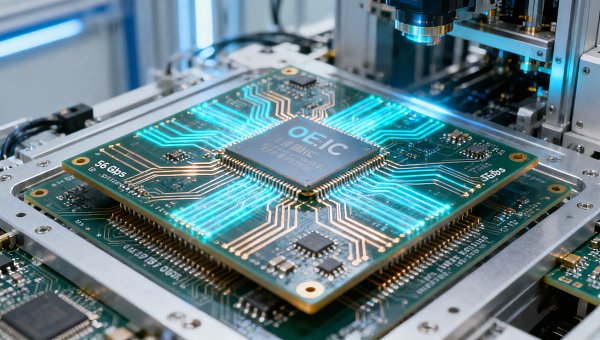
These manufacturers face intensified technical requirements due to the need for OEIC-level integration—specifically, simultaneous precision in high-speed differential routing and micron-scale optical coupling alignment. The shift toward photonic AI chips implies higher layer counts, tighter impedance control, and sub-10-µm placement tolerances for embedded optical elements—capabilities not routinely required in conventional digital PCB production.
Data Center Infrastructure Suppliers:
As photonic compute modules gain traction for AI acceleration, suppliers of interconnect hardware, thermal management subsystems, and board-level packaging may see early-stage RFPs referencing optical I/O density, co-packaged optics compatibility, and low-latency optical fabric integration—though no near-term volume shift is confirmed.
ADAS and Intelligent Sensing Module Developers:
These firms may begin evaluating photonic-based vision preprocessing units for improved real-time inference efficiency. However, current automotive qualification cycles and functional safety validation frameworks remain unchanged; no regulatory or standards-body update has accompanied this publication.
What Relevant Enterprises or Practitioners Should Monitor and Do Now
Track official follow-up disclosures from Penn and peer institutions
Monitor for technology transfer announcements, licensing activity, or spin-off formation—these would indicate readiness for engineering prototyping. Absent such signals, the work remains at the fundamental physics stage.
Assess internal capability gaps in OEIC-specific manufacturing processes
Specifically evaluate capacity for: (i) ≤5 µm optical alignment repeatability during component placement; (ii) controlled refractive-index matching between dielectric layers and integrated waveguides; and (iii) high-frequency (≥56 Gbps/lane) differential routing adjacent to passive optical structures—without crosstalk-induced jitter.
Distinguish between academic milestone and near-term procurement signals
This publication does not constitute a market pull. No OEM, foundry, or system integrator has issued specifications referencing this particle design. Procurement teams should treat it as a horizon-scanning item—not a sourcing trigger.
Engage with university tech transfer offices on non-exclusive pre-commercial access
Some U.S. and EU universities offer early-stage collaboration frameworks (e.g., sponsored research agreements) that allow qualified manufacturers to explore process integration challenges ahead of public IP licensing. Such engagement requires no capital commitment but supports technical due diligence.
Editorial Perspective / Industry Observation
Analysis shows this development is best understood as a physics-level enabler—not an immediate product driver. It confirms feasibility of all-optical logic primitives using hybrid quasiparticles, but does not specify architecture, scalability path, or power-efficiency benchmarks relative to existing electronic or photonic alternatives. Observably, the primary near-term impact lies in raising the technical bar for OEIC-capable PCB fabrication, especially where optical-electrical co-integration is required. From an industry perspective, this milestone reinforces the growing divergence between standard HDI PCB capability and next-generation optoelectronic substrate requirements—making it a signal worth tracking, but not yet a catalyst for operational change.
Current more appropriate interpretation is that this work expands the theoretical design space for photonic computing; actual chip integration, yield optimization, and system-level validation remain multi-year challenges. Continuous observation is warranted—but premature investment in dedicated OEIC lines is not supported by this single publication.
Conclusion:
This publication marks a validated step in photonic computing’s underlying physics—but its industrial implications remain indirect and medium-term. For PCB/PCBA fabricators, it underscores a widening capability gap rather than an imminent order surge. For system developers, it affirms long-term viability of optical signal processing in AI-accelerated workloads, without altering current hardware roadmaps. The event is better interpreted as a scientific benchmark than a commercial inflection point.
Source Attribution:
Main source: Physical Review Letters, May 19, 2026, University of Pennsylvania.
Note: Commercialization timeline, industry partnerships, and performance metrics beyond all-optical switching have not been disclosed and remain subject to ongoing observation.

The Archive Newsletter
Critical industrial intelligence delivered every Tuesday. Peer-reviewed summaries of the week's most impactful logistics and market shifts.