Monday, May 22, 2024

Fine Chemical Supplier Evaluation: Cost, Compliance, and Supply Stability
by
Published
Views:
Fine Chemical Supplier Evaluation: Cost, Compliance, and Supply Stability
For procurement teams, fine chemical supplier evaluation is no longer just about price. It now depends on compliance, supply continuity, and reliable technical performance.
In a volatile market, the right supplier can reduce risk, protect output quality, and improve sourcing resilience across production cycles.
This guide explains how to approach fine chemical supplier evaluation with a practical lens. The focus stays on cost, compliance, and supply stability.
Why Fine Chemical Supplier Evaluation Has Become More Complex
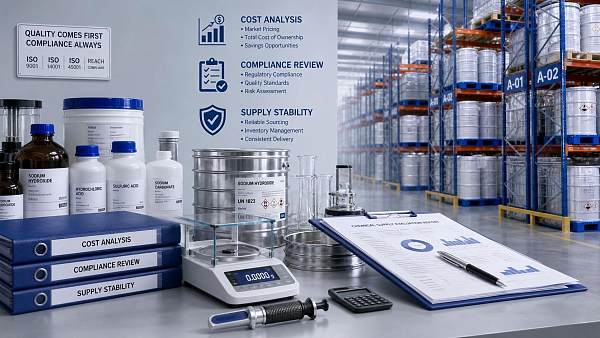
A few years ago, many buying decisions centered on unit price and lead time. That approach is now too narrow for most industrial categories.
Fine chemicals often sit inside regulated, quality-sensitive, and process-critical applications. A low-cost source can become expensive after one failed batch.
More noticeable today is the pressure from audits, customer traceability requests, and regional compliance checks. These signals directly affect supplier selection.
In real procurement work, a supplier must support both current production and future business continuity. That changes how fine chemical supplier evaluation should be structured.
The strongest sourcing teams compare commercial terms with technical risk, regulatory readiness, and operational resilience before awarding volume.
Start With Total Cost, Not Quoted Price
The first step in fine chemical supplier evaluation is redefining cost. The quoted price is only one part of the actual landed and operating cost.
A cheaper material can increase testing, handling, reformulation, inventory buffers, and scrap. These hidden costs usually appear after onboarding, not before.
A practical cost review should include:
- Unit price by grade, purity, and package size
- Freight, duties, hazardous handling, and storage costs
- Batch approval cost and incoming inspection workload
- Yield impact, processing loss, and rework exposure
- Payment terms, currency risk, and safety stock requirements
This also means commercial comparison should be normalized. Two suppliers may look similar on price while carrying very different process risks.
In many cases, the more competitive source is the one with lower variability, faster corrective action, and fewer production interruptions.
That is why effective fine chemical supplier evaluation links cost analysis to quality data, not to price spreadsheets alone.
Check Compliance Before It Becomes a Delay
Compliance is often treated as a document exercise. In practice, it is a delivery risk, a customer risk, and sometimes a market access risk.
A solid fine chemical supplier evaluation reviews whether the supplier can consistently support the regulatory profile your product requires.
Key items usually include:
- REACH, RoHS, TSCA, and local registration status where relevant
- SDS quality, revision control, and hazard communication accuracy
- Change notification procedures for raw materials and process steps
- Traceability by batch, lot genealogy, and retention sample practice
- Environmental, health, and safety controls tied to site operations
From a sourcing perspective, missing paperwork is rarely the only issue. Weak document control often points to weak process control.
That is especially relevant when the chemical feeds electronics, coatings, catalysts, agro-inputs, water treatment, or mobility applications.
Procurement should also verify audit maturity. Certifications matter, but the supplier’s response discipline matters more when deviations happen.
Good fine chemical supplier evaluation asks one simple question: can this supplier maintain compliance during scale-up, disruption, and change?
Measure Supply Stability With Real Operational Signals
Supply stability deserves the same weight as cost. A compliant supplier still fails the test if shipments become unpredictable.
In fine chemical supplier evaluation, supply stability should be measured through operating evidence rather than sales promises.
Useful indicators include:
- Historical on-time delivery by lane and by product family
- Capacity utilization and bottleneck dependency at the plant level
- Single-source raw material exposure upstream
- Backup manufacturing lines or qualified alternate sites
- Energy, utility, and logistics vulnerability in the operating region
Recent market changes make this even more important. Port delays, export controls, and energy disruptions can quickly reshape lead times.
A resilient supplier usually has a documented continuity plan, realistic lead time windows, and a clear escalation path during shortages.
This is where fine chemical supplier evaluation becomes strategic. It helps prevent downtime instead of reacting to it after the fact.
Do Not Separate Technical Consistency From Commercial Review
Fine chemicals can meet the same headline specification and still behave differently in production. That gap causes many sourcing surprises.
A strong fine chemical supplier evaluation checks whether the supplier can hold consistency across lots, seasons, and scale changes.
Ask for evidence around:
- Typical versus minimum specification values
- Impurity profile control and analytical method alignment
- Batch-to-batch statistical stability over time
- Deviation handling, CAPA quality, and response speed
- Pilot samples, retain samples, and scale-up comparability
This review is especially valuable when qualification cycles are long or customer approval windows are tight.
In practical terms, stable chemistry reduces firefighting. It also protects planning accuracy, conversion efficiency, and downstream warranty exposure.
For that reason, fine chemical supplier evaluation should involve procurement, quality, and process stakeholders early in the sourcing cycle.
A Simple Supplier Scorecard for Better Decisions
A scorecard helps turn subjective impressions into a repeatable decision model. It also makes supplier discussions easier across internal functions.
For most categories, the weighting should reflect product criticality and business exposure. High-risk materials need stronger emphasis on continuity and control.
This structure makes fine chemical supplier evaluation easier to defend internally. It also supports dual-sourcing and supplier development decisions.
At GIM, this type of benchmarking matters because industrial performance rarely sits inside one silo. Procurement outcomes connect to engineering, quality, and resilience.
Common Red Flags During Fine Chemical Supplier Evaluation
Several warning signs deserve immediate attention:
- Specifications are broad, but process capability data is missing.
- Audit answers are polished, yet corrective action records are weak.
- Lead times look short, but capacity proof is unavailable.
- Change notifications are informal or handled too late.
- The supplier depends on one plant, one route, or one key raw material.
None of these issues automatically disqualifies a supplier. But each one should change the risk score and the sourcing strategy.
That may mean smaller initial volume, tighter incoming control, or a parallel approval path for an alternate source.
Turn Evaluation Into a Stronger Sourcing Process
The best fine chemical supplier evaluation process is disciplined, cross-functional, and updated over time. It should not end when the first PO is issued.
Start with total cost. Then verify compliance depth, test supply stability, and confirm technical consistency with evidence.
This approach improves negotiation quality because it shifts discussion from headline price to measurable sourcing value.
It also builds a more resilient supply base, which matters even more when markets are tight and product requirements keep rising.
Used well, fine chemical supplier evaluation becomes a decision framework, not a checklist. That is what helps procurement make fewer reactive decisions.
The next practical move is simple: score current suppliers against these criteria, identify the biggest gaps, and use that data to guide the next sourcing round.
The Archive Newsletter
Critical industrial intelligence delivered every Tuesday. Peer-reviewed summaries of the week's most impactful logistics and market shifts.