Monday, May 22, 2024

How Can Buyers Reduce Semiconductor Supply Risk?
by
Published
Views:
Buyers can reduce semiconductor supply risk by identifying which components could stop production, qualifying alternatives before shortages occur, and matching inventory protection to the time needed to recover. Supplier visibility, traceability, and purchasing agreements support those decisions. Buying more chips alone can leave a business holding expensive inventory while another critical component remains unavailable.
The starting point is a practical question: If this part stopped arriving, how would production continue, and how long would that take? The answer helps distinguish components that need immediate protection from those that can be managed through routine purchasing. It also exposes gaps that a supplier count or inventory total can hide.
Find the components that can actually stop production
A semiconductor risk assessment should begin with the bill of materials, including chips embedded in purchased modules and assemblies. A controller board, sensor module, or motor drive can contain a constrained device even when the assembly supplier appears to have adequate capacity.
Purchase value is a poor measure of production risk. An inexpensive power-management device can prevent shipment of an entire machine if no approved replacement exists. A more expensive processor may be easier to manage if demand is predictable, supply is stable, and an alternative design is already available.
For each production-critical part, record the manufacturer and exact orderable part number, approved sources, usable inventory, confirmed incoming supply, lifecycle status, and replacement options. Include the finished products that depend on it. This makes it possible to see when one component creates exposure across several product lines.
Assess the consequence of a shortage alongside the difficulty of recovery:
Keep the assessment proportional to the consequence. A standard device with several approved substitutes needs less attention than a proprietary controller supporting a long-lived industrial product. The purpose is to direct effort toward the parts where an interruption would be hardest to resolve.
Check whether alternative sources are truly independent
Two distributors selling the same semiconductor provide useful purchasing flexibility, but both may depend on the same manufacturer allocation. Similarly, two chip suppliers can share a foundry, packaging subcontractor, or geographic concentration. More supplier names do not automatically create more supply resilience.
Separate purchasing-channel diversity from manufacturing diversity. Authorized channels can offer different inventory positions, delivery arrangements, and commercial support. An approved device from another manufacturer can provide additional protection, depending on its production footprint and technical suitability.
Where information is available, examine wafer fabrication, assembly, testing, and shipment locations. A disruption at any of these stages can delay finished components. Ask suppliers how production transfers are handled, whether alternative sites are qualified for the relevant device, and how customers receive notices of significant changes.
Supplier performance also deserves scrutiny. Compare quoted lead times with actual receipts and examine how often confirmed delivery dates move. A short quotation is less useful if orders repeatedly slip. Clear communication about constraints can be more valuable than optimistic promises that cannot support a production schedule.
For critical components, document what remains dependent on a single source. This gives purchasing and engineering a shared basis for deciding whether to hold inventory, negotiate stronger commitments, or develop another technical route.
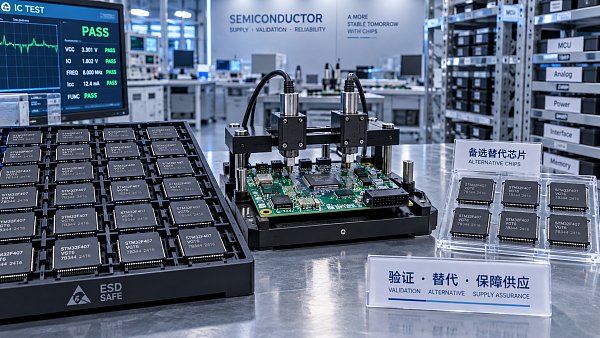
Qualify replacement chips before an emergency
Alternative component qualification often determines whether a business can recover quickly from a shortage. A replacement listed as “equivalent” may still require board changes, firmware updates, thermal evaluation, or customer approval.
Matching package dimensions and headline electrical ratings is only an initial screen. Relevant differences can include pin functions, startup behavior, timing, protection features, power sequencing, analog accuracy, and operation across the intended temperature range. For programmable devices, software tools and firmware compatibility can become major constraints.
Qualification should reflect the device’s role in the application. Replacing a simple logic device may need a narrower evaluation than changing a microcontroller in an automotive subsystem. A power semiconductor in an industrial drive may require checks on switching behavior, heat dissipation, electromagnetic compatibility, and interaction with protection circuits.
A workable approval process connects engineering evidence to purchasing execution:
- Define the functions and operating conditions the replacement must satisfy.
- Identify differences that could affect hardware, software, reliability, or manufacturing.
- Test representative assemblies under relevant operating conditions.
- Complete applicable internal and customer approvals.
- Update the approved parts list, production instructions, and purchasing records.
Keep qualification status explicit. “Candidate identified,” “evaluation underway,” and “approved for production” describe different levels of protection. A candidate part should not be counted as an available fallback while essential validation remains unfinished.
Some proprietary processors or specialized integrated circuits have no practical substitute within the current design. In that situation, inventory protection and supplier planning carry more weight. For future designs, assess component availability early enough to influence architecture, package selection, and software dependencies.
Size inventory around recovery time
Safety stock should cover a credible interruption and the time needed to restore usable supply. That period may include obtaining samples, modifying a board, validating firmware, completing approvals, and receiving production quantities. The supplier’s quoted lead time captures only part of that exposure.
Compare usable inventory coverage with the estimated recovery period. Include expected demand changes and delivery variability, but separate confirmed supply from uncommitted forecasts. Stock assigned to another program, awaiting quality release, or unsuitable for the intended build should not be treated as immediately available.
Different components need different inventory policies. A stable device used across several established products may justify a larger buffer than a specialized chip tied to an uncertain product launch. Shared components also need allocation rules so that one program does not consume stock required by another.
Holding additional inventory creates its own obligations. Packaging integrity, moisture sensitivity where applicable, storage conditions, shelf-life considerations, and lot traceability affect whether stored components remain suitable for production. Inventory records should preserve the connection between received material and supplier documentation.
A buffer needs both a reason to exist and a condition for reduction. Review it when demand changes, an alternative becomes approved, or supply performance improves. Otherwise, temporary protection can become permanent excess inventory.
Make purchasing commitments useful to both sides
Suppliers can plan more effectively when demand forecasts are credible and changes are communicated promptly. Forecasts should distinguish firm production requirements from probable and speculative demand. Inflated forecasts and duplicate orders can obscure actual need and create excess commitments when supply improves.
For constrained components, blanket orders, scheduled releases, or longer planning horizons may support continuity. Their value depends on the terms: committed quantities, delivery windows, rescheduling rights, cancellation limits, and the treatment of allocation during shortages.
Noncancelable, nonreturnable purchases deserve particular attention. They can secure material while transferring demand risk to the buyer. Such commitments are easier to justify for established products with stable consumption than for designs awaiting approval or markets with uncertain demand.
Clarify how supplier-held stock works before counting it as protection. Reserved inventory, consignment inventory, and ordinary distributor stock have different ownership and availability implications. Establish who can release the material, what happens when demand changes, and whether the stock is dedicated to the intended customer.
Commercial commitments should follow the component risk assessment. Stronger terms are most useful where an interruption has a material production consequence and where the commitment addresses a specific supply dependency.
Keep emergency sourcing from creating quality failures
When authorized supply is unavailable, independent sourcing may appear to offer immediate relief. It also requires a separate quality decision. Risks include counterfeit devices, altered markings, unsuitable storage, mixed lots, and material whose origin cannot be adequately established.
Start with the sourcing route and its documentation. Authorization should relate to the relevant manufacturer and product line. For independent sources, assess the chain of custody, supplier controls, inspection arrangements, and remedies if the material fails acceptance.
Testing should reflect the component and application risk. Visual inspection alone cannot establish authenticity or long-term reliability. Electrical testing can provide useful evidence, but it may not reveal every defect or reproduce the conditions encountered in service.
Define an exception process before a shortage forces the decision. Specify who approves the purchase, what evidence is required, how material is segregated, and when it can enter production. Quality and engineering approval should remain part of the release decision.
For applications with demanding reliability or customer requirements, some sourcing routes may remain unsuitable even when the material is available. The financial consequence of a delayed build must be considered alongside the consequence of releasing questionable components.
Manage lifecycle exposure across the product’s service life
Semiconductor supply risk continues after a product enters production. Industrial equipment, agricultural machinery, and infrastructure controls may need replacement electronics long after the original design was released.
Track product-change and discontinuation notices for critical devices, and connect them to both production demand and service obligations. A notification received by purchasing may require decisions from engineering, manufacturing, and after-sales support.
A final purchase should account for remaining production, repair demand, existing stock, expected redesign timing, and storage suitability. Buying too little can leave service gaps; buying too much can tie up funds in components that a later redesign no longer uses.
Compare that purchase with the cost and feasibility of redesigning the affected assembly. Where component reuse across products is practical, a common replacement design can simplify future support and reduce fragmented inventory.
Turn risk information into decisions that get made
A useful review connects each material risk to an owner, a response, and a trigger for action. Review production-critical parts more frequently when delivery dates deteriorate, inventory coverage falls, or lifecycle notices arrive. Lower-risk components can follow a lighter schedule.
Track outcomes that reveal whether protection works: critical parts with approved alternatives, coverage against recovery time, overdue qualification actions, supplier delivery reliability, and exposure to purchasing commitments. A single combined risk score can conceal the difference between a supply problem and a technical approval bottleneck.
Global Industrial Matrix’s cross-sector intelligence and technical benchmarking approach is relevant where component decisions affect electronics, mobility, agricultural equipment, and industrial infrastructure. Comparing technical requirements and supply dependencies across these applications can support better judgments about substitution and continuity. That context complements device-specific qualification and supplier commitments.
Begin with the components whose absence would halt shipment. For each one, establish usable inventory, realistic replenishment prospects, an approved recovery route, and the person responsible for activating it. If the recovery route depends on unfinished engineering work, give that work a deadline while supply is still available.

The Archive Newsletter
Critical industrial intelligence delivered every Tuesday. Peer-reviewed summaries of the week's most impactful logistics and market shifts.