Monday, May 22, 2024

How to include supplier compliance checks in procurement planning
by
Published
Views:
Supplier compliance checks belong in the procurement plan as soon as the buying team defines what it needs and where it expects to source it. At that stage, buyers can identify which requirements apply, how much evidence suppliers must provide, and how long any review or corrective action may take. Leaving those decisions until contract signature can narrow the choice to accepting an unresolved risk or delaying the purchase.
The level of checking should reflect the purchase. A critical component used in a regulated product may need a detailed technical and compliance review before a supplier is shortlisted. A low-risk, readily replaceable item may require a simpler set of checks. In both cases, the plan should make clear who decides whether the evidence is sufficient and what happens when it is not.
Turn compliance requirements into sourcing requirements
Start with the intended use of the purchase, the countries involved, and any customer commitments that apply. These determine which checks should be built into the sourcing process. A supplier may have an acceptable general management system but still be unable to demonstrate that a particular material, manufacturing site, or product meets the buyer’s requirements.
Bring procurement, quality, engineering, legal, and other relevant teams into the requirements discussion early enough to influence the request for quotation. Depending on the purchase, the resulting list may cover:
- Product and technical requirements: Specifications, test evidence, traceability, and any applicable industry or customer standards.
- Supplier and site qualifications: Management system certificates, manufacturing capabilities, and approval of the facility that will perform the work.
- Legal and contractual obligations: Requirements associated with the product, destination, trade route, or customer agreement.
- Operational controls: Subcontracting arrangements, change notification, record retention, and the ability to provide evidence when requested.
Make each requirement specific enough that a buyer can evaluate a response. “Supplier must comply with relevant standards” leaves too much room for interpretation. A more useful sourcing requirement identifies the applicable standard or specification, the product or process it covers, the evidence required, and the point at which that evidence must be available.
For example, if a customer specification requires a particular manufacturing process to be controlled, ask for evidence covering that process at the proposed production site. A certificate for a different facility may be useful background, but it does not answer the question on its own. Equally, do not require a certification merely because it is familiar: establish whether it is required by law, contract, customer specification, or the organization’s own sourcing policy.
Decide how much checking each purchase needs
Procurement teams rarely have enough time to examine every supplier in the same depth. Build a review proportionate to the consequences of failure and the uncertainty surrounding the supplier. Consider the product’s intended use, the severity of a potential nonconformity, the difficulty of replacing the source, the supplier’s track record, and the visibility available into its operations.
A practical planning distinction is to separate routine purchases from those where compliance failure could affect product safety, customer acceptance, continuity of supply, or a significant contractual obligation. For routine purchases, a review of basic supplier information and relevant declarations may be sufficient under company policy. Higher-consequence purchases may justify technical document reviews, site assessments, sample testing, or review of critical subcontractors.
Risk can also change during sourcing. A supplier initially treated as low risk may propose moving production to another country, outsourcing a controlled process, or substituting a material. Each change can introduce a new requirement or make previously collected evidence less useful. The procurement plan should therefore identify which changes require another review before award or release.
A risk rating is a way to set review priorities, not a substitute for a mandatory requirement. If a condition is required by an applicable law or contract, a low overall score does not remove the need to meet it.
Put checks at decision points in the purchasing schedule
The most useful compliance plan is tied to sourcing milestones. A review scheduled after the commercial decision has effectively been made has little influence over supplier selection. Work backward from the date the purchase must be awarded, then allow time for evidence collection, technical review, supplier clarification, and any approved corrective actions.
These decision points can be built into an ordinary procurement workflow:
- Before issuing the request: Agree on applicable requirements, evidence, review owners, and any conditions that would prevent award.
- During supplier screening: Check whether potential suppliers can meet the essential requirements and identify gaps that could affect the sourcing schedule.
- During bid evaluation: Review submitted evidence alongside price, quality, capacity, and delivery. Record open questions before the preferred supplier is selected.
- Before award: Confirm that required approvals are complete or that any permitted exception has been authorized by the appropriate owner.
- After award: Track obligations that continue through production, delivery, and changes to the supplied product or process.
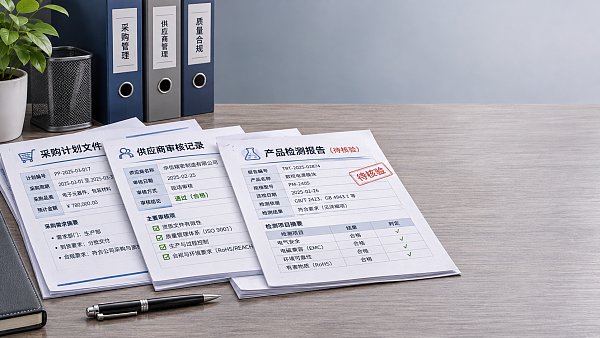
Include compliance work in the sourcing timeline as an activity with an owner and an expected completion date. If a site assessment or technical test depends on a supplier providing samples, the schedule should show that dependency. Where a gap may require corrective action, agree on the evidence needed to close it and the latest date by which the decision can be made without disrupting the purchase.
Procurement planning resources work best when compliance teams and buyers use the same requirements and status records. A shared register or sourcing system can capture the requirement, supplier response, evidence location, reviewer, due date, decision, and any follow-up. The tool can be simple; the important operational requirement is that everyone can see which issues are open and who owns the next action.
Review the evidence, not just the answer
A completed questionnaire is a useful starting point, but an unchecked “yes” does not always establish compliance. Match the evidence to the requirement and examine its scope. For a certificate, that means checking the named entity, covered sites and activities, validity period, and relevance to the goods or services being purchased. For a test report, consider whether the tested product, configuration, and method correspond to what will actually be supplied.
Declarations also need context. A supplier may declare that a product meets a requirement based on information from its own suppliers. The buyer should decide whether the declaration is sufficient for the purchase or whether supporting material, testing, or further traceability is needed. The answer depends on the obligation being assessed and the consequences of relying on incomplete information.
Do not confuse evidence that a supplier has a process with evidence that the process produced a compliant item. A quality management certificate can support confidence in how work is managed, while product specifications, inspection records, or test results may address different questions. Engineering and quality reviewers should help procurement determine which documents establish the necessary facts.
When evidence is missing or inconsistent, record the issue in terms the supplier can act on. “Certificate missing” is less useful than identifying the required scope, the proposed production site, and the date by which an acceptable document or alternative evidence must be supplied. Ask for clarification before assuming that a discrepancy is either harmless or disqualifying.
Make gaps visible in the award decision
Supplier comparison should show compliance status beside commercial performance. A low bid can appear attractive while carrying an unresolved requirement that affects acceptance, delivery, or the cost of bringing the supplier into conformity. Conversely, a gap may be manageable if it is permitted, has a clear owner, and can be closed before the relevant milestone.
For each material gap, document the requirement, the evidence reviewed, the potential consequence, the proposed action, and the person authorized to decide. Where policy permits an exception, record its scope and end date, any controls needed in the meantime, and the conditions for closure. A temporary exception should not silently become a permanent supplier approval.
Some gaps cannot be accepted through an internal exception. If a requirement is mandatory under an applicable law or binding customer agreement, the team must establish a compliant route before proceeding. Legal, quality, or other designated specialists should assess such cases; procurement should not assume that commercial urgency changes the obligation.
Corrective actions also need realistic timing. If a supplier must revise a process or obtain evidence from a subcontractor, ask what will be delivered, how it will be verified, and what happens if the date is missed. The purchase plan may need an alternative source, a revised delivery date, or a decision to remove the supplier from consideration.
Carry the requirements into supplier management
Approval at award is a point-in-time decision. The contract and purchase documentation should carry forward the obligations that matter during supply: applicable specifications, notification of proposed changes, access to relevant records, and requirements for reporting nonconformities. The level of detail should fit the purchase and be agreed with the teams responsible for administering it.
Set review triggers as well as review dates. An expiring certificate, a change in manufacturing site, a new subcontractor, a material substitution, a significant quality issue, or a change in the buyer’s requirements may justify checking the supplier again. A periodic review can catch overdue documents, but it may come too late if an important change occurs between reviews.
For repeat purchases, use the previous assessment as a starting point and check whether its scope still matches the order. A supplier approved for one component, site, or market should not automatically be treated as approved for every new application. Keeping that distinction visible lets procurement reuse reliable work while directing further checks to the parts of the purchase that have changed.

The Archive Newsletter
Critical industrial intelligence delivered every Tuesday. Peer-reviewed summaries of the week's most impactful logistics and market shifts.