Monday, May 22, 2024

Semiconductor Benchmarking Metrics That Matter More in 2026
by
Published
Views:
In 2026, Semiconductor benchmarking is no longer about headline specs alone. For researchers and industrial decision-makers, the metrics that truly matter are those that reveal performance stability, supply chain resilience, process efficiency, and standards compliance across real-world applications. This article explores the indicators that deliver deeper technical insight and stronger competitive context for smarter evaluation.
Why a checklist approach works better for Semiconductor benchmarking in 2026
For information researchers, the biggest risk in Semiconductor benchmarking is not lack of data. It is comparing the wrong data. Marketing sheets still emphasize node names, peak throughput, and cost-per-unit headlines, but industrial buyers, engineers, and sourcing teams now need a more layered evaluation method. Chips are judged not only by how fast they perform in ideal conditions, but also by how consistently they behave across temperature ranges, how reliably they can be sourced, how efficiently they can be packaged and integrated, and how clearly they align with international manufacturing standards.
A checklist format helps separate useful metrics from distracting ones. It also supports cross-sector comparison, which matters because semiconductors now sit inside EV power electronics, smart agricultural systems, factory automation modules, industrial ESG monitoring platforms, and environmental control infrastructure. In a connected industrial landscape, benchmarking must capture technical performance, manufacturability, compliance readiness, and lifecycle risk at the same time.
Start here: the first metrics to verify before deeper analysis
Before reviewing any advanced claims, researchers should confirm a short list of foundational metrics. These are the first filters in Semiconductor benchmarking because they determine whether a component is even relevant for downstream comparison.
- Application fit: Confirm whether the semiconductor is intended for compute, power management, sensing, RF, memory, or mixed-signal control. Benchmarking a data center accelerator against an automotive-grade MCU creates false conclusions.
- Operating environment: Check rated voltage, thermal envelope, humidity tolerance, and shock or vibration suitability when relevant to industrial use cases.
- Process maturity: Identify whether the process node is leading-edge, mature-node, or specialty. In many sectors, mature process stability can outweigh nominal performance gains.
- Package type and integration burden: Package selection affects thermal dissipation, board density, repair complexity, and assembly yield.
- Lifecycle visibility: Verify product roadmap, revision history, expected longevity, and end-of-life signaling. This is essential for long qualification cycles.
If these five basics are unclear, deeper Semiconductor benchmarking will be unstable from the start.
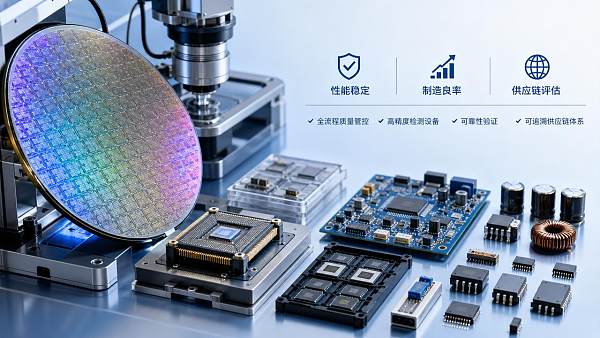
The core Semiconductor benchmarking checklist that matters more than headline specs
1. Performance stability under real operating conditions
Peak benchmark scores remain useful, but only as a starting point. In 2026, stronger Semiconductor benchmarking looks at sustained output over time. The key question is whether the chip maintains acceptable performance under thermal load, variable input conditions, and realistic duty cycles. Researchers should check thermal throttling thresholds, voltage-frequency behavior, latency consistency, and error rates under prolonged operation. For industrial deployments, stable output over thousands of hours usually matters more than a short burst result.
2. Energy efficiency per real workload
Power efficiency is now a strategic metric, not just a design preference. Compare watts per inference, power loss under switching conditions, standby draw, leakage, and performance per watt under target workloads. This is especially important in automotive systems, edge devices, and environmental infrastructure where cooling budgets and energy costs influence total deployment economics. Good Semiconductor benchmarking should distinguish between lab efficiency and installed system efficiency.
3. Yield sensitivity and manufacturability
A technically superior die can still be commercially weak if yields are unstable. Researchers should assess defect density trends, process window tolerance, package assembly yield, and susceptibility to material variability. For procurement teams, manufacturability indicators often provide a more realistic signal of future pricing and supply continuity than launch pricing alone. In Semiconductor benchmarking, yield-linked analysis helps explain why some products scale smoothly while others remain constrained.
4. Supply chain resilience and source concentration
This metric has become unavoidable. Check fab dependency, OSAT concentration, substrate sourcing exposure, regional logistics vulnerability, and single-source material risks. A component with excellent technical attributes may still rank poorly if it depends on a fragile manufacturing chain. Researchers should examine whether second-source options exist, whether the package relies on constrained materials, and whether geopolitical exposure could disrupt continuity.
5. Reliability and field failure behavior
Reliability metrics deserve more weight in 2026 Semiconductor benchmarking, especially for mission-critical sectors. Useful checks include mean time to failure, electromigration susceptibility, thermal cycling endurance, moisture sensitivity level, and field return trends where available. For power devices, gate oxide robustness and switching degradation should also be reviewed. The best benchmark is not the chip that tests well once, but the one that fails least across varied deployment conditions.
6. Standards compliance and qualification readiness
Compliance is often overlooked by early-stage researchers. Yet alignment with ISO, IATF, IPC, JEDEC, AEC-Q, RoHS, REACH, and related frameworks can determine whether a device can move quickly into approved supply chains. Semiconductor benchmarking should include document completeness, qualification status, traceability controls, and test method consistency. For companies like GIM operating across electronics, automotive, agriculture, and infrastructure, compliance comparability is what makes cross-sector benchmarking credible.
A practical comparison table for faster evaluation
Use the following framework when comparing vendors, product families, or alternative architectures. It helps convert broad Semiconductor benchmarking into a prioritized review process.
What to prioritize by use case
Not every metric has equal importance in every sector. Effective Semiconductor benchmarking depends on context.
For automotive and mobility systems
Prioritize thermal reliability, functional safety support, AEC qualification, long lifecycle assurance, and source continuity. High switching efficiency is critical for power semiconductors in EV systems, but qualification evidence often decides final selection.
For industrial automation and infrastructure
Focus on uptime behavior, field durability, package serviceability, and tolerance to harsh electrical environments. Researchers should also check whether the supplier supports stable revision control, because frequent undocumented changes can disrupt maintenance cycles.
For smart agriculture and remote edge systems
Power draw, wide-temperature performance, and communication reliability matter more than absolute compute leadership. Semiconductor benchmarking in these deployments should include low-power idle behavior and resilience under intermittent network conditions.
For electronics and compute-intensive platforms
Evaluate memory bandwidth efficiency, package thermal headroom, software ecosystem compatibility, and substrate availability. A chip may lead on architecture but still underperform commercially if advanced packaging capacity is constrained.
Common blind spots that weaken Semiconductor benchmarking
- Treating node size as a shortcut for superiority. A smaller node does not automatically mean better cost, reliability, or supply security.
- Ignoring package and substrate constraints. Many delivery delays now come from advanced packaging bottlenecks, not wafer fabrication alone.
- Using benchmark data without workload context. Synthetic performance may not represent industrial control, sensor fusion, or power conversion behavior.
- Overlooking revision management. Silent changes in process, assembly site, or bill of materials can alter validation results.
- Failing to connect compliance data to procurement risk. Missing qualification records can delay sourcing even when the device is technically suitable.
Execution guide: how researchers should structure the next benchmarking round
A disciplined Semiconductor benchmarking process usually works best in four steps. First, define the target application and exclude irrelevant comparisons. Second, score candidates on sustained performance, efficiency, reliability, manufacturability, and standards readiness. Third, map each candidate to supply chain exposure, including fab location, packaging dependency, and material concentration. Fourth, validate whether published data is supported by test conditions that resemble the intended operating environment.
If the benchmark is for strategic sourcing rather than engineering selection alone, add a fifth step: compare lifecycle support signals, including roadmap stability, PCN discipline, and documentation responsiveness. This is where an intelligence platform such as GIM becomes valuable, because cross-sector visibility can reveal hidden dependencies between semiconductor choices and broader manufacturing systems.
FAQ for faster decision support
Is price still a primary benchmark metric?
Yes, but only after reliability, efficiency, and supply resilience are verified. Low upfront price can become expensive if field failures, redesigns, or allocation problems follow.
What is the most underrated metric in Semiconductor benchmarking?
For many industrial buyers, it is sustained performance under realistic thermal conditions. It exposes the gap between promotional results and operational value.
How often should benchmarking data be updated?
At minimum, every quarter for fast-moving categories and every major process, package, or sourcing change for long-cycle industrial categories.
What to prepare before requesting deeper benchmarking support
If your organization wants more actionable Semiconductor benchmarking, prepare a clear application profile, target operating conditions, required standards, expected production volume, acceptable risk level, and timeline for qualification. Also gather any known constraints around package type, thermal limits, region of manufacture, or second-source policy. These inputs make the benchmark significantly more useful than generic vendor comparisons.
For teams evaluating next-step options, the best starting discussion is not “Which chip is best?” but “Which metrics matter most for our use case, risk tolerance, compliance needs, and supply strategy?” If you need to confirm parameters, fit, validation scope, sourcing resilience, or collaboration models, prioritize those questions first. That is how Semiconductor benchmarking becomes a decision tool rather than just a data collection exercise.

The Archive Newsletter
Critical industrial intelligence delivered every Tuesday. Peer-reviewed summaries of the week's most impactful logistics and market shifts.