Monday, May 22, 2024

Semiconductors Factory Risks to Watch in 2026
by
Published
Views:
In 2026, every semiconductors factory will face a sharper mix of geopolitical shocks, energy volatility, talent shortages, and quality compliance pressures. For business decision-makers, understanding these emerging risks is no longer optional—it is essential for protecting supply continuity, capital efficiency, and long-term competitiveness. This article highlights the critical factory risks leaders should watch closely and the strategic signals that matter most.
For most decision-makers, the core search intent behind “Semiconductors Factory Risks to Watch in 2026” is not academic. It is practical: which risks are rising fastest, which ones can disrupt output or margins, and what signals should guide investment and sourcing decisions now.
That makes this topic especially relevant for procurement leaders, plant executives, operations heads, and industrial strategists. They are not looking for generic commentary. They want to understand where a semiconductors factory is most exposed and how to reduce downside before it shows up in lead times, scrap rates, or missed revenue.
The highest-value answer is therefore a decision framework. It should connect factory-level risks to business outcomes such as supply continuity, capex efficiency, customer compliance, and resilience across multi-country manufacturing networks.
Why 2026 Will Be a Harder Operating Year for Any Semiconductors Factory
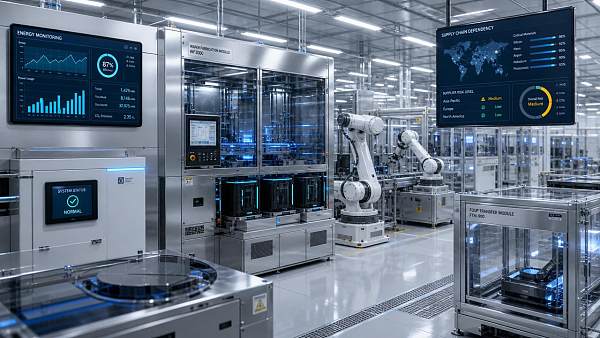
In 2026, risk concentration will increase because several pressures are converging at once. Semiconductor manufacturing is already capital-intensive, energy-hungry, quality-sensitive, and globally interconnected. When those structural traits meet political friction and volatile utility markets, even well-run facilities can become vulnerable.
For executives, the key point is this: the biggest risks are no longer isolated events. A power instability issue can become a yield issue. A geopolitical restriction can become a tooling delay. A labor shortage can become a quality escape. The real threat is interdependence.
That is why leaders should evaluate a semiconductors factory not only by output and unit cost, but also by its risk architecture: energy security, tool maintenance depth, supplier concentration, workforce capability, compliance readiness, and response speed under stress.
Geopolitical Exposure Is Now a Factory-Level Risk, Not Just a Trade Issue
Geopolitical risk used to be treated mainly as a sourcing or export-control concern. In 2026, it will directly affect factory operations. Restrictions on advanced equipment, specialty chemicals, design IP, and cross-border service support can all impair production continuity.
A semiconductors factory may appear operationally sound, yet still face hidden fragility if critical tools depend on foreign field service teams, controlled spare parts, or politically sensitive subcomponents. This is especially serious for advanced nodes, packaging lines, and process-critical metrology systems.
Decision-makers should ask a more specific question than “Are we diversified?” They should ask which exact processes become unstable if one country tightens licensing, one shipping route slows, or one supplier support channel becomes restricted for ninety days.
The most resilient operators are mapping exposure at the equipment, material, and service level. They are also building second-source pathways where technically feasible, even if that raises short-term cost. In 2026, optionality will often be cheaper than disruption.
Energy Volatility Can Destroy Cost Predictability and Process Stability
Energy is now both a financial and operational risk for every semiconductors factory. Fabs and related facilities require stable electricity, tightly controlled environmental systems, and uninterrupted support infrastructure. A price spike hurts margins, but a quality or continuity issue can damage output itself.
Power disturbances, even brief ones, can affect sensitive process tools, wafer handling, cleanroom systems, and thermal controls. In some environments, water treatment and gas delivery systems also become points of vulnerability during utility instability.
Executives should separate three issues that are often blurred together: energy price risk, power quality risk, and utility continuity risk. A factory may hedge prices effectively but still remain exposed to voltage events, grid curtailment, or localized infrastructure bottlenecks.
Practical mitigation includes on-site redundancy, higher-quality monitoring, utility supplier engagement, and energy-intensity benchmarking by process step. For management teams, the goal is not just lower cost. It is more predictable throughput and less unplanned process variation.
Talent Shortages Are Becoming a Yield and Reliability Problem
In 2026, semiconductor labor constraints will not only affect hiring timelines. They will increasingly influence process discipline, preventive maintenance quality, equipment uptime, and root-cause speed. In other words, talent shortages can directly degrade factory performance.
This issue is especially sharp where regional expansion has outpaced the supply of experienced engineers, tool technicians, contamination control specialists, and quality managers. New facilities may secure hardware and buildings faster than they build a mature operating culture.
For business leaders, headcount alone is a poor metric. The better question is whether the semiconductors factory has enough role-specific competence to sustain stable ramp-up, statistical process control, and cross-shift consistency. A thin bench creates hidden execution risk.
Companies that outperform here are investing in structured knowledge transfer, technician certification pathways, digital work instructions, and retention programs for hard-to-replace functions. In a quality-sensitive environment, capability depth matters more than headline hiring numbers.
Quality and Compliance Failures Will Carry Higher Commercial Costs
As semiconductor supply chains become more critical to automotive, industrial, medical, and infrastructure markets, customers are placing greater emphasis on traceability, auditability, and defect prevention. That raises the commercial consequences of even small compliance gaps.
A semiconductors factory that serves high-reliability sectors must now prove more than nominal conformance. Buyers increasingly want confidence in process control, contamination management, lot traceability, change control, and supplier qualification discipline aligned with standards and customer-specific requirements.
In 2026, the risk is not only product recall or customer complaint. It is delayed qualification, lost preferred-supplier status, pricing pressure, or exclusion from high-value programs. Compliance weakness can quietly destroy future revenue before it causes a visible crisis.
Decision-makers should pay close attention to near-miss trends, audit closure speed, excursion management, and engineering change governance. These indicators often reveal more about future risk than headline defect rates alone.
Material and Tooling Dependencies Remain a Critical Weak Point
Many semiconductor leaders have improved inventory visibility since recent supply disruptions, but deep dependencies still remain. Specialty gases, photoresists, substrates, ultrapure consumables, replacement parts, and precision tooling can all become bottlenecks with disproportionate impact.
The risk is magnified because semiconductor production cannot always substitute materials easily. In many cases, a seemingly small input change requires qualification work, customer approval, or process retuning. That limits flexibility during disruption.
Executives should distinguish between high-spend suppliers and high-criticality suppliers. Some of the most dangerous exposures involve relatively low-cost items that can stop expensive assets from running. A narrow focus on spend analysis misses this.
The best practice is to combine multi-tier supplier mapping with process criticality scoring. This helps leaders identify where a single-source dependency could escalate into a major output loss, and where buffer stock, dual qualification, or local stocking agreements would be justified.
Cyber-Physical Risk Is Rising Across Smart Factory Environments
As more fabs and backend facilities connect manufacturing execution systems, predictive maintenance tools, machine interfaces, and supplier portals, cyber risk increasingly overlaps with operational technology risk. In a semiconductors factory, a digital issue can quickly become a production issue.
The concern is broader than ransomware headlines. Misconfigured interfaces, delayed patching, vendor remote access weaknesses, and compromised data integrity can all affect recipe control, equipment availability, and traceability confidence.
For executives, the material question is not whether the IT team has security policies. It is whether factory operations can maintain controlled performance if a critical system is degraded, isolated, or manipulated. Business continuity planning must reflect production realities.
Strong plants are segmenting networks, tightening vendor access, validating backup procedures, and rehearsing incident response across operations, quality, and engineering teams. Cyber resilience is now part of manufacturing resilience.
Environmental and Water Constraints Are Moving Up the Risk Register
Environmental risk in semiconductor manufacturing is no longer only a reputational issue. Water availability, wastewater treatment capacity, emissions compliance, and local permitting conditions can all affect expansion plans, output stability, and cost structure.
This is especially relevant in regions where climate stress, community scrutiny, or industrial infrastructure limits are intensifying. A semiconductors factory may have strong market demand yet face practical constraints in utilities, discharge handling, or environmental approval timelines.
For decision-makers, this means ESG should be treated as an operational planning issue, not a standalone reporting exercise. Water recycling capability, chemical handling controls, and infrastructure resilience increasingly influence site competitiveness.
Factories that perform well on this front tend to integrate environmental engineering into capacity planning early. They also benchmark not just compliance status, but resource efficiency and local infrastructure dependence over a multi-year horizon.
How Leaders Should Evaluate Semiconductors Factory Risk in 2026
For business decision-makers, the most useful approach is to move from broad concern to ranked exposure. Not every plant faces every risk equally. The goal is to identify which vulnerabilities could cause the largest combined impact on supply continuity, margin, customer trust, or strategic flexibility.
A practical assessment starts with six lenses: geopolitical dependency, utility resilience, workforce capability, quality maturity, supplier criticality, and digital-operational security. Leaders should score each area by likelihood, impact, recovery time, and mitigation cost.
It is also important to compare direct factory risks with network risks. A site may look robust on its own but still depend on fragile external nodes, such as one packaging partner, one gas supplier, or one regionally constrained water source.
For boards and senior management, the output should not be a static checklist. It should be a live decision tool that informs sourcing strategy, capex prioritization, customer allocation, and regional expansion choices throughout 2026.
What a Strong 2026 Response Looks Like
The strongest companies will not wait for perfect certainty. They will invest selectively where risks are measurable and consequences are asymmetric. In semiconductor manufacturing, delayed action often costs far more than early mitigation.
That does not mean trying to solve everything at once. It means identifying the few risk controls that materially improve resilience: dual-qualified inputs, stronger preventive maintenance capability, utility redundancy, compliance discipline, supplier visibility, and cross-functional crisis readiness.
For a semiconductors factory, resilience should be evaluated the same way efficiency is evaluated: with evidence, benchmarks, and management accountability. The right question is not whether a plant is low-cost today, but whether it can stay reliable under 2026 conditions.
Organizations that act on this distinction will be better positioned to protect customer commitments, absorb external shocks, and make sharper capital decisions in an industry where execution quality remains the ultimate competitive advantage.
Conclusion: The Real Risk Is Underestimating Interconnected Exposure
In 2026, the biggest threat to any semiconductors factory will not be one isolated problem. It will be the compounding effect of geopolitical tension, energy instability, labor gaps, compliance pressure, and supply dependencies interacting faster than management systems can respond.
For enterprise decision-makers, that means factory risk must be viewed through a strategic lens, not just an operational one. The facilities that win will be those designed and managed for resilience, visibility, and disciplined adaptation.
If leaders can identify where exposure is concentrated, distinguish critical vulnerabilities from background noise, and invest in the right controls early, they will not just reduce disruption. They will strengthen competitiveness in a market where reliability is increasingly a premium asset.

The Archive Newsletter
Critical industrial intelligence delivered every Tuesday. Peer-reviewed summaries of the week's most impactful logistics and market shifts.