Monday, May 22, 2024

Carbon Capture Technologies: Which Systems Fit Industrial Sites?
by
Published
Views:
Carbon Capture Technologies: Which Systems Fit Industrial Sites?
Choosing the right carbon capture system is no longer only about sustainability goals.
It is now tied to project delivery, utility loading, retrofit complexity, and operating risk.
That shift matters because industrial sites rarely start from a blank sheet.
Most plants already have fixed layouts, aging assets, and tight production windows.
So the real question is practical: which carbon capture technologies fit site conditions without creating bigger execution problems?
For heavy industry, the answer depends on flue gas quality, available heat, power stability, water access, and storage or utilization pathways.
It also depends on whether the site needs a quick retrofit, a phased rollout, or a long-horizon decarbonization platform.
From a delivery standpoint, carbon capture works best when technology selection follows process reality, not presentation slides.
A good fit reduces rework, protects uptime, and improves the business case over the full asset life.
Start With the Emissions Profile, Not the Vendor List
Before comparing systems, map the emissions source in detail.
That includes CO2 concentration, contaminants, flow variability, pressure, and temperature.
These factors shape absorber size, pretreatment needs, energy demand, and maintenance frequency.
A cement kiln, a gas-fired turbine, and a steel reheating furnace do not present the same carbon capture challenge.
Even within one facility, different stacks may call for different capture strategies.
- High-CO2 streams often support more efficient capture economics.
- Low-CO2 streams usually need more energy and larger equipment.
- Impurities such as SOx, NOx, and particulates increase pretreatment requirements.
- Intermittent operations can reduce solvent efficiency and lower equipment utilization.
This is where disciplined benchmarking becomes valuable.
A cross-sector view helps teams compare similar duty cycles, utility profiles, and retrofit constraints across industries.
That wider perspective often reveals better carbon capture pathways than a narrow, single-vendor study.
Which Carbon Capture Technologies Match Industrial Conditions?
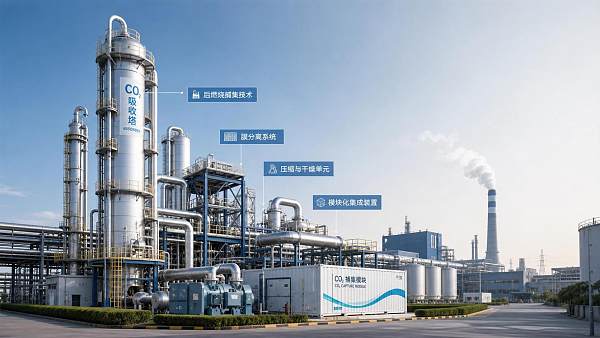
In most industrial projects, four carbon capture routes dominate early screening.
Each has a clear role, but each comes with tradeoffs that affect layout, utilities, and lifecycle cost.
1. Post-Combustion Solvent Capture
This is the most mature carbon capture option for retrofits.
It removes CO2 from flue gas after combustion, usually using amine-based solvents.
It fits cement, waste-to-energy, refining, chemicals, and many power applications.
- Best for brownfield sites needing proven deployment pathways.
- Works well where steam or waste heat is available.
- Needs careful pretreatment to protect solvent life.
- Requires space for absorbers, regenerators, and compression units.
2. Solid Sorbent Carbon Capture
Solid sorbent systems attract attention where modularity matters.
They can reduce some solvent handling issues and may support lower-temperature regeneration.
For sites with footprint constraints, that can be useful.
- Useful for distributed sources or phased installations.
- Can support flexible system packaging.
- Performance depends heavily on real flue gas contaminants.
- Commercial maturity still varies by supplier and duty case.
3. Membrane-Based Carbon Capture
Membrane systems separate gases through selective permeability.
They often appeal where compact skid-based integration is preferred.
However, performance can drop when feed gas is dilute or unstable.
- Good for selected gas processing and higher-pressure applications.
- Can simplify moving parts and some maintenance tasks.
- May require multi-stage design for higher capture rates.
- Compression energy can shift the economics quickly.
4. Oxy-Fuel and Process-Integrated Capture
These options are usually more attractive in new-builds or major rebuilds.
They change the process itself to produce a more concentrated CO2 stream.
That can improve capture efficiency, but project complexity rises sharply.
- Best for long-term industrial transformation programs.
- Can align with major capacity expansions or furnace replacement cycles.
- Needs deeper front-end engineering and stronger change management.
- Often carries higher schedule and integration risk.
Key Site Filters That Decide the Best Fit
In actual project screening, technical fit alone is not enough.
Carbon capture must also fit the site’s execution envelope.
The most common filters are straightforward, but they are often underestimated.
In practice, these filters can eliminate technically viable options very early.
That is not a problem.
It is usually a sign that the screening process is becoming more realistic.
How to Compare Carbon Capture Options Without Missing Project Risk
A common mistake is selecting carbon capture based only on headline capture rate.
That number matters, but it never tells the full delivery story.
A stronger comparison framework includes technical, commercial, and operational dimensions.
- Measure net CO2 reduction, not gross capture alone.
- Compare utility penalties under expected operating conditions.
- Review contaminant tolerance and pretreatment dependency.
- Test layout feasibility against real piping and structural constraints.
- Assess supplier maturity, reference plants, and scale-up evidence.
- Quantify downtime risk during tie-ins and commissioning.
- Model CO2 transport and storage interfaces from day one.
This broader view matters even more when industrial teams face multiple investment priorities.
A carbon capture project competes with debottlenecking, reliability upgrades, digital controls, and energy efficiency programs.
So the winning option is often the one that protects throughput while still meeting emissions targets.
Best-Fit Scenarios by Industrial Site Type
Recent project activity shows a clearer pattern across sectors.
The best carbon capture solution often follows source characteristics and capital timing.
Cement and Lime
These sites are strong carbon capture candidates because process emissions are unavoidable.
Post-combustion systems are often the first route evaluated.
Process-integrated options become more attractive during major kiln upgrades.
Refining and Chemicals
These facilities often have multiple CO2 sources with different concentrations.
That creates opportunities for targeted carbon capture on higher-value streams first.
Integration with hydrogen, steam systems, and CO2 use cases can improve project logic.
Power and Waste-to-Energy
These projects usually prioritize retrofit readiness and operating flexibility.
Solvent-based carbon capture remains a common lead option.
But energy penalty must be modeled carefully against dispatch strategy and revenue structure.
Steel and High-Heat Manufacturing
These sites often require a staged approach.
Carbon capture may start on concentrated process streams before expanding plant-wide.
The right roadmap often combines capture with broader fuel and process transition planning.
A Practical Selection Framework for Industrial Teams
If the goal is a bankable and buildable decision, keep the process simple and evidence-based.
- Characterize each emission source using recent plant data.
- Screen carbon capture technologies against utilities, contaminants, and footprint.
- Eliminate options that fail turnaround or tie-in constraints.
- Model total cost with compression, transport, and storage included.
- Validate vendor claims with reference cases and performance boundaries.
- Phase the roadmap if site-wide rollout is too disruptive.
This approach helps teams avoid a familiar trap.
Many carbon capture studies look promising until balance-of-plant details appear.
By then, schedule, cost, and stakeholder confidence may already be under pressure.
A grounded front-end selection process is the better path.
The best carbon capture system is not the most talked-about one.
It is the one that fits the plant, supports operations, and stays viable from concept to commissioning.
When carbon capture decisions are anchored in site data, utility reality, and benchmarked delivery risk, industrial decarbonization becomes far more executable.
The Archive Newsletter
Critical industrial intelligence delivered every Tuesday. Peer-reviewed summaries of the week's most impactful logistics and market shifts.