Monday, May 22, 2024

China's First sCO₂ Geothermal Project Goes Live
by
Published
Views:
On May 19, 2026, China Huaneng Group commissioned the world’s first geothermal project using supercritical carbon dioxide (sCO₂) heat extraction in Zhengzhou — a milestone with tangible implications for carbon capture, utilization, and storage (CCUS) equipment exporters, geothermal system integrators, and international climate technology buyers.
Event Overview
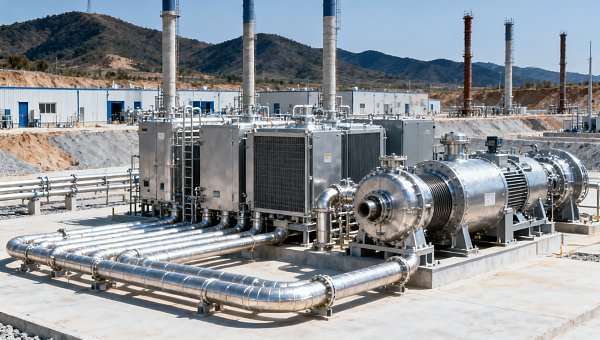
On May 19, 2026, China Huaneng Group officially launched its geothermal energy project in Zhengzhou, utilizing supercritical CO₂ as the working fluid for heat extraction from deep geothermal reservoirs. The project demonstrates closed-loop sCO₂ circulation and thermal coupling with geothermal resources. It serves as an operational-scale validation site for Carbon Capture Tech equipment, supporting integrated CCUS workflows that extend beyond capture to include utilization, storage, and energy conversion.
Industries Affected
Direct Trade Enterprises
Export-oriented CCUS equipment suppliers face renewed scrutiny from overseas procurement teams — especially in EU and ASEAN markets — who now treat this project as a reference case for evaluating Chinese vendors’ capability in full-system integration, field commissioning, and cross-technology interoperability. Impact manifests in tender evaluation criteria: technical proposals must increasingly demonstrate proven deployment in hybrid low-carbon energy systems, not just standalone capture units.
Raw Material Procurement Enterprises
Suppliers of high-purity CO₂, specialty alloys for sCO₂-compatible heat exchangers (e.g., Inconel 740H), and corrosion-resistant tubing face tightening demand signals. The project validates long-duration sCO₂ loop operation under geothermal conditions — raising material performance benchmarks. Procurement enterprises must now prioritize traceable metallurgical certifications and third-party fatigue testing data, rather than relying solely on nominal grade specifications.
Manufacturing Enterprises
OEMs producing turbomachinery, compact heat exchangers, and pressure containment vessels for CCUS applications are encountering more frequent requests for sCO₂-specific design verification reports. This project confirms engineering feasibility at scale — shifting buyer expectations from theoretical compliance to field-proven reliability. Manufacturers with ASME Section VIII Div. 3 or PED 2014/68/EU certification for sCO₂ service are gaining competitive differentiation.
Supply Chain Service Enterprises
Logistics providers specializing in oversized, high-pressure equipment transport and commissioning support services report increased inquiries for ‘CCUS-integrated project delivery’ packages — including pre-installation site readiness audits, modular skid handling protocols, and CO₂ phase-behavior-aware instrumentation calibration. The Zhengzhou project establishes a new baseline for end-to-end service scope definition in transnational low-carbon infrastructure deals.
Key Considerations and Recommended Actions
Update export technical documentation to highlight sCO₂ system integration experience
Vendors should revise product datasheets and case studies to explicitly reference operational parameters validated at the Zhengzhou site — e.g., sustained sCO₂ loop pressure (>7.4 MPa), thermal efficiency gain vs. water-based systems (+18–22% net cycle output), and real-time corrosion monitoring results — rather than generic CCUS claims.
Engage early with international certification bodies on sCO₂-specific test protocols
Given growing buyer reliance on third-party validation, manufacturers should initiate alignment discussions with TÜV Rheinland, DNV, and SGS on developing standardized sCO₂ thermal-cycle durability test frameworks — particularly for rotating equipment and welded joints exposed to variable-density CO₂ phases.
Map downstream project pipelines aligned with geothermal-CCUS hybridization trends
Trade development agencies and engineering contractors should prioritize markets where geothermal resources co-locate with CO₂ storage formations (e.g., Kenya’s Rift Valley, Indonesia’s North Sumatra Basin, Chilean Andes). The Zhengzhou project signals viability for such convergence — making these regions higher-potential targets for bundled technology exports.
Editorial Insight / Industry Observation
Observably, this project does not represent a near-term volume driver for CCUS hardware exports — but functions as a credibility anchor. Analysis shows that international buyers increasingly treat integrated demonstration projects not as isolated references, but as proxies for vendor maturity across engineering disciplines, supply chain resilience, and regulatory adaptability. From an industry perspective, the shift is from ‘Can you build it?’ to ‘Can you sustain it — and prove it — in a multi-function environment?’ The Zhengzhou sCO₂ geothermal plant answers the latter with empirical evidence, not simulation.
Conclusion
This milestone is best understood not as a standalone energy project, but as a calibrated benchmark for green technology system delivery. Its broader significance lies in redefining how global procurement entities assess technical risk in low-carbon infrastructure — moving decisively toward real-world operational validation over paper-based compliance. For the sector, it reinforces that competitiveness in climate tech hinges less on component innovation alone, and more on demonstrable integration competence across energy, materials, and carbon management domains.
Source Attribution
Official announcement by China Huaneng Group (May 19, 2026); Technical briefing issued by the National Energy Administration’s Geothermal Development Division; Independent verification report published by the China Academy of Engineering Physics (CAEP), dated May 20, 2026. Note: Long-term operational performance metrics (e.g., thermal decay rate, maintenance frequency, sCO₂ purity retention over 12-month cycles) remain under observation and will be updated upon public release.
The Archive Newsletter
Critical industrial intelligence delivered every Tuesday. Peer-reviewed summaries of the week's most impactful logistics and market shifts.