Monday, May 22, 2024

Industrial infrastructure upgrades fail when downtime is underestimated
by
Published
Views:
Industrial infrastructure upgrades often fail not because the technology is weak, but because downtime is misjudged across modern manufacturing systems. From PCBA manufacturing and tech hardware to tooling solutions and plastic injection mold factory operations, every delay affects cost, quality, compliance, and industrial sustainability. For global manufacturing leaders, aligning execution with engineering standards is essential to reducing risk and protecting long-term performance.
For operators, technical evaluators, project managers, procurement teams, quality leaders, and financial approvers, the central question is rarely whether an upgrade is necessary. The real question is how to execute it without disrupting output, missing delivery windows, or creating hidden failures that surface 30, 60, or 90 days later.
In cross-sector manufacturing environments, downtime is no longer a single maintenance event. It is a compound operational risk that touches machine availability, process validation, supplier coordination, operator training, regulatory checks, spare parts readiness, and restart stability. A 6-hour line stop can become a 3-day commercial problem when upstream and downstream systems are not synchronized.
This is where a system-level view matters. Global Industrial Matrix (GIM) supports industrial stakeholders with cross-sector benchmarking and technical intelligence across electronics, mobility, smart agri-tech, ESG infrastructure, and precision tooling. When infrastructure upgrades are evaluated through isolated departmental assumptions, failures multiply. When they are assessed through standards, dependencies, and measurable execution windows, upgrade risk becomes manageable.
Why downtime is systematically underestimated in industrial upgrades
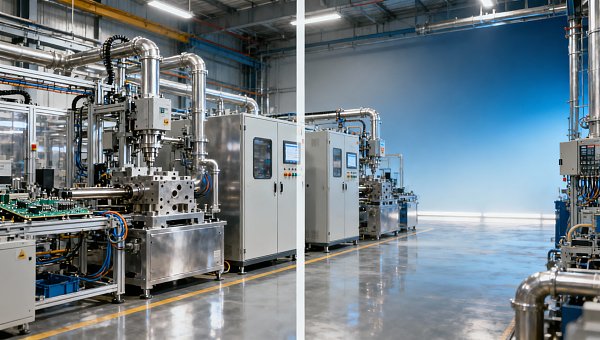
Most upgrade plans underestimate downtime because they focus on installation hours rather than full operational recovery time. In practice, industrial downtime includes shutdown preparation, lockout and safety controls, mechanical and electrical modification, software integration, calibration, trial production, quality approval, and ramp-up stabilization. In many facilities, the physical installation may take 8–12 hours, while full performance recovery takes 2–5 days.
This gap is especially visible in mixed-process plants where one infrastructure change affects multiple assets. A compressed air redesign can alter machine pressure stability, pick-and-place accuracy, mold cycle repeatability, and cleanroom particle behavior. An electrical bus upgrade may seem local, yet it can affect PLC communication, machine start-up sequencing, and thermal loading across several lines.
Another reason is organizational fragmentation. Engineering may estimate based on technical scope, production may estimate based on shift loss, finance may estimate based on hourly revenue, and quality may estimate based on first-pass yield degradation. If these views are not merged, the project budget captures only 40%–60% of the actual downtime impact.
In high-mix manufacturing, restart variability is often the hidden cost driver. After upgrades, output may return at only 70%–85% of normal throughput during the first 24–72 hours. That reduced rate can be more damaging than the official shutdown, especially when customer schedules, supplier replenishment, and inspection plans were built around nominal capacity.
Common sources of hidden downtime
The list below reflects the most common causes of schedule drift seen across integrated industrial projects:
- Utility instability after reconnection, including voltage fluctuation, compressed air pressure loss, and cooling water imbalance.
- Software and controls mismatch between new assets and legacy PLC, MES, SCADA, or traceability systems.
- Delayed validation of critical tolerances such as torque, temperature, placement accuracy, filtration quality, or mold dimensional output.
- Operator retraining requirements that add 1–3 shifts before stable cycle time is restored.
- Late arrival of spare parts, fixtures, calibration tools, or safety documentation needed for restart approval.
Where the planning model usually breaks
A useful way to diagnose planning weakness is to compare the “installation window” with the “business recovery window.” The table below shows how these two measurements often differ in real industrial settings.
The key conclusion is straightforward: if downtime is measured only by wrench time, infrastructure upgrades will almost always appear cheaper and faster than they really are. Mature organizations therefore define downtime as the period from controlled shutdown to verified return of target output, target quality, and target compliance status.
How downtime risk spreads across manufacturing functions
Downtime is not just an engineering variable. In a modern factory or multi-site industrial group, it affects at least 6 functional layers: operations, quality, supply chain, EHS, finance, and customer delivery. That is why the same upgrade can be judged as successful by one department and costly by another.
For operators and line supervisors, the immediate impact is schedule disruption. Shift plans, staffing levels, maintenance support, and material staging all change when a restart takes longer than expected. In a PCBA environment, one delayed line may block feeders, stencils, reflow sequencing, and AOI scheduling. In tooling or molding operations, missed restart timing can affect mold conditioning, resin handling, and preventive maintenance windows.
For quality and safety teams, downtime risk shows up as process drift. After upgrades, critical variables such as temperature control, pressure stability, torque range, air cleanliness, vibration, or dimensional repeatability may move outside acceptable bands. Even if the equipment runs, a capability drop from Cpk 1.33 to 1.00 can trigger containment, reinspection, or shipment delay.
For commercial evaluators and financial approvers, the major issue is that the total cost of downtime is rarely visible in the original capital request. A project may look justified with a 14-month payback under ideal assumptions, yet shift to 20–24 months once lost output, scrap, overtime, expedited freight, and delayed invoicing are included.
Functional impact map
A practical cross-functional view helps teams understand why downtime estimation must be built into procurement and project governance from day one.
The table shows why downtime cannot be owned by maintenance alone. It must be quantified as a shared operational variable. In cross-sector environments such as electronics, automotive subassemblies, smart agriculture machinery, and water treatment infrastructure, the interaction between systems increases both the spread and the cost of disruption.
Three warning signs before the project starts
- The project budget includes equipment and installation but excludes validation lots, temporary labor, or restart scrap assumptions.
- The supplier schedule ends at commissioning, while the plant plan requires stable output within the next 24 hours.
- The approval workflow lacks a documented threshold for acceptable throughput loss, such as no more than 10% below baseline after day 2.
When any of these signs are present, project managers should assume the downtime estimate is incomplete. The right response is not simply adding contingency hours, but restructuring the execution plan around measurable recovery gates.
A practical framework for estimating real downtime before approval
A stronger downtime model starts by separating direct shutdown time from recovery time. Direct shutdown includes the physical work window. Recovery time includes controls verification, calibration, operator qualification, process capability confirmation, and gradual output normalization. In many industrial settings, the recovery phase represents 50% or more of the total business impact.
For decision-makers, it is useful to evaluate upgrades in 4 layers: infrastructure dependency, process criticality, restart complexity, and customer sensitivity. A utility system feeding 12 lines requires a different risk premium than a standalone workstation. Likewise, a process with regulated inspection points or customer PPAP implications should carry a more conservative restart assumption.
A robust estimate should also test best-case, expected-case, and constrained-case scenarios. Many capital proposals use a single expected downtime figure, but industrial execution rarely follows one curve. Using a 3-scenario model allows finance and project teams to assign decision thresholds before spending starts.
Teams that manage downtime well often build a staged acceptance approach. Instead of asking whether the equipment is installed, they ask whether the line has reached 3 milestones: safe restart, validated process window, and sustained target output over a defined run length such as 8 hours, 1 shift, or 3 consecutive lots.
Recommended estimation structure
The following model can be adapted across manufacturing sectors where multiple systems interact.
- Phase 1: Shutdown preparation — 0.5 to 2 days for parts staging, risk review, permit control, and backup of controls data.
- Phase 2: Execution window — 6 to 48 hours depending on mechanical scope, utility isolation, and access complexity.
- Phase 3: Technical verification — 4 to 24 hours for electrical checks, software testing, calibration, and alarm validation.
- Phase 4: Controlled restart — 1 to 3 shifts for trial production, operator retraining, and recipe or parameter tuning.
- Phase 5: Stable production confirmation — 1 to 5 days to confirm quality, throughput, traceability, and reporting continuity.
Decision matrix for approval teams
Before financial approval, it helps to translate technical complexity into decision language. The matrix below gives a simple example.
If a project falls into the higher-risk column in 3 or more categories, a conservative downtime reserve is usually justified. That may include extra trial capacity, dual-source planning, temporary stock build, or phased commissioning instead of one full shutdown event.
Execution strategies that reduce disruption in cross-sector facilities
Once downtime is properly estimated, the next priority is execution design. The most effective industrial upgrade strategies are not always the fastest on paper. They are the ones that protect process stability, reduce restart variation, and preserve delivery reliability across connected production flows.
One proven method is phased implementation. Instead of stopping an entire infrastructure block, teams can sequence utility transfer, controls migration, or equipment replacement in modules. For example, a site may upgrade one molding cell, one filtration skid, or one SMT support utility loop at a time, monitoring output for 24–48 hours before scaling to the next zone.
Another strategy is temporary redundancy. In some cases, renting supplementary chillers, compressors, filtration units, or mobile power support for 1–2 weeks is cheaper than risking a full-system outage. This is especially relevant when infrastructure touches water treatment, HVAC stability, clean process environments, or high-precision tooling support.
Data discipline is equally important. Teams should baseline at least 5 performance indicators before shutdown: throughput, scrap rate, changeover time, utility consumption, and quality escape rate. Without a documented baseline, it becomes difficult to prove whether the upgrade actually delivered improvement or introduced hidden inefficiency.
Operational controls during the upgrade window
Project leaders can use the checklist below to reduce instability during execution.
- Freeze nonessential process changes for 7 days before the upgrade so baseline comparisons remain valid.
- Confirm spare parts, calibration tools, and software backups at least 72 hours before shutdown.
- Assign clear sign-off owners for safety, engineering, quality, production, and IT or controls integration.
- Run a dry review of restart parameters, alarm states, and emergency recovery steps before the live event.
- Schedule a structured observation period of at least 1 full shift after restart rather than declaring success immediately after first output.
Role of benchmarking and standards alignment
Cross-sector benchmarking improves execution because it reveals where assumptions differ from industrial norms. GIM’s value in this context is the ability to compare infrastructure behavior, component expectations, and process constraints across sectors rather than inside one silo. A utility upgrade affecting IPC-driven electronics output, IATF-governed mobility components, or ISO-aligned environmental infrastructure will not follow the same validation logic, even if the equipment category appears similar.
Standards alignment does not eliminate downtime, but it reduces uncertainty. When teams connect upgrade planning to known acceptance criteria, documented process windows, and benchmarked recovery ranges, they can make more reliable sourcing, scheduling, and approval decisions.
FAQ: practical questions before approving an infrastructure upgrade
The questions below reflect recurring concerns from industrial buyers, evaluators, operators, and project owners who need more than a basic installation estimate.
How do we know whether our downtime estimate is too optimistic?
A plan is likely too optimistic if it measures only shutdown hours and excludes validation, operator readiness, software checks, and ramp-up losses. As a practical rule, if no allowance has been made for 1–3 shifts of reduced output after restart, the business case may be understating operational risk.
Which facilities are most exposed to upgrade-related downtime?
Facilities with shared utilities, high-mix production, tight customer tolerances, or regulated inspection steps are typically more exposed. This includes PCBA plants, precision tooling operations, plastic injection molding sites, EV component manufacturing, smart agriculture assembly, and environmental infrastructure systems where restart conditions influence downstream quality or compliance.
What metrics should procurement and finance request before approval?
At minimum, request 6 items: planned shutdown duration, expected recovery time, first-week throughput assumption, validation requirement, temporary mitigation cost, and downside scenario impact on delivery. These metrics translate technical scope into approval language and prevent underfunded execution.
Is a phased upgrade always better than a full shutdown replacement?
Not always. Phased upgrades reduce peak disruption but can extend project duration and increase coordination complexity. Full shutdown replacement may be more efficient when interdependencies are too dense to isolate safely. The right choice depends on whether the plant can maintain output through redundancy, buffer inventory, or alternate routing for 3–10 days.
How can quality and safety teams contribute earlier?
They should join the project before equipment purchase is finalized. Early involvement helps define validation lots, alarm logic, safety permits, contamination controls, and acceptance criteria. This often prevents late-stage delays that add more downtime than the installation itself.
Industrial infrastructure upgrades succeed when downtime is treated as a full-system business variable, not a narrow maintenance estimate. The most resilient manufacturers build approval models that account for shutdown, restart, validation, quality stabilization, and customer delivery exposure in one integrated view.
For organizations operating across electronics, automotive and mobility, smart agri-tech, ESG infrastructure, and precision tooling, this system-level discipline is increasingly essential. GIM helps stakeholders compare technical pathways, benchmark operational assumptions, and make more confident upgrade decisions grounded in cross-sector visibility.
If your next upgrade involves complex dependencies, strict output targets, or multi-team approval risk, now is the right time to evaluate the downtime model before execution begins. Contact us to get a tailored benchmarking perspective, discuss project assumptions, and explore practical solutions for lower-risk industrial modernization.
- electronics
- tech hardware
- PCBA manufacturing
- Mobility
- Agri-Tech
- industrial sustainability
- tooling solutions
- injection molding
- plastic injection mold factory
- Precision tooling
- Smart Agri-Tech
- Global manufacturing
- Modern manufacturing
- Engineering standards
- Industrial infrastructure
- Environmental infrastructure
The Archive Newsletter
Critical industrial intelligence delivered every Tuesday. Peer-reviewed summaries of the week's most impactful logistics and market shifts.