Monday, May 22, 2024

Renewable Energy Storage ROI and Upgrade Risks
by
Published
Views:
For finance approvers, investing in renewable energy storage systems is no longer just a sustainability decision—it is a capital allocation question shaped by ROI, upgrade cycles, and long-term operational risk.
This article examines payback potential, hidden integration costs, and technology obsolescence. It helps compare projects with greater confidence while protecting budget performance and strategic resilience.
Across global manufacturing, energy decisions now connect production uptime, grid volatility, ESG targets, and asset lifecycle planning. That makes renewable energy storage systems a cross-functional investment, not a standalone utility upgrade.
What determines ROI for renewable energy storage systems?
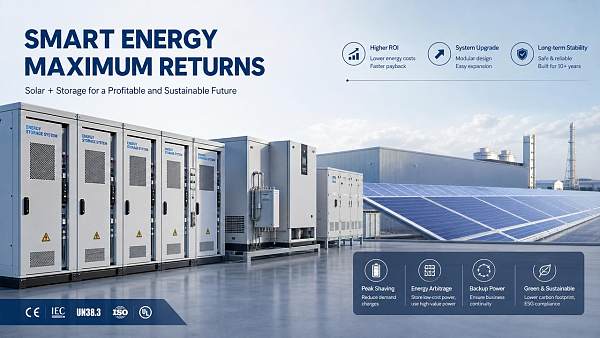
ROI for renewable energy storage systems depends on more than battery price. Financial returns come from stacked value streams that vary by site, tariff design, and operating profile.
The first driver is energy arbitrage. Storage charges when electricity is cheaper and discharges during expensive periods. This matters most in markets with sharp peak pricing.
The second driver is demand charge reduction. Many industrial sites pay penalties based on peak load. Storage can shave those peaks and lower monthly utility costs.
The third driver is resilience value. Facilities with high downtime costs may justify renewable energy storage systems even when direct bill savings look modest.
Other contributors include renewable self-consumption, backup support, ancillary services, and carbon performance. However, these benefits only count if local rules and site controls allow capture.
- Utility tariff structure and peak windows
- Solar or wind generation profile
- Cycle frequency and usable battery capacity
- Round-trip efficiency and degradation rate
- Inverter performance and EMS optimization
- Maintenance, warranty terms, and replacement timing
A simple payback number can be misleading. A better model uses net present value, internal rate of return, and scenario sensitivity over the full operating life.
GIM-style benchmarking is useful here. It compares component quality, standards alignment, and system integration assumptions across sectors where uptime and compliance carry real economic weight.
Which hidden costs often reduce project returns?
Many renewable energy storage systems underperform financially because planning focused on hardware cost while ignoring implementation friction. The missed items often appear after approval, not before.
Interconnection upgrades are a common surprise. Some sites need transformer changes, protection redesign, relay coordination, or switchgear replacement before the storage system can operate safely.
Controls integration can also be expensive. Renewable energy storage systems must communicate with solar inverters, building management systems, SCADA platforms, and utility interfaces.
Software is another hidden layer. Basic dispatch logic may not maximize revenue. Advanced EMS tools, cybersecurity controls, and remote diagnostics can materially change total cost.
Site preparation should not be underestimated. Civil works, fire suppression, thermal management, ventilation, permitting, and insurance conditions can move budgets significantly.
Then there is performance loss. Degradation, partial availability, ambient temperature effects, and conservative operating windows reduce usable energy over time.
Common budget items missed in early models
- Grid studies and permitting fees
- PCS, inverter, and transformer upgrades
- Fire code compliance and safety systems
- Data integration and cybersecurity hardening
- Training, commissioning, and acceptance testing
- Warranty exclusions and end-of-life handling
A disciplined model separates capex, soft costs, operating costs, and risk-adjusted contingency. That creates a more defensible view of renewable energy storage systems in capital committees.
How should upgrade cycles and obsolescence risk be evaluated?
Technology progress is a benefit and a risk. Renewable energy storage systems improve quickly, but fast evolution can shorten the practical life of current architectures.
Battery chemistry is only one issue. Obsolescence often starts in power electronics, controls software, communication protocols, and spare parts availability.
A system with closed interfaces may become difficult to expand later. A modular design with interoperable controls can lower future retrofit costs and improve long-term value.
Warranty structure matters. A ten-year battery warranty sounds strong, but throughput limits, temperature conditions, and performance guarantees determine actual protection.
Decision-makers should test two upgrade scenarios. First, what happens if capacity needs grow? Second, what happens if software or inverter platforms are discontinued?
Useful questions include battery augmentation compatibility, firmware support period, replacement part lead times, and whether future chemistries can coexist within the same control environment.
Practical signs of lower upgrade risk
- Open communication standards
- Modular containers or cabinet architecture
- Documented augmentation roadmap
- Clear software update policy
- Certified compliance with relevant safety standards
In industrial environments, upgrade risk also affects continuity planning. Systems tied to automation, water treatment, cold storage, or EV charging cannot tolerate uncertain support windows.
Where do renewable energy storage systems make the most financial sense?
The best economics appear where energy costs are volatile, outages are expensive, or onsite renewables are underused. Site context is more important than broad market averages.
Industrial campuses with high peak demand are strong candidates. So are logistics hubs, cold-chain facilities, process plants, and water infrastructure with critical uptime requirements.
Renewable energy storage systems also work well in locations with constrained grids. There, storage can defer infrastructure expansion and support operational continuity during instability.
Sites with large solar arrays often unlock better returns. Storage raises self-consumption, reduces curtailment, and improves the economic use of existing renewable assets.
However, low-utilization sites may struggle. If peaks are infrequent and power quality is already stable, the business case may rely too heavily on uncertain market revenues.
This is why benchmarking by application is essential. Renewable energy storage systems should be assessed against actual load behavior, not generic vendor assumptions.
How can projects be compared without relying on vendor headline claims?
A reliable comparison framework starts with normalized inputs. Every bid for renewable energy storage systems should be recalculated using the same tariff assumptions, cycle profile, and degradation model.
Next, compare usable output rather than nameplate capacity. Installed kWh alone does not show what the asset will actually deliver at required temperatures and discharge rates.
Availability guarantees deserve close reading. A lower-cost system with weak service commitments can create higher effective cost when downtime and delayed repairs are considered.
It also helps to score proposals beyond price. Safety certification, standards alignment, cyber readiness, and vendor support depth all influence long-term economics.
FAQ comparison checklist
This structured approach gives renewable energy storage systems a fairer technical and financial comparison. It also reduces the chance of approving a low-price option with hidden lifecycle penalties.
What are the most common mistakes in storage investment decisions?
One frequent mistake is treating storage as a simple battery purchase. In practice, renewable energy storage systems are integrated infrastructure with electrical, digital, and operational dependencies.
Another mistake is using static utility prices. If tariffs, production schedules, or renewable output shift, the original business case can change quickly.
Some evaluations ignore replacement timing. Batteries, inverters, and control layers age differently. Without staged lifecycle planning, midlife costs arrive as unpleasant surprises.
There is also a tendency to overvalue resilience without a downtime model. Backup capability has real worth, but it should be tied to measured operational impact.
Finally, projects often move forward without a clear data strategy. Renewable energy storage systems generate critical performance information that should feed enterprise-level energy and risk decisions.
- Model multiple price and usage scenarios
- Stress-test integration and permitting assumptions
- Quantify downtime exposure before assigning resilience value
- Favor scalable architectures over closed systems
- Use benchmarked technical data, not brochure claims
Renewable energy storage systems can deliver strong returns, but only when evaluated as lifecycle assets rather than isolated equipment purchases.
The strongest business cases combine bill savings, resilience value, standards-based system quality, and credible upgrade planning. The weakest rely on optimistic assumptions and incomplete integration budgets.
A practical next step is to build a comparison model using normalized tariffs, real load data, integration scope, and end-of-life assumptions. That turns storage evaluation into a disciplined investment decision.
Within complex industrial ecosystems, cross-sector benchmarking adds another layer of protection. It helps validate whether renewable energy storage systems fit both current operations and future infrastructure strategy.

The Archive Newsletter
Critical industrial intelligence delivered every Tuesday. Peer-reviewed summaries of the week's most impactful logistics and market shifts.