Monday, May 22, 2024

UV Water Sterilizers: How to Judge Disinfection Performance
by
Published
Views:
In industrial water treatment, judging UVwatersterilizers is less about lamp power alone and more about whether a system can deliver a verified germicidal dose under real operating conditions.
That distinction matters across manufacturing, environmental infrastructure, food processing, smart agriculture, and high-purity utility loops, where inconsistent disinfection can create technical, compliance, and continuity risks.
A useful evaluation framework connects microbiological performance with reactor hydraulics, water quality, sensor reliability, and standard-based validation. That is where a cross-sector benchmarking mindset becomes practical.
What disinfection performance really means
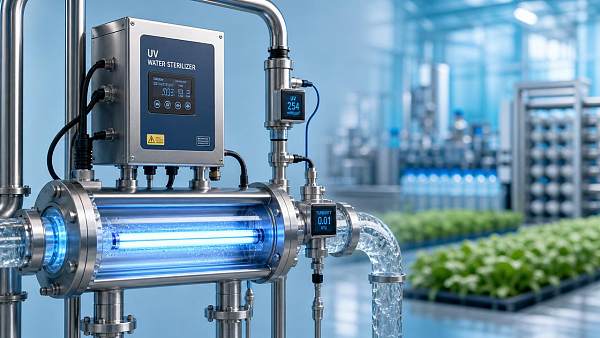
UVwatersterilizers disinfect by exposing microorganisms to ultraviolet energy, typically in the UVC range, which damages nucleic acids and prevents replication.
In practice, the key question is not whether UV is present, but whether the delivered dose is high enough at the worst point inside the reactor.
Dose is usually understood as UV intensity multiplied by exposure time. Both parts can change when flow rate, transmittance, fouling, or lamp condition shifts.
This is why two units with similar electrical ratings may produce very different outcomes. A higher wattage does not automatically mean better disinfection.
For meaningful comparison, UVwatersterilizers should be judged on reduction performance against target organisms, validated dose claims, and operating stability over time.
Why the topic matters across industries
Water systems now sit inside larger production ecosystems. A sterilizer may support electronics rinsing, cooling water reuse, irrigation recirculation, wastewater polishing, or process water protection.
Each use case imposes different failure costs. In one setting, poor disinfection means microbial regrowth. In another, it means membrane fouling, unplanned cleaning, or downstream contamination.
This broader context aligns with the GIM approach to technical benchmarking. Cross-sector evaluation works best when hardware is not treated as an isolated component.
Instead, UVwatersterilizers should be reviewed as part of a system of systems, linked to upstream filtration, controls, maintenance routines, and applicable standards.
That perspective helps reduce supply chain risk as well. A unit that looks competitive on paper may underperform once real water conditions and service intervals are considered.
The parameters that deserve the closest attention
Several technical factors determine whether UVwatersterilizers perform consistently. The most important are usually dose delivery, hydraulic design, and water quality sensitivity.
UV dose and validation basis
A supplier may present a target dose value, but the more important detail is how that value was established.
Look for biodosimetry or third-party validation rather than theoretical calculations alone. Claimed performance should connect to recognized protocols and measurable log reduction.
Reactor geometry and flow behavior
Good reactor design limits short-circuiting and dead zones. Poor hydraulics can leave parts of the flow underexposed even when average intensity appears acceptable.
Flow distribution, chamber shape, lamp placement, and residence time profile all influence the minimum dose point, which is often the true performance constraint.
Water quality variables
UV transmittance is a central metric. Suspended solids, color, iron, manganese, organics, and scaling potential can all reduce effective dose.
In actual installations, UVwatersterilizers rarely see ideal water all the time. Evaluation should include expected seasonal variation, upset conditions, and pretreatment quality.
Monitoring and control integrity
Sensor placement, calibration routines, alarm logic, lamp aging compensation, and quartz sleeve fouling management affect whether the unit remains inside its validated envelope.
A strong control package improves visibility. A weak one leaves uncertainty about whether disinfection performance was actually maintained between maintenance events.
How to compare systems without relying on headline numbers
A simple comparison matrix often reveals more than a brochure summary. The point is to compare tested performance under realistic boundaries, not just catalog specifications.
When this structure is used, UVwatersterilizers become easier to compare across brands, regions, and application categories.
Where application context changes the answer
There is no universal performance threshold that fits every site. The right judgment depends on what the water supports and what microorganisms matter most.
Industrial and utility water loops
Here, UVwatersterilizers are often used to limit biofilm pressure, protect membranes, or stabilize reuse quality. Reliability and low maintenance can outweigh compact design.
Agricultural recirculation and irrigation
In these systems, water quality variability is usually higher. Solids, organics, and seasonal shifts make pretreatment and fouling control especially important.
High-purity or sensitive process lines
Semiconductor, electronics, and precision manufacturing environments may prioritize microbial control consistency, material compatibility, and data traceability more than raw throughput.
Environmental infrastructure
Municipal or industrial discharge treatment often depends on validated pathogen reduction under regulated operating conditions. Documentation quality becomes part of performance assessment.
Standards, documentation, and proof of performance
Well-documented UVwatersterilizers are easier to trust because performance claims can be traced to methods, limits, and maintenance assumptions.
Recognized validation frameworks, operating manuals, calibration procedures, and material specifications should all align. Gaps in one area often signal risk in another.
For organizations already using benchmarking disciplines around ISO, IATF, IPC, or similar standards, this style of evidence-based review is familiar.
The same logic applies here: if disinfection performance cannot be verified under defined conditions, it should not be treated as fully comparable.
A practical checklist for the next evaluation round
Before shortlisting UVwatersterilizers, it helps to organize the decision around the water itself, the target outcome, and the level of proof required.
- Define the actual water quality range, not just design-point water.
- Match microbial reduction goals to the process risk, not to generic marketing claims.
- Ask whether validated performance covers peak flow and low-UVT conditions.
- Review sensor strategy, alarm philosophy, and maintenance access early.
- Compare lifecycle stability, spare part support, and documentation depth.
That approach usually produces better decisions than comparing wattage, footprint, and price in isolation.
For teams building a more robust benchmark, the next step is to create a side-by-side scorecard using validated dose, water quality limits, controls, and maintenance burden.
Used this way, UVwatersterilizers become easier to judge as performance-critical assets rather than interchangeable accessories.

The Archive Newsletter
Critical industrial intelligence delivered every Tuesday. Peer-reviewed summaries of the week's most impactful logistics and market shifts.