Monday, May 22, 2024
Wastewater Treatment Solutions for High-TDS Industrial Effluent
by
Published
Views:
Selecting effective wastewater treatment solutions for high-TDS industrial effluent requires more than generic process matching. For technical evaluators, the priority is usually not finding a single “best” technology, but identifying the most reliable treatment train for a specific effluent profile, recovery target, and compliance requirement.
In practice, high total dissolved solids streams are rarely solved by one unit operation alone. The most robust approach typically combines pretreatment, concentration control, selective separation, and brine management, with decisions guided by fouling risk, energy intensity, material compatibility, and lifecycle economics.
For industrial benchmarking teams, the key question is straightforward: which wastewater treatment solutions can consistently achieve discharge or reuse goals without creating unacceptable operating instability or cost escalation? The answer depends on feedwater chemistry, process variability, and the site’s tolerance for concentrate disposal, downtime, and operator complexity.
What technical evaluators should assess first in high-TDS effluent projects
Before comparing technologies, evaluators need a clear definition of the water problem. “High-TDS” alone is not enough. Performance and risk are shaped by salt composition, scaling ions, organics, suspended solids, temperature, pH, silica, hardness, heavy metals, and daily flow variability.
Two streams with similar conductivity may require completely different designs. A wastewater stream dominated by sodium chloride behaves very differently from one containing calcium sulfate, silica, ammonia, solvents, or emulsified oil. This is why laboratory characterization and pilot validation matter more than vendor generalizations.
The first screening step should focus on five variables: required final water quality, target recovery rate, brine volume tolerance, specific energy consumption, and expected membrane or equipment lifespan. These metrics frame whether the project should prioritize desalination, volume reduction, pollutant removal, or a hybrid objective.
For technical assessment teams, another critical issue is operational resilience. A treatment system that performs well under ideal influent conditions may still fail economically if the plant experiences production swings, cleaning chemical carryover, or seasonal changes in wastewater composition.
That is why wastewater treatment solutions for industrial high-TDS applications should be evaluated as systems, not standalone products. Pretreatment quality, control logic, cleaning strategy, spare parts availability, and operator skill requirements often determine long-term success more than headline removal percentages.
Why conventional biological or physical treatment is often insufficient
Many industrial plants begin with existing equalization, clarification, or biological treatment assets. These can still play an important role, but they usually cannot address dissolved salt loading on their own. High TDS passes through most conventional physical and biological systems with limited reduction.
Biological treatment can also become unstable when salinity exceeds the tolerance of the microbial population. Elevated osmotic pressure may suppress biological activity, reduce COD removal efficiency, and complicate nitrification or denitrification, especially in mixed industrial wastewater streams.
Simple evaporation ponds or dilution strategies are increasingly constrained by land availability, environmental policy, and water reuse targets. In many jurisdictions, regulators are tightening discharge permits for conductivity, chlorides, sulfates, and priority contaminants associated with concentrated industrial effluent.
For this reason, modern wastewater treatment solutions usually need to combine dissolved solids control with broader treatment goals. These may include organics reduction, metals removal, water recovery for reuse, and minimized concentrate generation to support zero liquid discharge or near-ZLD strategies.
How to match the right treatment pathway to the effluent profile
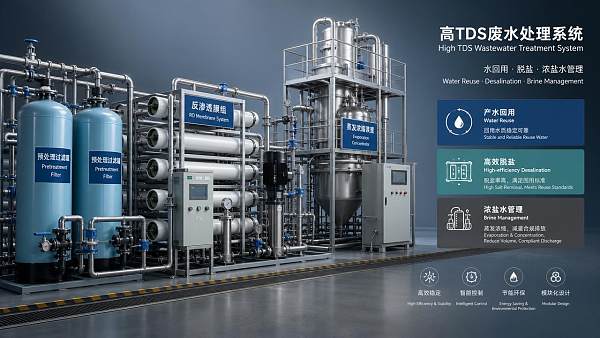
There is no universal process train for high-TDS wastewater. However, most viable solutions fall into several practical pathways: membrane-based desalination, thermal concentration, physicochemical precipitation, ion-selective polishing, or integrated hybrid systems built around staged recovery.
Reverse osmosis is often the first technology considered when moderate-to-high recovery is required and salinity is still within membrane-operable limits. RO can be highly effective for many industrial reuse applications, but only if upstream fouling, scaling, and organic loading are tightly controlled.
Nanofiltration can be useful when selective divalent ion removal is needed ahead of RO or crystallization. It may reduce hardness and sulfate loading, which helps protect downstream systems. In some cases, electrodialysis or electrodialysis reversal is more suitable for selective ionic separation.
Where salinity is too high for conventional RO or where near-complete recovery is required, thermal systems become more relevant. Mechanical vapor recompression evaporators and crystallizers are common in high-recovery industrial schemes, especially for brine concentration and ZLD-oriented designs.
Thermal systems offer strong robustness against dissolved solids, but they come with higher energy demand, scaling management challenges, and substantial capital cost. Their suitability depends on site utilities, waste heat availability, concentrate disposal cost, and the strategic value of water reuse.
Physicochemical treatment remains essential in many treatment trains. Lime softening, chemical precipitation, coagulation-flocculation, oxidation, and metals removal do not eliminate all salts, but they can significantly improve the treatability of downstream membrane or thermal systems.
The best wastewater treatment solutions often use staged logic: remove what is cheap to remove first, protect the high-cost separation equipment second, and only then apply advanced concentration technologies. This sequence reduces fouling risk and improves total system economics.
Key pretreatment decisions that determine downstream performance
In high-TDS systems, pretreatment is not a secondary detail. It is one of the strongest predictors of whether the plant will achieve stable recovery, acceptable cleaning frequency, and realistic membrane or evaporator uptime. Many failures attributed to core technology actually begin upstream.
Suspended solids control should be designed around particle load, colloidal behavior, and hydraulic consistency. Depending on the wastewater, this may involve multimedia filtration, ultrafiltration, dissolved air flotation, clarifiers, or cartridge polishing before advanced treatment stages.
Scaling control requires close attention to calcium, magnesium, barium, strontium, silica, sulfate, alkalinity, and temperature effects. Antiscalants can help, but they are not a substitute for proper saturation modeling and process chemistry validation across recovery scenarios.
Organic fouling is another underestimated issue. Oily residues, surfactants, solvents, and high COD can rapidly reduce membrane flux or create foaming and heat-transfer problems in thermal systems. Activated carbon, advanced oxidation, or tailored coagulation may be needed before desalination.
pH control also deserves detailed review. It affects metal precipitation, scaling potential, membrane compatibility, and cleaning efficiency. Evaluators should verify not only target operating pH, but also chemical consumption, control stability, and the consequences of upset conditions.
Membrane versus thermal systems: the most important trade-offs
For many technical evaluators, the central comparison is between membrane-intensive and thermal-intensive wastewater treatment solutions. The decision should not be made on recovery claims alone. It should be based on the full relationship between salinity, energy, fouling, maintenance, and concentrate endpoint requirements.
Membrane systems usually offer lower energy consumption for lower-to-moderate salinity ranges and can be highly attractive where reuse water quality is the main goal. They are generally more compact and often easier to automate, but they are sensitive to fouling and scaling.
Thermal systems generally tolerate higher TDS and can push recovery much further, especially when paired with crystallization. They are often selected where brine minimization is strategic or legally necessary. However, the penalty is higher capital intensity and a stronger dependence on utility economics.
Hybrid systems are increasingly common because they capture the strengths of both approaches. An RO front end may recover the bulk of reusable water at lower energy cost, while the residual brine is treated by evaporation or crystallization to reduce disposal volume.
This hybrid approach often provides the best balance for industrial sites facing tightening discharge limits and rising freshwater stress. It allows technical teams to avoid overbuilding thermal capacity while still addressing the practical problem of membrane concentrate management.
How to benchmark lifecycle cost instead of only upfront price
Technical evaluators rarely benefit from comparing capital expenditure in isolation. A lower initial quote can quickly become the more expensive option if the design requires frequent cleanings, expensive consumables, oversized chemical dosing, or repeated membrane replacement.
A stronger benchmarking framework includes capital cost, energy consumption, chemical use, labor demand, maintenance intervals, spares, cleaning downtime, reject handling cost, and expected performance degradation over time. Disposal cost for concentrate is especially important in high-TDS projects.
Water recovery should also be interpreted carefully. High recovery looks attractive on paper, but if it drives severe scaling, unstable operation, or excessive cleaning frequency, actual annualized performance may be worse than a more conservative design point.
Teams should request normalized performance guarantees, not just nominal values. Useful vendor data includes flux decline trends, cleaning recovery ratios, membrane replacement assumptions, steam or electricity demand under realistic loads, and sensitivity analyses for variable influent chemistry.
When comparing wastewater treatment solutions, it is also valuable to model three scenarios: typical operation, worst-case influent conditions, and partial-load operation. Industrial plants do not run under perfect steady-state conditions, and water systems should be judged accordingly.
Compliance, reuse, and risk questions that should shape final selection
Technology selection should be anchored to the real endpoint. Is the water being discharged, reused in cooling, fed to boilers, returned to process, or managed under a ZLD program? Each endpoint changes the required treatment depth and the acceptable risk profile.
For discharge-driven projects, the main question is whether the system can reliably meet permit conditions across variable production cycles. For reuse-driven projects, consistency often matters more than peak removal, especially where treated water will affect production quality or equipment reliability.
Material compatibility is another practical concern. High chloride streams, aggressive cleaning chemistry, and elevated temperatures can shorten the life of pumps, piping, heat exchangers, and instrumentation. Corrosion risk should be part of technical due diligence, not an afterthought.
Evaluators should also examine failure modes. What happens if feed conductivity spikes, antiscalant dosing is interrupted, sludge carryover increases, or a membrane train underperforms? A strong design includes bypass logic, monitoring redundancy, and a clear upset recovery procedure.
Digital monitoring can significantly improve confidence in complex installations. Online conductivity, TOC, pH, differential pressure, silt density index, and scaling indicators support earlier intervention and better long-term optimization, particularly in multi-stage industrial treatment trains.
A practical decision framework for selecting wastewater treatment solutions
A useful decision sequence starts with characterization, then treatability testing, then process screening, and finally pilot validation where uncertainty remains significant. This avoids overcommitting to a technology based on assumptions that do not hold under real wastewater conditions.
First, define the non-negotiables: compliance limit, reuse specification, target recovery, footprint, utility constraints, and disposal pathway. Second, identify the dominant technical risks, such as silica scaling, organic fouling, variable salinity, or metal precipitation instability.
Third, compare candidate treatment trains using normalized metrics rather than generic promises. These should include recovery, specific energy, fouling rate, cleaning interval, chemical intensity, brine volume, expected uptime, and total cost of ownership over the design horizon.
Finally, evaluate supplier capability as part of the solution itself. In high-TDS industrial projects, commissioning quality, controls integration, pilot interpretation, and after-sales support often influence real-world performance as much as process selection.
For technical evaluators, the most effective wastewater treatment solutions are rarely the most advertised or the most aggressive on paper. They are the ones that fit the actual chemistry, operate reliably under plant variability, and meet water goals without hidden operational penalties.
Conclusion
High-TDS industrial effluent requires disciplined evaluation, not generic treatment matching. The right answer usually lies in a tailored treatment train that aligns influent chemistry, recovery goals, compliance demands, and lifecycle economics rather than in a single flagship technology.
Membrane systems, thermal processes, and hybrid configurations all have valid roles, but their success depends on pretreatment quality, scaling control, operational resilience, and realistic cost modeling. For technical assessment teams, system-level benchmarking is the most reliable path to sound selection.
In short, choosing wastewater treatment solutions for high-TDS streams means asking better questions before selecting equipment. When evaluators prioritize chemistry-specific design, risk visibility, and long-term operating performance, they are far more likely to deliver durable value in industrial water management.
The Archive Newsletter
Critical industrial intelligence delivered every Tuesday. Peer-reviewed summaries of the week's most impactful logistics and market shifts.