Monday, May 22, 2024

When do MBR filtration membranes outperform conventional systems
by
Published
Views:
For technical evaluators comparing wastewater treatment options, understanding when MBR filtration membranes deliver measurable advantages is essential. In applications where footprint reduction, effluent quality, automation, and lifecycle efficiency matter more than basic capital cost, MBR filtration membranes often outperform conventional systems. This article examines the operating conditions, performance benchmarks, and industrial decision factors that determine when membrane bioreactors become the smarter, more resilient choice.
What Is the Real Search Intent Behind Comparing MBR Filtration Membranes and Conventional Systems?
The core search intent is not simply to define membrane bioreactors. Technical evaluators usually want to know when MBR filtration membranes create practical, measurable advantages over conventional activated sludge systems.
In most cases, the reader is screening technology options for industrial, municipal, or decentralized wastewater treatment projects. They need a decision framework, not a generic description of how membranes work.
That means the most useful answer must focus on application fit, performance thresholds, operating constraints, and lifecycle tradeoffs. Readers are trying to determine where the technology premium is justified.
For this audience, the central question is straightforward: under what plant conditions do MBR filtration membranes deliver better effluent quality, smaller footprint, and more controllable operation than clarifier-based systems?
Why Do Technical Evaluators Consider MBR Filtration Membranes in the First Place?
Technical evaluators are usually brought in when existing systems face hard constraints. These may include limited site area, tighter discharge permits, water reuse targets, unstable influent quality, or modernization of aging infrastructure.
Conventional biological systems remain effective in many wastewater applications. However, their performance often depends heavily on settling behavior, clarifier design, sludge characteristics, and sufficient hydraulic retention and land area.
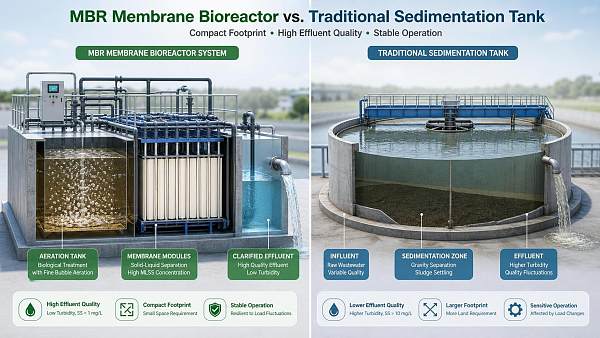
MBR filtration membranes replace or reduce reliance on gravity settling by physically separating biomass from treated water. This changes the design logic and creates advantages in situations where conventional separation becomes the limiting factor.
As a result, evaluators are less interested in whether MBR is technically feasible and more interested in whether it improves project outcomes enough to offset membrane and operating costs.
When Do MBR Filtration Membranes Clearly Outperform Conventional Systems?
The strongest case for MBR filtration membranes appears when effluent quality requirements are strict. If the project demands consistently low suspended solids, low turbidity, and reliable pathogen reduction, MBR often has a clear edge.
This is especially true where treated water will be reused for industrial processes, cooling, irrigation, utility service water, or further polishing stages. Stable downstream performance matters more than minimum upfront cost.
MBR systems also outperform conventional systems when land is constrained. Because they support higher mixed liquor suspended solids and eliminate large secondary clarifiers, they can reduce total treatment footprint significantly.
That footprint advantage is particularly valuable in urban retrofits, plant expansions within existing boundaries, and industrial facilities where available land has high strategic value or is physically unavailable.
Another strong use case is variable influent quality. Facilities with fluctuating hydraulic loading, shifting organic content, or intermittent process discharges often benefit from the biomass retention and process stability that MBR designs can support.
In these settings, conventional clarifier performance may degrade during shock loads, filament events, or solids bulking. MBR filtration membranes can maintain separation performance even when sludge settleability is poor.
Automation is another reason MBR may outperform. Technical teams seeking tighter process control, lower operator dependence, and easier integration with digital monitoring often find membrane-based systems better suited to modern control architecture.
Which Performance Benchmarks Matter Most in a Real Evaluation?
Effluent quality is usually the first benchmark. Evaluators should compare total suspended solids, turbidity, biochemical oxygen demand, ammonia control, total nitrogen strategy, and the consistency of those results across variable loading conditions.
Membrane systems typically provide near-complete solids separation and very low effluent turbidity. That advantage becomes economically important when downstream reuse, disinfection efficiency, or sensitive discharge environments are involved.
Footprint is the second benchmark. The key issue is not just tank volume, but total installed area including clarifiers, filters, hydraulic allowances, chemical systems, and future expansion requirements.
Energy consumption must also be judged carefully. MBR systems often consume more energy than conventional activated sludge because of membrane aeration and recirculation demands. However, this cannot be evaluated in isolation.
If a conventional system requires tertiary filtration, larger land use, more frequent solids upsets, or expensive retrofit works, the apparent energy advantage may narrow when the full treatment train is compared.
Sludge quality and sludge production should also be reviewed. Depending on operating strategy, MBR systems can support longer sludge ages and improved biological stability, though this does not automatically mean lower total sludge management cost.
Membrane fouling behavior is another critical benchmark. A serious evaluation should examine flux design, cleaning frequency, chemical recovery protocols, expected membrane life, and resilience under realistic feed conditions.
What Operating Conditions Usually Justify the Higher Cost of MBR?
MBR filtration membranes tend to justify their cost when the alternative is not a simple conventional plant, but a conventional plant plus added safeguards, tertiary filtration, land acquisition, and higher compliance risk.
If a project already needs tertiary treatment to meet reuse or discharge targets, the cost gap between conventional systems and MBR may shrink more than initial vendor comparisons suggest.
The economics also shift when non-treatment costs are high. Land value, civil works complexity, expansion constraints, and operational penalties from compliance failures can outweigh the membrane premium over the asset lifecycle.
For retrofit projects, MBR can be particularly attractive where upgrading clarifiers is difficult or where existing basins can be repurposed. In these cases, implementation speed and site continuity become material decision factors.
Facilities with limited operator availability may also see value in MBR, provided the design includes reliable controls and a realistic maintenance plan. Better process consistency can reduce the operational burden of troubleshooting unstable settling.
That said, MBR is not automatically the lower-cost solution. Where land is abundant, discharge standards are moderate, influent is stable, and conventional settling performs well, a traditional system may remain the better choice.
Where Do Conventional Systems Still Hold the Advantage?
Conventional activated sludge systems still make sense in many projects. If the treatment objective is straightforward compliance rather than reuse-grade quality, their lower capital cost can be compelling.
They also remain competitive where footprint is not constrained and operator teams are experienced with clarifier-based biology. In those settings, familiar maintenance routines and simpler equipment profiles can reduce implementation friction.
High-fouling influent can also complicate membrane economics. Wastewater with heavy oils, fibers, scaling potential, or poorly controlled industrial contaminants may demand aggressive pretreatment before MBR becomes reliable.
If pretreatment discipline is weak, membrane performance can deteriorate faster than projected. In that situation, conventional systems may offer greater tolerance for operational inconsistency, even if final effluent quality is lower.
Technical evaluators should therefore avoid treating MBR as a universal upgrade. The right comparison is always application-specific and should be grounded in influent characteristics, performance obligations, and total plant constraints.
How Should Technical Evaluators Build a Practical Decision Framework?
A strong evaluation starts with project requirements rather than technology preference. First define the real constraints: discharge limits, reuse goals, available footprint, future capacity needs, staffing model, and utility cost structure.
Next, compare process trains at the system level. Do not compare MBR only against basic activated sludge if the conventional option would actually require tertiary polishing, larger structures, or more intensive compliance management.
Then test operational assumptions. Review membrane flux margins, cleaning strategy, pretreatment requirements, blower energy, sludge handling, redundancy philosophy, and control system integration with plant maintenance capabilities.
Vendor benchmarking is also essential. Not all MBR filtration membranes perform equally under the same loading profile. Module design, air scour efficiency, material chemistry, and service support can materially affect lifecycle outcomes.
For organizations like GIM that benchmark industrial systems across sectors, this cross-functional view matters. Procurement, engineering, and operations should evaluate membrane performance against standards, not marketing claims alone.
Finally, consider resilience. A system that delivers stable compliance, easier expansion, and better reuse readiness may create more strategic value than one that appears cheaper on a narrow capital expenditure basis.
What Is the Bottom-Line Answer for Decision Makers?
MBR filtration membranes outperform conventional systems when separation reliability becomes the decisive factor. That usually means tight effluent targets, reuse applications, limited footprint, retrofit constraints, or unstable sludge settling conditions.
They also become attractive when full lifecycle costs are considered across land, tertiary treatment, compliance risk, and operational consistency. In those cases, the higher initial investment can be technically and economically justified.
Conventional systems still remain appropriate where land is available, effluent standards are moderate, influent is manageable, and lower capital cost is the main driver. The better option depends on the treatment objective, not on trend value.
For technical evaluators, the most reliable conclusion is this: MBR filtration membranes are strongest where performance certainty, compact design, and reuse-grade output matter more than lowest first cost. That is the point at which they genuinely outperform conventional systems.

The Archive Newsletter
Critical industrial intelligence delivered every Tuesday. Peer-reviewed summaries of the week's most impactful logistics and market shifts.