Monday, May 22, 2024

ISO Standards for Quality Management Systems Explained
by
Published
Views:
For quality control and safety management professionals, understanding ISO standards for quality management systems is essential to reducing risk, improving consistency, and meeting global compliance demands.
This guide explains how ISO standards for quality management systems apply across integrated industrial environments, where electronics, mobility, agriculture, infrastructure, and tooling increasingly overlap.
In cross-sector operations, one quality failure can trigger delivery delays, warranty claims, audit issues, and environmental exposure. A structured management system helps control those outcomes before they escalate.
For organizations operating within complex global manufacturing networks, ISO standards for quality management systems provide a common language for process discipline, traceability, and continual improvement.
When Multi-Industry Operations Need a Common Quality Framework
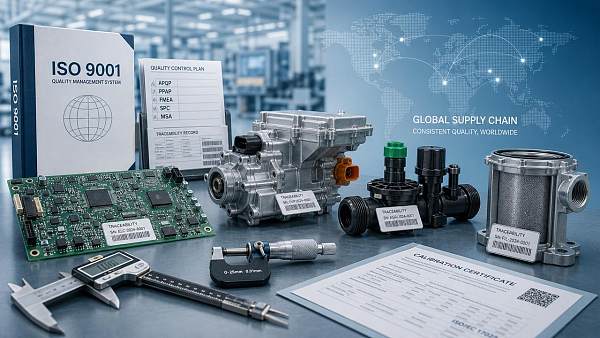
Not every operating environment faces the same quality risks. A semiconductor line, EV subsystem plant, irrigation equipment facility, and filtration module project all manage different failure modes.
Yet they share one challenge: quality must remain consistent across suppliers, processes, documentation, and regulatory expectations. That is where ISO standards for quality management systems become strategically important.
The most recognized framework is ISO 9001. It defines requirements for a quality management system, or QMS, focused on customer needs, risk-based thinking, process control, and measurable improvement.
In broad industrial ecosystems, ISO 9001 often works alongside sector-specific standards such as IATF 16949, IPC requirements, or environmental and safety frameworks. It forms the base layer of operational governance.
Which Operating Scenarios Benefit Most from ISO Standards for Quality Management Systems
Scenario 1: Complex Supplier Networks with Variable Process Maturity
Global supply chains rarely perform at the same quality level. Some facilities are highly automated, while others depend on manual inspection and fragmented records.
In this scenario, ISO standards for quality management systems support supplier alignment. They establish common expectations for document control, nonconformance handling, corrective action, and traceability.
The key judgment point is repeatability. If incoming quality varies by site, shift, or subcontractor, a formal QMS becomes necessary rather than optional.
Scenario 2: High-Reliability Products with Low Tolerance for Failure
Applications such as EV power systems, electronic substrates, smart controls, and precision tooling demand stable output under strict tolerances. Small deviations can create major field failures.
Here, ISO standards for quality management systems help connect design intent to manufacturing control. They support verification planning, process validation, calibration discipline, and root-cause analysis.
The key judgment point is consequence severity. When defects affect safety, uptime, or compliance, quality systems must be proactive, not reactive.
Scenario 3: Facilities Expanding Across Regions or Business Units
Growth often introduces inconsistency. New lines, acquired sites, and regional partners may use different work instructions, approval flows, and performance metrics.
ISO standards for quality management systems provide a scalable structure for harmonization. Procedures can be standardized while still allowing local control of technical details.
The key judgment point is system fragmentation. If each site defines quality differently, audit readiness and customer confidence will weaken quickly.
Scenario 4: Sustainability and Infrastructure Projects with Long Lifecycle Exposure
Water treatment modules, agricultural systems, and environmental infrastructure assets often operate for years under changing field conditions.
In these cases, ISO standards for quality management systems improve lifecycle consistency. They strengthen records, maintenance feedback loops, service quality, and control of outsourced activities.
The key judgment point is operational continuity. When long-term performance matters, quality must extend beyond factory release.
How Core ISO QMS Principles Change by Industry Scenario
The same standard can drive different priorities depending on context. ISO standards for quality management systems are flexible, but implementation choices should match operating risk.
This is why ISO standards for quality management systems should not be treated as paperwork alone. Their value depends on where variation, failure, and compliance pressure actually occur.
Practical Ways to Apply ISO Standards for Quality Management Systems
Implementation becomes more effective when actions are tied to operational realities. The following practices help translate standards into measurable control.
- Map critical processes from order intake through delivery and service feedback.
- Define quality risks by product family, process step, and supplier category.
- Create revision-controlled procedures for inspection, release, deviation, and change management.
- Use measurable indicators such as defect rate, yield loss, complaint recurrence, and on-time corrective closure.
- Link training records to competency requirements, not attendance alone.
- Review nonconformities for systemic causes, not isolated symptoms.
Within GIM-style cross-sector benchmarking environments, these practices are strengthened by comparing internal performance against recognized standards and adjacent industry expectations.
That benchmarking view is especially useful when one organization handles mixed portfolios, such as electronics assemblies, mobility hardware, agricultural equipment, and environmental modules.
Common Misjudgments When Interpreting ISO QMS Requirements
Many quality gaps come from poor assumptions rather than missing intent. Several mistakes appear repeatedly across industrial settings.
- Assuming certification equals strong execution. A certificate does not guarantee process discipline every day.
- Focusing on documentation volume instead of control quality. Excess paperwork can hide weak risk ownership.
- Treating supplier quality as separate from the QMS. External variation often drives internal instability.
- Using generic procedures across very different operations without adjusting for failure severity.
- Closing corrective actions before effectiveness is verified with objective evidence.
These misjudgments reduce the real value of ISO standards for quality management systems. The standard is most effective when linked to actual technical and operational risk.
How to Decide the Next Step for Your Quality Management System
A practical starting point is a scenario-based gap review. Identify where quality loss, compliance exposure, or process inconsistency creates the highest operational cost.
Then compare existing controls against ISO standards for quality management systems, especially in process ownership, records, supplier oversight, internal audits, and corrective action closure.
For integrated industrial environments, quality should also be reviewed across adjacent domains. Mechanical reliability, digital traceability, and environmental performance increasingly influence one another.
A stronger QMS does more than prepare for audits. It supports resilient operations, clearer decision-making, and more dependable performance across global manufacturing networks.
If the goal is to improve cross-sector consistency, reduce preventable failures, and align with international expectations, ISO standards for quality management systems offer a proven structure for disciplined growth.
The Archive Newsletter
Critical industrial intelligence delivered every Tuesday. Peer-reviewed summaries of the week's most impactful logistics and market shifts.