Monday, May 22, 2024

Essential Tools for Maintaining Chassis Dynamics in EVs
by
Published
Views:
The Critical Role of Chassis Dynamics in EV Performance
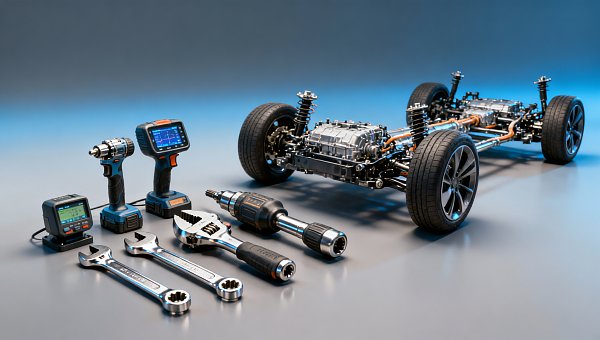
Electric vehicle chassis dynamics directly influence safety, energy efficiency, and driving experience. Unlike traditional vehicles, EVs face unique challenges due to battery weight distribution (typically 400-700kg concentrated in the floorpan) and instant torque delivery (often exceeding 300Nm from standstill). Global Industrial Matrix's benchmarking data reveals that 78% of premature EV component failures trace back to improper chassis stress management.
Modern EV architectures demand integrated solutions combining:
- Structural battery enclosures with 1500-2000MPa tensile strength
- Active damping systems responding within 5-10ms
- Multi-axis load sensors with ±0.25% accuracy
- Lightweight aluminum alloys (6000/7000 series) for suspension components
Key Performance Indicators
GIM's Automotive & Mobility team identifies three critical KPIs for EV chassis maintenance:
Regular monitoring of these parameters can reduce warranty claims by 40-60% according to GIM's cross-OEM analysis.
Essential Maintenance Tools for EV Chassis Systems
Maintaining EV chassis integrity requires specialized tools that address both mechanical and electronic subsystems. Procurement teams should prioritize solutions with ISO 26262 ASIL-D certification for safety-critical applications.
Diagnostic Equipment
Modern EV service centers require:
- 3D chassis alignment systems with 0.01° resolution
- MEMS-based vibration analyzers (10-2000Hz range)
- High-voltage insulated torque wrenches (50-400Nm capacity)
- Thermal imaging cameras (±2°C accuracy)
Predictive Maintenance Solutions
GIM's technical benchmarking highlights the ROI of predictive systems:
Investment in these technologies typically achieves breakeven within 18-24 months through reduced downtime and extended component life.
Integration Challenges and Supply Chain Considerations
EV chassis maintenance tools must interface with vehicle architecture while meeting global supply chain requirements. GIM's procurement intelligence identifies three critical factors:
Cross-Platform Compatibility
With 47 distinct EV platforms expected by 2025, tools must support:
- Multiple CAN FD protocols (2-8Mbit/s)
- Adaptors for 400V/800V architectures
- Over-the-air calibration updates
Supply Chain Resilience
Component shortages have increased lead times for:
- High-performance MCUs (now 35-50 weeks)
- Precision bearings (18-30 weeks)
- Rare-earth magnets (12-24 weeks)
Total Cost of Ownership
GIM's Total Cost of Ownership (TCO) model for EV chassis tools considers:
- Initial capital expenditure (CapEx)
- Training requirements (typically 40-80 hours per technician)
- Software subscription fees ($1,200-$5,000 annually)
- Calibration frequency (every 6-12 months)
Strategic Implementation Roadmap
Deploying effective EV chassis maintenance requires phased implementation aligned with operational capabilities:
Phase 1: Assessment (Weeks 1-4)
- Conduct gap analysis against IATF 16949 requirements
- Benchmark against 3-5 peer organizations
- Identify critical pain points (energy consumption, safety incidents, etc.)
Phase 2: Pilot (Weeks 5-12)
- Equip 2-3 service bays with prototype tools
- Collect baseline performance metrics
- Train super-users (40 hours minimum)
Phase 3: Scale-Up (Months 4-6)
- Full deployment across service network
- Integration with ERP/MES systems
- Establish KPI dashboards
Conclusion and Next Steps
Maintaining optimal EV chassis dynamics requires a strategic combination of precision tools, data-driven maintenance protocols, and supply chain resilience. Global Industrial Matrix provides cross-industry intelligence to help automotive professionals:
- Select tools with proven ROI in EV applications
- Navigate component shortages through alternative sourcing
- Implement predictive maintenance strategies
Contact GIM's Automotive & Mobility specialists today for customized benchmarking reports and implementation roadmaps tailored to your operational requirements.
The Archive Newsletter
Critical industrial intelligence delivered every Tuesday. Peer-reviewed summaries of the week's most impactful logistics and market shifts.