Monday, May 22, 2024

Automotive Supply Chain Risks and Resilience Strategies in 2026
by
Published
Views:
Why Automotive Supply Chain Risk Looks Different in 2026
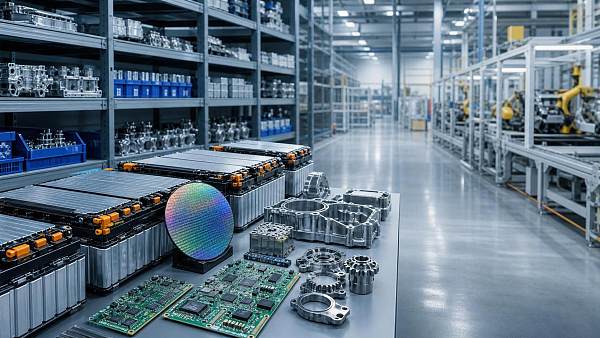
In 2026, Automotive supply chain pressure is no longer limited to delayed parts or higher freight bills.
The real issue is that disruption now travels across engineering, compliance, tooling, energy, and data systems at the same time.
A battery pack delay can start with minerals, move through cell processing, and end in software validation bottlenecks.
A semiconductor shortage may look like a chip problem, yet the impact often appears in PCB capacity, packaging, and test lead time.
That is why Automotive supply chain decisions now depend on cross-sector visibility rather than isolated supplier scorecards.
This is also where Global Industrial Matrix aligns well with current conditions.
Its benchmarking logic connects automotive hardware, electronics, industrial standards, and environmental infrastructure into one operational view.
In practice, that kind of connected intelligence matters because not every disruption behaves the same way.
A sourcing decision for EV inverters requires different judgment than a decision around stamped structures or filtration modules.
When the Risk Sits Inside Electrification Programs
Electrification remains the most visible stress point in the Automotive supply chain.
The pressure does not come from one component family alone.
It comes from how cells, thermal materials, power semiconductors, busbars, enclosures, and validation cycles depend on one another.
In high-voltage systems, a late material substitution can trigger recertification, tooling revision, and thermal redesign.
That creates a slower recovery path than conventional part shortages.
The more useful judgment is to ask where single-point dependency sits inside the architecture.
Sometimes the fragile node is not the battery cell supplier.
It is the converter substrate, bonding process, or a test fixture with limited regional support.
A resilient Automotive supply chain for EV platforms usually needs approved alternates at the material and process level.
It also needs design teams to define what can change without resetting every qualification gate.
What tends to be overlooked
- Regional cell supply looks stable, but precursor chemicals remain concentrated.
- Dual sourcing exists on paper, yet alternate suppliers use different process tolerances.
- Lead time models track parts, but miss certification and PPAP reset time.
Software-Defined Vehicles Change the Risk Map
Another common scenario appears in platforms with heavy electronic content.
Here, Automotive supply chain resilience depends on the link between silicon availability and integration readiness.
A controller may be physically available, but still unusable because firmware, memory, sensors, or communication modules lag behind.
This is where many organizations still misread exposure.
They measure component coverage by unit count rather than by system release dependency.
The result is a distorted view of resilience.
In practical terms, a vehicle program with abundant microcontrollers can still miss launch dates if PCB laminates, HDI fabrication, or test houses become constrained.
Cross-domain benchmarking helps here because it compares not just parts, but production ecosystems and quality baselines like ISO, IATF, and IPC.
For the Automotive supply chain, that broader lens often reveals hidden bottlenecks earlier than procurement data alone.
Different Production Footprints Need Different Resilience Logic
Not every supply strategy should chase the same target.
A high-volume assembly network has different tolerance for volatility than a low-volume premium program or a regional commercial vehicle line.
That difference changes how Automotive supply chain risk should be measured.
In high-volume programs, line stoppage probability often matters more than unit cost variance.
In specialty programs, engineering change flexibility may matter more than local inventory depth.
A useful comparison looks like this.
The table matters because resilience is not one universal checklist.
It needs to reflect production rhythm, validation burden, and substitution difficulty.
ESG, Water, and Energy Now Affect Supply Continuity
A more subtle Automotive supply chain risk appears outside the vehicle bill of materials.
Suppliers increasingly face exposure from water stress, emissions controls, and energy instability.
This is especially relevant for paint, metal finishing, battery processing, molded polymers, and semiconductor-related production.
In one region, the constraint may be wastewater treatment compliance.
In another, it may be power curtailment or carbon reporting requirements tied to customer contracts.
These issues are often treated as sustainability matters first.
In reality, they are also continuity risks.
GIM’s broader industrial perspective is useful here because filtration modules, infrastructure constraints, and manufacturing compliance are connected variables.
An Automotive supply chain that ignores utility and ESG readiness may appear lean, but remain operationally fragile.
A better way to assess supplier resilience
- Check environmental permits and treatment capacity beside output capacity.
- Review energy source reliability, not just price contracts.
- Map which compliance gaps can stop exports or customer approvals.
Where Teams Often Misjudge Automotive Supply Chain Exposure
One frequent mistake is treating similar parts as interchangeable without checking process context.
Two suppliers may offer the same specification sheet, but different tooling maturity, inspection capability, or traceability depth.
Another mistake is focusing on direct spend while underestimating restart cost after a quality failure.
This is common in precision tooling, castings, connectors, and safety-relevant electronics.
There is also a timing error that appears often in the Automotive supply chain.
Risk reviews are performed at sourcing award, then not updated when regulations, freight lanes, or engineering revisions change.
In actual operations, resilience should be re-evaluated whenever process changes alter qualification, logistics, or infrastructure assumptions.
How to Build a More Adaptable Response Without Overbuilding Cost
The strongest Automotive supply chain strategies in 2026 are selective, not excessive.
They do not place inventory everywhere or duplicate every supplier.
They identify which nodes would create long recovery time and protect those first.
That usually means combining technical benchmarking with supply mapping and scenario testing.
- Separate commodity delays from qualification-sensitive disruptions.
- Rank components by replacement difficulty, not only by spend.
- Track sub-tier dependencies in electronics, materials, and tooling.
- Build alternate paths that meet the same quality and standards framework.
- Update risk models when design, region, or compliance conditions change.
This approach fits a broad industrial environment because automotive risk now overlaps with electronics, infrastructure, and environmental operations.
That overlap is exactly why a system-level benchmark is more practical than a siloed dashboard.
What to Clarify Before the Next Supply Decision
The next step is not simply to ask whether the Automotive supply chain is risky.
The better question is where recovery time, compliance burden, or technical substitution risk is highest.
Start by separating stable components from architecture-sensitive ones.
Then compare sourcing options against standards readiness, infrastructure dependence, and process compatibility.
Where uncertainty remains, benchmark across adjacent sectors rather than relying on category history alone.
That is often where hidden Automotive supply chain exposure becomes visible early enough to act.
In 2026, resilience is less about reacting faster to every disruption.
It is more about understanding which scenario is unfolding, what conditions shape it, and which response truly fits.
The Archive Newsletter
Critical industrial intelligence delivered every Tuesday. Peer-reviewed summaries of the week's most impactful logistics and market shifts.