Monday, May 22, 2024

Battery-Grade Lithium Carbonate Rebounds to CNY 200,000/ton
by
Published
Views:
On May 13, 2026, battery-grade lithium carbonate spot prices rose to CNY 201,400 per ton — the highest level this year — triggering upstream cost adjustments across powertrain systems supply chains and influencing export pricing for key electrified vehicle components targeting overseas markets.
Event Overview
According to Shanghai Metal Exchange (Shanghai Steel Union) data released on May 13, 2026, the average spot price of battery-grade lithium carbonate reached CNY 201,400 per ton. As a result, export quotations for core powertrain system components — including battery modules, BMS controllers, and integrated e-drive packages — increased by 3–5% across Chinese suppliers. Some overseas automakers have initiated second-supplier benchmarking processes in response.
Impact on Specific Industry Segments
Direct Export Trading Enterprises: These firms face compressed margins as higher raw material costs reduce competitiveness in fixed-price contracts. Pricing revisions are now being implemented mid-cycle, requiring renegotiation support and updated commercial terms with overseas buyers.
Raw Material Procurement Teams: Procurement functions at OEMs and Tier 1 suppliers must reassess lithium carbonate exposure in existing supply agreements. Spot price volatility now directly affects landed cost calculations for imported cathode materials and pre-assembled modules.
Powertrain System Manufacturers (Battery Module / BMS / E-Drive Integrators): Cost pass-through is underway but constrained by contract duration and customer negotiation leverage. Production planning cycles may be adjusted to align with near-term material cost visibility, especially for programs with Q3 2026 delivery commitments.
Supply Chain Service Providers (Logistics, Customs Brokers, Trade Finance): Increased quotation frequency and documentation updates — particularly for origin declarations and cost breakdowns — are emerging as operational requirements. Clients are requesting more granular cost-allocation reports tied to lithium price indices.
What Relevant Enterprises or Practitioners Should Focus On Now
Monitor LMFP adoption timelines and SiC module cost trends
Analysis shows that lithium manganese iron phosphate (LMFP) cathode chemistry and domestic silicon carbide (SiC) power module cost reductions are cited as primary mitigation levers. Stakeholders should track pilot deployment milestones and volume ramp signals — not just R&D announcements — to assess substitution feasibility.
Review current export contracts for price adjustment clauses
Observably, many 2025–2026 export agreements lack automatic indexation mechanisms tied to lithium carbonate benchmarks. Legal and commercial teams should prioritize clause audits before Q3 2026, when new order cycles begin.
Prepare for intensified supplier diversification activity
From an industry perspective, the initiation of second-supplier benchmarking by overseas OEMs indicates growing procurement sensitivity to input cost volatility. Suppliers should ready technical documentation, audit readiness packages, and localized compliance summaries for rapid response.
Track official price indices — not just spot quotes
Current more relevant than spot price alone is the divergence between Shanghai Steel Union’s daily spot average and longer-term contract-weighted indices (e.g., those published by Asian Metal or SMM). This gap signals whether the rebound reflects structural tightening or short-term liquidity-driven spikes.
Editorial Perspective / Industry Observation
This price rebound is better understood as an early signal of renewed upstream pressure — not yet a sustained trend. Analysis shows it coincides with reduced off-take from Chinese LFP battery producers following seasonal inventory normalization, rather than broad-based demand acceleration. From an industry angle, its significance lies less in absolute price level and more in how quickly downstream players activate contingency pathways: LMFP integration, SiC adoption, and multi-source procurement strategies. Continued monitoring over the next 4–6 weeks will clarify whether this marks the start of a broader cycle correction or a transient inflection point.
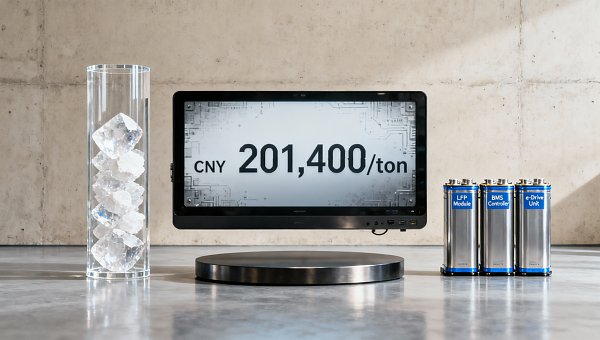
Conclusion: The rebound to CNY 200,000/ton reflects tightening near-term lithium carbonate availability and highlights transmission risks across powertrain export value chains. It does not yet indicate a structural shift in global lithium supply-demand balance, but serves as a timely reminder that cost volatility remains embedded in electrified drivetrain sourcing — especially for export-oriented operations. Current conditions are better interpreted as a calibration event for procurement, contracting, and technology roadmap alignment — not a trigger for strategic pivots.
Source Disclosure:
Primary source: Shanghai Steel Union (Shanghai Metal Exchange), May 13, 2026 daily spot price report.
Note: LMFP adoption progress and domestic SiC module cost trajectory remain under active observation and are not confirmed beyond the referenced advisory context.
The Archive Newsletter
Critical industrial intelligence delivered every Tuesday. Peer-reviewed summaries of the week's most impactful logistics and market shifts.