Monday, May 22, 2024

Precision Gear OEM Red Flags That Show Up After Sampling
by
Published
Views:
A precision gear OEM can look capable during sampling yet reveal costly weaknesses once production scales. For quality control and safety teams, the real warning signs often emerge in process stability, traceability, material consistency, and corrective action speed. This article outlines the red flags that appear after approval, helping industrial buyers reduce supplier risk and protect long-term reliability.
Why post-sampling risk matters in different production scenarios
A strong sample run does not always predict a strong production system. In many industrial buying programs, the sample phase is tightly supervised, often built with senior operators, cherry-picked materials, extra inspection time, and short machine runs. That controlled environment can make a precision gear OEM appear stable even when the wider factory system is not. Once order volume rises, shifts expand, tooling wears, subcontractors are added, and urgent changes begin, hidden weaknesses become visible.
This matters because quality and safety priorities differ by application. A gearbox supplier for a packaging line may face downtime losses if gear noise rises. A supplier for mobility components may trigger warranty claims if tooth geometry drifts. A supplier for agricultural equipment may create field failure risk when lubrication assumptions do not match dust-heavy operating conditions. The same precision gear OEM can therefore be acceptable in one scenario and high-risk in another.
For procurement, QC, and safety teams, the practical question is not only “Did the sample pass?” but “What changed after sampling, and which red flags matter most in our usage scenario?” That is where supplier surveillance becomes more useful than sample approval alone.
Where the red flags usually appear after approval
In cross-sector manufacturing, post-sampling problems tend to cluster in a few repeatable areas. A precision gear OEM may still meet drawing dimensions while failing in deeper system controls. These failures often surface in audits, incoming inspection trends, field returns, noise testing, fatigue performance, or corrective action delays.
- Process capability falls once batch sizes increase.
- Heat treatment results vary by lot, creating hardness or distortion shifts.
- Material certificates exist, but traceability to actual parts is weak.
- Tooling maintenance is reactive rather than scheduled.
- Nonconformance containment is slow across multiple shipments.
- Sub-tier outsourcing grows without transparent change notification.
- Inspection records look complete but are not statistically useful.
For a quality team, these are not isolated paperwork issues. They are operating signals that the precision gear OEM may struggle under real production pressure.
Scenario comparison: the same supplier can carry different levels of risk
The table below shows why supplier judgment should match the end-use scenario rather than rely on a single universal scorecard.
A precision gear OEM that performs well for low-duty indoor equipment may be unsuitable for safety-critical mobility or dirty outdoor service. The risk judgment must reflect the actual operating envelope.
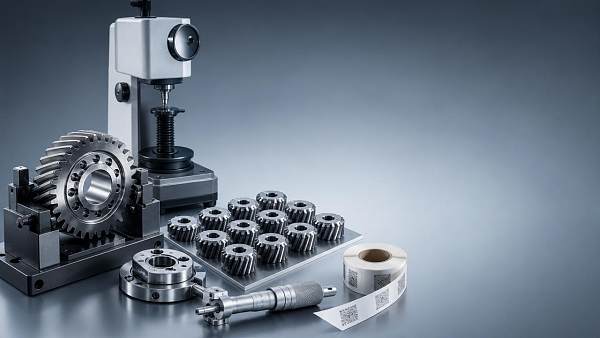
Scenario 1: Automotive and mobility programs demand disciplined change control
In vehicle-related programs, one of the biggest post-sampling red flags is silent process drift. A precision gear OEM may submit strong first articles, then adjust cutting parameters, raw material sources, or furnace loading patterns to protect margin or capacity. If these changes are not formally communicated, downstream quality risks grow quickly.
For this scenario, teams should watch for unstable Cp/Cpk on tooth profile, runout, lead, and pitch, especially across different shifts. Another warning sign is when the supplier can explain defects verbally but cannot show robust root-cause evidence, validated corrective action, or layered process audit records. In mobility applications, delayed response is itself a risk signal because it suggests weak internal escalation.
A capable precision gear OEM for this environment should demonstrate controlled change approval, disciplined gauge calibration, clear traceability from melt to shipment, and fast containment when anomalies appear. If the supplier treats these as customer paperwork instead of production discipline, caution is warranted.
Scenario 2: Automation equipment buyers should focus on consistency, not just dimension pass rates
In robotics, servo systems, and precision automation, the problem often is not catastrophic failure but degraded system performance. A precision gear OEM may deliver parts that pass dimensional inspection while still creating backlash variation, acoustic issues, or unpredictable efficiency losses in assembled units.
This is where many buyers make a post-sampling misjudgment. They rely too heavily on static dimensional reports and not enough on process-linked indicators such as grinding wheel condition, deburring consistency, particle cleanliness, or fixture repeatability. For high-precision assemblies, tiny changes in surface integrity can affect motion quality over time.
If the precision gear OEM reports excellent final inspection results but lacks in-process controls, that is a red flag. Mature suppliers prevent variation upstream instead of sorting it downstream. Quality teams should ask how the supplier manages machine drift, contamination control, and setup verification between batches.
Scenario 3: Agricultural and off-highway use exposes durability gaps fast
Agricultural machinery places gears in shock-loaded, dirty, and weather-exposed conditions. Here, a precision gear OEM may pass samples tested in clean indoor conditions yet fail once field loads, misalignment, and maintenance variability enter the picture. The red flags often show up after launch as tooth wear patterns, pitting, coating breakdown, or lubrication-related distress.
For this scenario, QC and safety teams should verify whether the supplier’s validation mirrors field reality. Did the OEM test only nominal torque, or did it include peak shock loading? Was corrosion exposure considered? Are material substitutions truly equivalent under outdoor duty cycles? When a supplier answers with generic statements rather than application-specific evidence, the risk increases.
A dependable precision gear OEM for off-highway use usually shows stronger awareness of contamination, lubrication tolerance, and practical assembly fit, not just print compliance.
Scenario 4: Infrastructure and process equipment require long-cycle reliability data
In pumps, mixers, wastewater modules, and environmental infrastructure, failures may emerge slowly but expensively. A precision gear OEM can appear acceptable in a short sample review yet fall short in corrosion resistance, lubricant compatibility, or sustained wear behavior over extended duty. This is especially relevant where maintenance access is difficult or downtime affects regulated operations.
The post-sampling red flag here is thin endurance evidence. If the supplier has strong dimensional data but weak lifecycle documentation, quality teams should probe further. Another concern is inconsistent sub-tier control over coatings, heat treatment, and machining consumables. Long-cycle assets depend heavily on repeatability across months, not just one approved lot.
How to spot whether the problem is capacity, culture, or control
Not every supplier issue has the same source. A precision gear OEM may struggle because demand outgrew its process discipline, because quality culture is weak, or because sub-tier management is opaque. Distinguishing the source helps buyers decide whether to develop the supplier or reduce exposure.
Common misjudgments quality teams make after a good sample phase
One common mistake is assuming that a precision gear OEM with modern machines automatically has mature process control. Equipment quality helps, but management discipline matters more. Another mistake is overvaluing certificates while undervaluing live evidence such as layered audits, scrap trends, rework rates, or operator turnover.
Buyers also underestimate the risk of undocumented subcontracting. A supplier may retain the same company name and contact team while moving heat treatment, finishing, or inspection to outside partners under capacity pressure. If those changes are invisible to the customer, approved samples become a weak reference point.
Finally, some teams treat on-time delivery as proof of supplier health. In reality, a precision gear OEM can protect delivery by shipping borderline lots, compressing inspection, or increasing sorting activity. Delivery performance should always be read together with complaint trends and process stability data.
What a stronger scenario-based supplier review should include
A practical review model should match the risk level of the end use. For lower-risk industrial applications, periodic lot verification and process change notification may be enough. For safety-relevant or high-cost downtime scenarios, the review should go deeper.
- Check post-approval consistency across at least three production lots.
- Review traceability from raw steel and heat treatment to final packing.
- Compare sample-phase operators and tooling with mass-production reality.
- Audit response speed for containment, root cause, and verification.
- Link supplier controls to the true application environment, not only the drawing.
For organizations working across automotive, electronics, smart agriculture, infrastructure, and precision tooling, this scenario-based view is essential. It reflects the same cross-sector benchmarking logic used by advanced industrial intelligence platforms: parts should be judged within systems, not in isolation.
FAQ: practical questions before expanding orders with a precision gear OEM
How many good sample lots are enough?
Usually not just one. For a precision gear OEM, multiple production lots under normal scheduling conditions provide a better picture than a dedicated pilot run.
Which red flag should trigger immediate escalation?
Any unapproved process change involving material source, heat treatment, tooling route, subcontractor, or inspection method should be escalated immediately, especially in safety-sensitive applications.
Can a supplier with slow corrective action still be acceptable?
Only in low-risk situations, and even then with caution. Slow containment and weak root-cause discipline usually indicate broader system weakness inside the precision gear OEM.
Final takeaways for QC and safety decision-makers
The real test of a precision gear OEM begins after sampling, when the supplier must prove repeatability under normal production pressure. The most useful judgment framework is scenario-based: identify the actual duty cycle, define which failure modes matter most, and then verify whether the supplier’s controls match that environment. For quality and safety teams, this approach reduces the chance of approving a supplier that looks impressive in a pilot run but unstable in ongoing production.
Before increasing order volume, confirm not only dimensional capability but also traceability depth, process change discipline, lot-to-lot consistency, and corrective action speed. That is how industrial buyers turn sample approval into long-term reliability rather than delayed supplier risk.
The Archive Newsletter
Critical industrial intelligence delivered every Tuesday. Peer-reviewed summaries of the week's most impactful logistics and market shifts.