Monday, May 22, 2024

When to redesign powertrain systems instead of retrofitting
by
Published
Views:
Knowing when to redesign powertrain systems instead of retrofitting can determine long-term cost, performance, and compliance. As future mobility, emissions reduction, automotive safety, and driver assistance demands accelerate, manufacturers must assess whether legacy architectures can still support active components, PCB fabrication, and integration needs tied to electric motor manufacturer standards, smart grid technology, and wider industry applications.
For engineers, procurement teams, plant operators, project leaders, and investment approvers, this decision is rarely only technical. It affects capital allocation, service life, validation timelines, supplier risk, and downstream operating cost over the next 5–10 years. In cross-sector manufacturing environments, the wrong choice can lock a program into repeated patchwork fixes, while the right choice can create a scalable platform for electrification, software updates, thermal control, and compliance.
A retrofit can be attractive when a platform still has structural headroom and only needs targeted upgrades. A redesign becomes more rational when system limits are already visible in torque delivery, packaging, cooling, electromagnetic compatibility, PCB integration, or functional safety architecture. The most effective decision framework combines lifecycle cost, standards alignment, component availability, and implementation risk rather than relying on initial budget alone.
How to tell whether a legacy powertrain has reached its practical limit
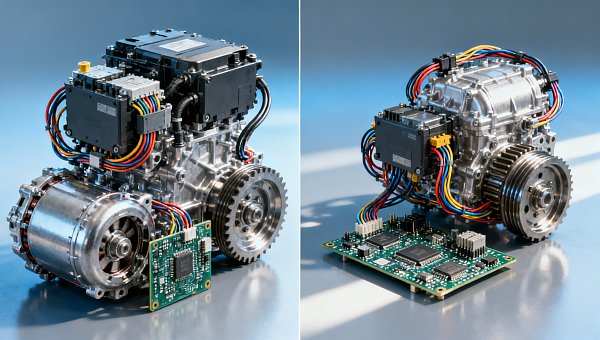
Many organizations continue retrofitting because the installed base is familiar, spare parts are known, and change control seems simpler. However, legacy powertrain systems often reveal hard limits long before a complete failure occurs. Common warning signs include repeated thermal derating above 80% load, insufficient bus voltage for new electric drive demands, lack of packaging space for power electronics, and control architecture that cannot support additional sensors, active safety logic, or advanced diagnostics.
In practical terms, if a platform requires 3 or more major subsystem changes at the same time—such as inverter replacement, cooling loop enlargement, wiring harness revision, and controller redesign—the retrofit case becomes weaker. Engineering teams should also review whether the existing gearbox, mounting interfaces, and battery or fuel system can support target duty cycles for another 7–10 years without disproportionate maintenance or redesign rework.
For cross-industry applications such as EVs, off-highway equipment, autonomous tractors, municipal utility vehicles, and industrial mobility platforms, system coupling matters. A motor upgrade may force changes in shaft alignment, vibration isolation, enclosure ingress protection, and PCB layout for control boards. When one upgrade pushes changes into 4 or 5 adjacent modules, the architecture may already be signaling that a clean-sheet redesign is more efficient than incremental adaptation.
Typical technical thresholds that point toward redesign
The table below summarizes common field indicators used by technical evaluation teams when deciding whether continued retrofitting still makes economic and engineering sense.
The key takeaway is that redesign decisions are usually triggered not by a single failure point, but by the interaction of performance deficit, compliance burden, and subsystem dependency. Once these stack together, retrofit savings can disappear within 12–24 months of operation.
A practical screening checklist
- Confirm whether the existing architecture can support planned power density, typically measured across a 15%–25% growth scenario.
- Check if thermal management can absorb peak-duty events without recurring derating or shortening component life.
- Review PCB fabrication limits, connector count, and shielding needs for additional control functions and sensing layers.
- Assess whether supplier lead times for legacy parts exceed 20–26 weeks, which often signals growing obsolescence risk.
Why retrofitting can become more expensive than a redesign
Retrofitting appears less expensive because it reduces first-phase capital spend. Yet total cost often rises when integration hours, repeated validation, warranty exposure, and uneven field performance are included. In industrial programs, an engineering change that seems modest on paper can trigger new tooling, revised harness routing, software recertification, and additional test cycles across 2 or 3 supplier tiers.
A redesign usually requires higher upfront planning, but it can lower long-run cost by consolidating interfaces, standardizing components, and reducing service variation. This is especially relevant where powertrains must interface with driver assistance electronics, battery management systems, sensor arrays, or smart-grid-compatible charging infrastructure. A clean redesign can remove adapters, reduce conversion losses, and simplify maintenance procedures at the fleet or plant level.
Financial approvers should also consider hidden retrofit costs. These include 6–12 months of staggered engineering support, excess inventory for mixed platform generations, technician retraining, and downtime during field installation. For procurement teams, retrofit-heavy strategies can expand the approved vendor list instead of simplifying it, which increases audit burden and complicates quality traceability.
Lifecycle cost comparison
The following comparison helps decision-makers evaluate cost beyond the initial purchase order value.
For many programs, the inflection point appears when retrofit work creates more than 15%–20% recurring overhead in validation, service, or inventory. At that stage, redesign is not simply a technical preference; it becomes a cost-control strategy with clearer long-term value.
Common cost traps teams overlook
- Underestimating software and controls requalification after hardware changes.
- Assuming mechanical fit means thermal, EMC, and reliability fit.
- Ignoring procurement exposure when old and new components must be sourced in parallel for 18–36 months.
- Delaying redesign until a customer bid requires features the old architecture can no longer support.
Compliance, reliability, and integration signals that justify redesign
Across automotive, off-highway, electronics-integrated machinery, and infrastructure-linked mobility systems, compliance requirements are becoming more interconnected. A powertrain no longer stands alone; it must operate within electrical safety, functional safety, EMC, thermal durability, cybersecurity-adjacent control logic, and product traceability expectations. If a legacy platform was not designed for this level of integration, retrofitting can become a chain of exceptions rather than a robust upgrade path.
Reliability is another decisive factor. If field data shows repeated bearing stress, inverter heat soak, insulation degradation, or connector failures under vibration, adding new modules to the same architecture may amplify risk. A redesign offers the opportunity to rebalance load paths, improve sealing, revise PCB stack-up, and align cable routing and shielding with current duty requirements. These changes are difficult to optimize when engineers are constrained by outdated housings or fixed mechanical interfaces.
This matters for quality managers and safety officers because each workaround increases process variability. A retrofit-heavy program may require more inspection points, more operator instructions, and tighter assembly checks to maintain the same output quality. In high-mix manufacturing, that can lengthen cycle time by 5%–12% and increase nonconformance risk during ramp-up.
Key standards and validation areas to review
A redesign discussion should include not only performance targets but also the validation domains that will influence acceptance, production readiness, and supplier qualification.
- Mechanical durability: verify shock, vibration, sealing, and alignment across the intended duty cycle, often over 1,000+ operating hours in industrial use cases.
- Electrical integrity: review insulation, bus voltage compatibility, grounding strategy, and electromagnetic performance for mixed electronic environments.
- Quality and process standards: align with applicable ISO, IATF, and IPC expectations where electronics, vehicle systems, and manufactured assemblies intersect.
- Serviceability: confirm mean time to repair, diagnostic access, and field replacement steps can be completed without excessive disassembly.
If compliance gaps affect more than 2 of these 4 areas, redesign usually provides a cleaner route to approval and lower operational risk. This is particularly true for export-oriented manufacturing programs that serve multiple regions with different certification, documentation, and aftermarket expectations.
Integration issues that often trigger a redesign decision
Examples include migrating from low-voltage auxiliary controls to a more digitized architecture, integrating active braking support, adding telematics and remote diagnostics, or increasing power density without expanding the vehicle envelope. In each case, the powertrain must work as part of a wider system. Once integration pressure extends beyond 2 interface layers—mechanical, electrical, and software—a redesign often reduces future friction even if the first project phase takes longer.
A practical decision framework for engineering, procurement, and leadership teams
The most reliable decisions are made through a cross-functional gate review rather than a purely engineering judgment. Procurement may see sourcing risk earlier than design teams. Operators may detect maintainability problems before managers do. Finance may identify that retrofit savings disappear once warranty reserves and field-service labor are fully costed. A useful framework should score technical feasibility, compliance burden, total cost, and business continuity on the same page.
In practice, many organizations use a 4-category assessment: capability gap, integration complexity, lifecycle economics, and supply-chain resilience. Each category can be scored from 1 to 5. If the combined score exceeds 14 out of 20, a redesign should move from “optional” to “actively recommended.” This approach is simple enough for project governance yet detailed enough to support investment decisions.
GIM-style benchmarking is especially valuable here because powertrain choices increasingly depend on cross-sector interactions. A decision that looks acceptable in mechanical terms may fail when semiconductor lead times, PCB manufacturing limits, ESG reporting, or charger interoperability are included. Comparing candidate architectures against current international standards and typical delivery windows helps teams avoid narrow decisions that create new bottlenecks elsewhere in the program.
Recommended evaluation matrix
The matrix below can be adapted for bid reviews, capital approvals, supplier discussions, or stage-gate project meetings.
This matrix helps turn a subjective discussion into a documented decision path. It also improves supplier communication by clarifying whether the project needs a tactical upgrade or a platform-level architecture change.
Suggested implementation steps
- Run a 2–4 week feasibility review covering mechanics, electronics, controls, and sourcing.
- Map all dependent interfaces, including thermal loops, harnesses, PCB assemblies, and software layers.
- Estimate 5-year total cost with at least 3 scenarios: minimal retrofit, deep retrofit, and redesign.
- Validate against standards and customer requirements before committing tooling or long-lead components.
- Use pilot builds to confirm assembly impact, service access, and field maintainability.
Frequently asked questions before committing to retrofit or redesign
How long does a redesign usually take compared with a retrofit?
A targeted retrofit may take 8–16 weeks for a limited module update, while a full redesign often requires 6–12 months depending on validation scope, tooling changes, and supplier readiness. However, if the retrofit triggers repeated engineering revisions, the schedule gap can narrow quickly. What matters is not only launch date, but also how many post-launch corrections are likely in the first 12 months.
Which organizations benefit most from redesigning earlier?
Manufacturers with multi-region compliance exposure, growing electrification targets, advanced control requirements, or unstable legacy sourcing benefit most from earlier redesign. The same applies to businesses scaling from pilot production to volume manufacturing, where assembly consistency and service standardization become critical to margin protection.
What procurement signals suggest retrofit risk is too high?
Key warning signs include single-source legacy parts, lead times above 20–26 weeks, low visibility into component lifecycle status, and increased reliance on custom adapters or low-volume special orders. If procurement must manage 2 generations of components for the same product family, inventory and quality-control complexity usually rise materially.
Can a hybrid approach work?
Yes. A phased strategy can stabilize operations while preparing a redesign. For example, teams may retrofit safety-critical items for the next 12–18 months, then launch a redesigned platform with updated controls, cooling, and electrical architecture. This approach works best when the interim changes do not consume resources needed for the final platform transition.
Choosing between retrofitting and redesigning powertrain systems is ultimately a strategic manufacturing decision, not just an engineering preference. When legacy constraints affect performance, compliance, integration, and sourcing at the same time, redesign often delivers stronger lifecycle economics and lower operational risk. For organizations navigating automotive, electronics, smart agri-tech, and infrastructure-linked mobility programs, a benchmark-led evaluation can prevent expensive short-term fixes from becoming long-term liabilities.
If your team needs a clearer basis for architecture selection, supplier benchmarking, or total-cost comparison, now is the right time to review the platform against current standards and future operating demands. Contact us to discuss your application, request a tailored assessment framework, or explore more cross-sector powertrain benchmarking solutions.

The Archive Newsletter
Critical industrial intelligence delivered every Tuesday. Peer-reviewed summaries of the week's most impactful logistics and market shifts.