Monday, May 22, 2024

Auto Lighting Supplier Checklist for Stable Quality
by
Published
Views:
Choosing the right auto lighting supplier is critical when quality stability, road safety, and compliance performance are under pressure. A structured checklist reduces guesswork and helps verify process discipline before defects move downstream. This guide explains how to assess an auto lighting supplier with practical checkpoints covering validation, traceability, durability, and supply continuity.
Why a Checklist Matters for Auto Lighting Supplier Selection
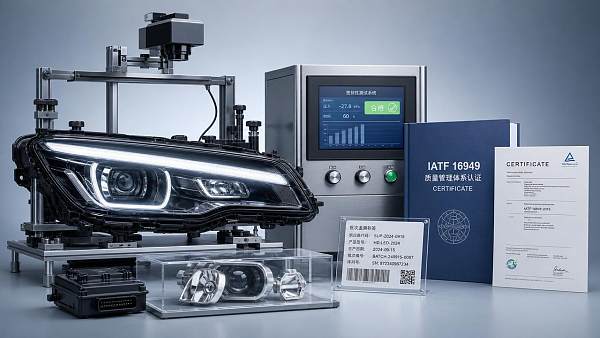
Automotive lighting sits at the intersection of optics, electronics, plastics, sealing, and regulatory control. Even minor process drift can trigger beam deviation, moisture ingress, LED color shift, or premature failure.
A checklist-based review creates a repeatable method for comparing each auto lighting supplier. It supports stable quality by turning broad claims into verifiable evidence, measured capability, and documented corrective action.
This approach also fits broader industrial benchmarking practices. In complex global manufacturing, stable suppliers are identified by data transparency, standard alignment, and control over failure modes, not by price alone.
Core Checklist for Stable Quality
Use the following checklist to evaluate an auto lighting supplier in a consistent, audit-ready way.
- Verify certification scope. Confirm IATF 16949, ISO 9001, and relevant lab controls actually cover the lighting plant, product family, and outsourced critical processes.
- Review design validation. Request DV, PV, photometric, vibration, thermal cycling, ingress protection, and salt spray data matched to the actual lamp configuration.
- Check regulatory competence. Confirm the auto lighting supplier understands ECE, SAE, FMVSS, EMC, and market-specific marking requirements before tooling release.
- Assess optical process control. Ask how beam pattern, lumen output, color temperature, reflector accuracy, and lens transmission are measured and trended by lot.
- Audit sealing reliability. Review controls for welding, gasket compression, vent design, adhesive cure, and leak testing to prevent fogging and moisture ingress.
- Examine electronics robustness. Confirm PCB assembly quality, solder profile control, driver protection design, ESD handling, and burn-in screening for LED modules.
- Measure process capability. Request Cp, Cpk, first-pass yield, PPM history, and trend charts for critical dimensions, aiming features, and electrical parameters.
- Trace critical materials. Make sure LEDs, resins, coatings, vents, adhesives, and connectors are traceable to approved sources with change control records.
- Confirm APQP discipline. Review PFMEA, control plans, work instructions, layered process audits, and reaction plans tied to major failure modes.
- Test defect containment speed. Ask how nonconforming lamps are quarantined, sorted, root-caused, and closed through 8D within defined response windows.
- Evaluate tooling maintenance. Check mold upkeep, fixture calibration, poka-yoke devices, and preventive maintenance intervals affecting alignment and cosmetic quality.
- Review supply continuity. Validate safety stock policy, dual-source strategy for key components, logistics visibility, and contingency planning for semiconductor shortages.
Fast Comparison Table
How the Checklist Changes by Application
Passenger Vehicle Lighting
For passenger platforms, cosmetic consistency is almost as important as functional compliance. An auto lighting supplier should show tight control of lens clarity, chrome appearance, color bins, and visible gap variation.
Adaptive lighting or signature lamps require stronger electronics validation. Focus on EMC behavior, software-controlled drivers, thermal management, and stable performance across voltage fluctuations.
Commercial Vehicle and Off-Road Lighting
Heavy-duty applications prioritize impact resistance, vibration tolerance, water sealing, and service life under dust, mud, and chemical exposure. Here, the best auto lighting supplier proves ruggedness, not just lab compliance.
Check connector retention, housing strength, potting quality, and field-replaceable design features. Validation should reflect real operating cycles, not only standard passenger-car test durations.
EV and Smart Mobility Programs
EV platforms often introduce tighter energy efficiency targets and denser electronic integration. The auto lighting supplier should demonstrate low power draw, thermal simulation capability, and compatibility with advanced vehicle architectures.
Smart mobility programs also require disciplined change management. Lighting systems linked to sensors, communication modules, or brand-signature functions demand stronger software, EMC, and interface validation.
Commonly Overlooked Risks
Sub-supplier Drift
A capable auto lighting supplier can still struggle if LED bins, resin batches, or vent membranes change without robust approval control. Review second-tier monitoring, not only final assembly quality.
Lab Data That Does Not Match Production
Some validation results come from prototype tools or hand-built samples. Confirm that test reports reflect serial materials, serial fixtures, and serial process settings before relying on the data.
Weak Reaction Plans
Stable quality depends on what happens after detection. If the auto lighting supplier cannot define stop-ship rules, quarantine flow, and escalation timing, defect containment will be inconsistent.
Insufficient Field Feedback Loop
Warranty returns, teardown findings, and usage-condition analysis should feed PFMEA and control plan updates. Without that loop, recurring failures often survive multiple production lots.
Practical Execution Tips
- Score each auto lighting supplier using weighted criteria for compliance, process capability, validation depth, and supply resilience.
- Request three months of actual production data, not summary slides, to confirm yield stability and recurring defect patterns.
- Run a process audit during serial output so observations reflect real takt time, operator behavior, and inspection discipline.
- Sample traceability backward from finished lamp to LED lot, resin lot, operator record, and machine parameter history.
- Align acceptance criteria early for appearance, photometry, and packaging to avoid disputes after shipment begins.
Where cross-sector benchmarking is available, compare the supplier’s controls against best practices from electronics, automotive, and precision tooling. Stable quality usually comes from integrated systems, not isolated inspection gates.
Conclusion and Next Step
Selecting an auto lighting supplier for stable quality requires more than checking certifications or reviewing samples. The strongest decisions come from disciplined evaluation of validation, optics control, sealing integrity, traceability, and problem-solving speed.
Use this checklist as a working qualification tool, then adapt it by vehicle class, regulatory market, and technology level. A data-backed review process reduces failure risk, improves launch confidence, and supports safer long-term lighting performance.
If needed, convert this list into a scored audit sheet, request evidence by item, and close gaps before nomination or volume release. That is the fastest path to a reliable auto lighting supplier decision.
The Archive Newsletter
Critical industrial intelligence delivered every Tuesday. Peer-reviewed summaries of the week's most impactful logistics and market shifts.