Monday, May 22, 2024

Best EV Setups for Logistics Fleets in 2026
by
Published
Views:
As logistics networks face rising fuel costs, emissions targets, and tighter delivery demands, choosing the right Electric Vehicles for logistics has become a strategic priority for fleet leaders in 2026. This guide explores the most effective EV setups for different operational needs, helping enterprise decision-makers compare performance, charging readiness, total cost of ownership, and long-term scalability with greater confidence.
What enterprise buyers are really looking for in 2026 EV fleet planning
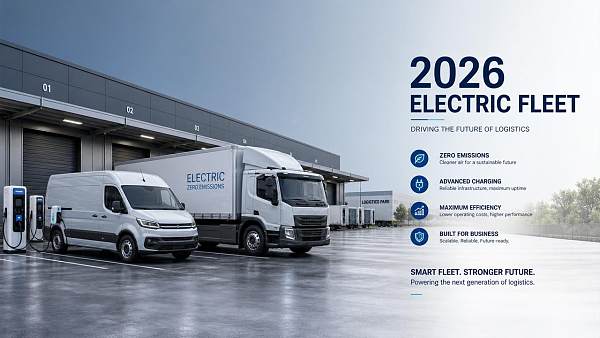
The core search intent behind this topic is not simply to identify popular electric vans or trucks. Decision-makers want to know which EV setup best fits their logistics model.
For enterprise readers, the real question is practical: which vehicle, charging, and operating configuration can reduce cost, preserve service levels, and scale without creating new operational risk.
That makes the best Electric Vehicles for logistics a systems decision. Vehicle range alone is not enough. Fleet planners must align duty cycles, depot power, utilization rates, maintenance workflows, and financing structure.
In 2026, the strongest fleet outcomes usually come from matching EV architecture to route profile. Urban last-mile fleets, regional delivery fleets, and mixed-temperature distribution fleets rarely need the same setup.
The most useful evaluation framework therefore centers on five areas: route compatibility, charging design, payload impact, total cost of ownership, and rollout scalability across multiple sites.
Why “best EV setup” means matching vehicles to route economics
The biggest mistake in fleet electrification is choosing vehicles before defining operating patterns. Logistics operators should first segment their network by daily mileage, dwell time, payload variance, and delivery predictability.
For dense urban routes with fixed returns to depot, battery electric vans usually offer the cleanest business case. They benefit from regenerative braking, stable mileage patterns, and relatively simple overnight charging.
For suburban and regional networks, the best setup often involves medium-duty electric trucks with larger battery packs, supported by scheduled fast charging or opportunity charging during loading windows.
For long-haul operations with unpredictable routing, full electrification may still require selective deployment in 2026. Many operators are better served by phased electrification on repeatable lanes rather than universal conversion.
In other words, vehicle choice should emerge from route economics. The right Electric Vehicles for logistics are the ones that protect delivery reliability while lowering energy and maintenance cost over the asset life.
Best EV setups for last-mile urban delivery fleets
Urban parcel, grocery, and service fleets remain the most mature use case for logistics electrification. In these environments, compact and medium electric vans usually outperform combustion equivalents on both energy cost and stop-and-go efficiency.
The ideal setup includes right-sized battery capacity rather than the largest available pack. Oversized batteries increase capital cost and reduce payload efficiency without adding value on short, repetitive routes.
Depot charging is typically the operational backbone for this segment. Overnight AC charging often covers daily needs at the lowest infrastructure cost, especially when fleets can stagger charging during off-peak power periods.
Fleet managers should also prioritize telematics integration. State-of-charge visibility, route adherence, and idle-time analytics are essential for preventing service disruptions and improving charger utilization.
For decision-makers, the strongest urban EV setup is usually a closed-loop system: fixed-route vans, centralized charging, route-aware scheduling, and maintenance teams trained on high-voltage systems.
Best EV setups for regional and medium-duty logistics operations
Regional delivery fleets face a more complex balance between range, payload, and charging downtime. This is where medium-duty EV trucks become attractive, but only when the operating window supports them.
In 2026, successful setups in this segment often rely on route clustering. Companies group electrified routes by geography and energy demand, then assign vehicles with battery sizes optimized for those specific service zones.
DC fast charging becomes more important here, but it should be used strategically. Frequent dependence on high-power charging can raise demand charges and put pressure on battery life if poorly managed.
A better model is mixed charging: overnight depot charging for baseline energy, plus selective daytime charging at regional hubs for routes that approach battery limits during seasonal peaks.
Operators should also assess payload sensitivity carefully. Battery weight can reduce cargo flexibility, especially in weight-constrained applications. The best setup is not always the longest range, but the best payload-to-range compromise.
How cold chain, heavy payload, and specialized fleets should evaluate electrification
Not every logistics segment follows the same EV logic. Refrigerated delivery, high-cube transport, airport logistics, port drayage, and construction-adjacent distribution all impose unique energy demands.
Refrigerated fleets must account for auxiliary load from cooling systems. In these cases, usable range can drop materially, especially in extreme temperatures or high-door-open delivery patterns.
Specialized operators should request real-world duty simulations from suppliers rather than relying on headline range claims. Battery performance under payload, climate, and accessory loads matters more than brochure specifications.
For heavy-use fleets, charging infrastructure redundancy is also critical. A single charger outage can affect multiple routes, so reliability planning should include spare capacity, maintenance contracts, and fallback operating procedures.
The best Electric Vehicles for logistics in specialized operations are those validated against actual duty cycles, not generic benchmarks. Pilots should focus on route proof, energy modeling, and service continuity.
Charging strategy is often more decisive than vehicle selection
Many fleet programs underperform not because the vehicles are wrong, but because charging was treated as a secondary decision. In practice, charging architecture often determines utilization, uptime, and economics.
For most enterprises, depot charging remains the most controllable and financeable option. It supports centralized energy management, easier maintenance, and better integration with fleet scheduling.
However, multi-site operators must assess grid readiness early. Transformer limits, interconnection delays, and civil works can slow deployments more than vehicle procurement lead times.
Smart charging software is increasingly essential in 2026. It helps fleets avoid peak tariffs, sequence charging by departure priority, and reduce the need for expensive electrical upgrades.
Some organizations should also evaluate on-site energy storage or solar support, especially where power pricing is volatile. These tools may not fit every site, but they can strengthen long-term charging resilience.
Total cost of ownership: where the business case is won or lost
Enterprise buyers rarely adopt Electric Vehicles for logistics based on sustainability claims alone. The investment must work financially across vehicle cost, energy spend, maintenance, infrastructure, and asset utilization.
Upfront purchase prices are still higher in many categories, but TCO can improve when routes are predictable, annual mileage is high, and fuel savings are captured consistently over multiple years.
Maintenance savings are real, but they vary by application. Fleets with intensive stop-start patterns typically benefit more because EV drivetrains reduce wear on brakes and eliminate many combustion-related service items.
Infrastructure cost should be modeled per site, not averaged across the enterprise. A location with surplus electrical capacity may deliver fast payback, while another may require substantial upgrades and longer returns.
Decision-makers should request TCO models that include residual value assumptions, charger maintenance, software subscriptions, battery warranty terms, and productivity effects from charging downtime.
Risk factors enterprise fleets should not ignore
Procurement leaders need to evaluate electrification as a risk-managed transition. The main concerns usually involve charging uptime, grid constraints, technology obsolescence, and uncertain residual values.
Vendor bankability matters. Buyers should assess whether OEMs, charging providers, and software vendors have the service footprint, financial durability, and parts support needed for multi-year fleet commitments.
Interoperability is another major issue. Charging hardware, fleet software, and telematics systems must exchange data reliably, especially for large operators managing mixed vehicle brands and multiple depots.
There is also an organizational risk. Without driver training, site energy coordination, and maintenance readiness, even technically sound EV deployments can produce avoidable downtime and poor user adoption.
A prudent 2026 strategy is therefore phased and data-led: pilot first, validate route fit, confirm charging performance, and then scale using measured operational evidence rather than optimistic assumptions.
A practical decision framework for selecting the right 2026 EV fleet setup
For enterprise logistics leaders, the most effective path is to structure decisions around operating archetypes rather than product categories. Start by dividing the fleet into urban, regional, specialized, and experimental use cases.
Next, map each archetype against daily distance, return-to-base frequency, payload profile, dwell windows, and service criticality. This creates a clear view of where electrification is already viable.
Then compare EV options using three filters: operational fit, infrastructure readiness, and economic return. A vehicle that looks attractive on paper may fail if charger deployment timelines miss the operating calendar.
From there, define rollout sequence. Most successful programs begin with high-confidence routes, build internal capability, and only then expand into more demanding duty cycles.
This approach helps companies avoid overcommitting capital too early. It also produces better internal alignment among procurement, operations, facilities, finance, and sustainability teams.
Conclusion: the best setup is the one that can scale without disrupting service
In 2026, the best Electric Vehicles for logistics are not defined by the largest battery, the newest model, or the most ambitious sustainability messaging. They are defined by route fit and system readiness.
For urban fleets, that often means electric vans with overnight depot charging and strong telematics integration. For regional fleets, it usually means targeted medium-duty deployment supported by mixed charging strategies.
For specialized operations, success depends on rigorous duty-cycle validation and infrastructure resilience. Across every segment, charging design, TCO discipline, and phased execution matter more than headline specifications.
Enterprise decision-makers should therefore treat electrification as an operational architecture decision. When vehicle selection, infrastructure, and data management are aligned, EV fleets can reduce cost, support emissions goals, and scale with confidence.

The Archive Newsletter
Critical industrial intelligence delivered every Tuesday. Peer-reviewed summaries of the week's most impactful logistics and market shifts.