Monday, May 22, 2024

Connected Car Trends: Which Features Are Becoming Standard?
by
Published
Views:
Connected car features are no longer staying in the premium lane
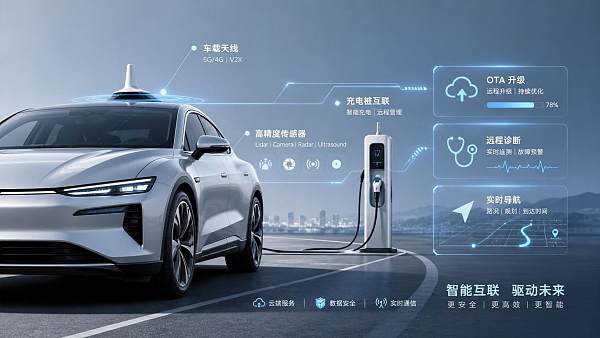
The connected car market has entered a different phase. What once signaled a flagship model now increasingly defines the expected baseline across segments.
That shift matters beyond vehicle branding. It affects electronics sourcing, software architecture, validation methods, data governance, and lifecycle cost assumptions.
For any industrial observer, the key question is no longer whether connectivity matters. It is which connected car features are becoming standard fast enough to reshape evaluation criteria.
Recent market behavior points to a clear answer. Standardization is moving first through functions that reduce downtime, simplify updates, strengthen safety response, and keep digital ecosystems consistent.
This is also where a cross-sector view becomes useful. Connected car adoption depends on semiconductors, telematics hardware, cloud services, cybersecurity controls, and compliance frameworks moving together.
That broader systems perspective is central to how Global Industrial Matrix approaches mobility intelligence. The same benchmarking logic applied to automotive electronics also connects to infrastructure, tooling, and environmental performance.
The strongest signals are coming from functions tied to uptime and trust
Not every digital feature is becoming standard at the same pace. Buyers and evaluators are separating novelty from functions that have operational consequences.
The connected car capabilities gaining the fastest baseline acceptance tend to share one trait. They solve recurring problems without requiring drivers to learn a new behavior.
Several features now stand out as moving toward standard status:
- Over-the-air software updates for infotainment, control modules, and security patches.
- Real-time diagnostics and predictive maintenance alerts through embedded telematics.
- Integrated navigation linked to live traffic, charging, or route condition data.
- Smartphone ecosystem integration that works reliably across operating systems.
- Automatic emergency communication and location-based safety support.
- Remote vehicle status access, including battery, fuel, lock, and health monitoring.
Some advanced driver assistance functions also rely on connectivity layers. Yet the market still treats them differently because standardization depends on regulation, sensor cost, and regional liability models.
By contrast, OTA and diagnostics already fit a practical business case. They reduce service friction, improve fleet visibility, and help preserve product performance after delivery.
Why this change is accelerating now
The connected car trend is not being driven by consumer expectation alone. Several industrial forces are converging, and each one raises the cost of staying offline.
A more subtle factor is platform convergence across industries. Automotive connectivity increasingly borrows methods from industrial IoT, cloud monitoring, and embedded electronics quality control.
That is why cross-disciplinary benchmarking matters. Standards such as ISO, IATF, and IPC no longer sit in separate technical conversations when connected car systems share common electronic foundations.
The impact is spreading far beyond the dashboard
It is easy to view connected car progress as an infotainment story. In practice, the bigger impact appears upstream and downstream from the user interface.
On the hardware side, embedded control units, antennas, sensors, power management, and high-reliability substrates all face tighter integration demands.
On the software side, validation cycles now extend into post-sale operation. That changes expectations for version control, failure logging, compatibility testing, and remote recovery paths.
Service networks are also affected. A connected car can reduce workshop visits for some issues, yet it increases the need for digital diagnostics discipline and secure data handling.
The sustainability angle is becoming more visible as well. Better diagnostics and update pathways can extend component life, improve energy management, and reduce unnecessary part replacement.
From a broader industrial perspective, this mirrors the same pattern seen in smart agriculture and infrastructure systems. Connectivity shifts value from standalone hardware toward managed performance over time.
What is becoming standard, and what still remains differentiated
A useful way to read the connected car market is to separate baseline features from premium differentiators that still carry genuine scarcity.
Baseline features moving toward standard status
- OTA firmware and software updates with clear rollback capability.
- Embedded telematics for health monitoring and remote alerts.
- Stable smartphone integration and app-based vehicle access.
- Connected navigation with live route intelligence.
- Emergency response connectivity and basic remote support.
Features still acting as differentiators
- Highly automated driving functions with dependable real-world edge case handling.
- Deep personalization driven by vehicle data, cloud profiles, and ecosystem services.
- Advanced vehicle-to-everything communication with strong regional support.
- Premium digital service bundles that depend on subscription retention.
This distinction helps clarify where benchmarking should be strict and where flexibility still makes sense. Standard features deserve mature comparability, not aspirational marketing language.
The real evaluation challenge is beneath the feature list
Two vehicles may present the same connected car features and still deliver very different operational outcomes. The gap usually sits in architecture quality and execution discipline.
In actual business review, several questions deserve closer attention:
- How often are OTA updates delivered, and how stable are they after deployment?
- Does diagnostics data support actionable maintenance decisions, or only fault reporting?
- How resilient is the electronics stack under thermal, vibration, and network stress?
- Are cybersecurity controls aligned with evolving automotive compliance expectations?
- Can suppliers document traceability across semiconductors, boards, modules, and software versions?
These questions reflect why connected car assessment now overlaps with semiconductor sourcing, PCB reliability, environmental testing, and infrastructure readiness.
A platform such as GIM becomes relevant here because feature claims alone are not enough. Cross-sector benchmarking helps reveal whether a connected car system is scalable, supportable, and technically defensible.
Where to watch next as the connected car baseline keeps rising
The next stage will likely be less about adding visible digital features and more about making connected car performance dependable across the full asset lifecycle.
Three directions look especially important.
First, data quality will matter more than data volume. Systems that generate cleaner diagnostic signals will support better service decisions and stronger residual value forecasting.
Second, update governance will become a major differentiator. As more functions shift into software control, rollback integrity, patch timing, and validation evidence will matter more.
Third, infrastructure fit will shape regional outcomes. Charging networks, telecom coverage, cybersecurity rules, and emergency response integration will influence how standard connected car features perform in practice.
The practical response is not to chase every new feature announcement. It is to build a clearer view of which connected car functions are crossing into baseline expectation, then test the supporting stack behind them.
That means comparing update maturity, electronics reliability, standards alignment, and supplier transparency in the same review framework.
For the next planning cycle, the most useful move is straightforward: track connected car features as system capabilities, not isolated options, and benchmark them against real operational performance.
The Archive Newsletter
Critical industrial intelligence delivered every Tuesday. Peer-reviewed summaries of the week's most impactful logistics and market shifts.