Monday, May 22, 2024

Last Mile Delivery Costs: What Drives Fees and Delays?
by
Published
Views:
Last Mile Delivery Costs: What Drives Fees and Delays?
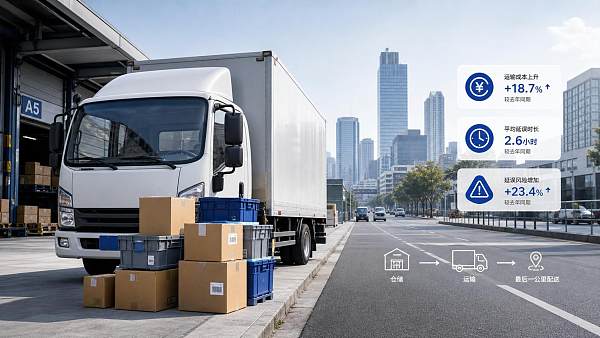
For many supply chains, last mile delivery is the most visible step and often the least predictable one.
It shapes customer experience, impacts service commitments, and can quietly expand total landed cost.
That matters because the final handoff usually involves the highest cost per stop and the greatest operational friction.
In practical terms, distance is only one part of the equation.
Labor scarcity, urban congestion, parcel mix, customer time windows, and delivery failure rates often matter more.
From a sourcing perspective, this also means cheap line-haul rates do not guarantee efficient last mile delivery performance.
A sound review should connect transportation pricing with route design, service density, and local execution risk.
This article explains what drives last mile delivery costs, why delays happen, and how to evaluate providers more precisely.
Why Last Mile Delivery Costs More Than Expected
Last mile delivery looks simple on paper, yet it combines many small cost layers that add up quickly.
Each stop requires route planning, driver time, vehicle capacity, proof of delivery, and customer communication.
When order volumes fluctuate, providers also absorb idle time, re-routing, and underused assets.
This is where last mile delivery becomes expensive even before fuel surcharges or accessorial fees appear.
Core cost components
- Driver wages, benefits, and overtime premiums
- Fuel, maintenance, insurance, and vehicle depreciation
- Dispatch systems, routing software, and real-time tracking tools
- Failed delivery handling, reverse logistics, and redelivery attempts
- Special requirements such as white-glove service, installation, or signature capture
A useful benchmark is cost per stop, not just cost per mile.
In dense routes, providers can spread fixed costs across more deliveries.
In sparse routes, each delivery absorbs more labor and travel time.
That difference explains why last mile delivery pricing can vary sharply between similar regions.
The Biggest Drivers Behind Last Mile Delivery Fees
Several variables consistently shape last mile delivery fees, and most of them are operational rather than geographic.
1. Labor availability and productivity
Labor is usually the largest cost driver in last mile delivery.
Tight labor markets raise wages, increase subcontractor dependence, and reduce schedule flexibility.
More importantly, low driver productivity means fewer stops per route and higher cost per order.
2. Route density
Route density is one of the clearest indicators of last mile delivery efficiency.
A provider serving many nearby stops can reduce dwell time, distance, and idle capacity.
Low density routes do the opposite and usually trigger higher minimum charges.
3. Fuel and energy volatility
Fuel surcharges can move quickly, especially in markets with unstable energy prices.
Even electric fleets face charging infrastructure limits, range planning issues, and capital recovery pressures.
So, last mile delivery savings from cleaner fleets depend on route fit and asset utilization.
4. Delivery speed expectations
Same-day and narrow time-window services increase complexity fast.
They reduce route consolidation and force extra standby capacity into the network.
That is why premium service promises often reshape total last mile delivery costs more than buyers expect.
5. Parcel and product characteristics
Large, fragile, temperature-sensitive, or high-value items need more handling controls.
That affects vehicle type, packaging, insurance, and delivery confirmation steps.
In actual operations, these details often separate a standard rate from a costly exception-based rate.
What Usually Causes Last Mile Delivery Delays
Fees draw attention first, but delays can create larger business losses.
Late deliveries can interrupt production schedules, reduce shelf availability, and damage service credibility.
The root causes are usually visible if the network is measured correctly.
Common delay triggers
- Traffic congestion and poor curbside access
- Incomplete addresses or weak order data quality
- Missed delivery windows and recipient unavailability
- Warehouse release delays before route departure
- Weather disruption, road restrictions, or local permitting issues
A missed delivery is especially expensive because it adds cost without creating revenue.
It consumes route time, customer support effort, and often another trip.
This also means delay analysis should include first-attempt delivery success, not just on-time arrival.
Another overlooked factor is handoff quality between upstream warehousing and local transport teams.
If orders leave the distribution node late, even an efficient last mile delivery partner starts behind schedule.
How to Evaluate Last Mile Delivery Providers
Price comparisons alone rarely reveal the best option.
A stronger sourcing review looks at cost structure, execution discipline, and resilience under stress.
Key questions to ask
- What percentage of fees comes from base transport versus accessorial charges?
- How stable is route density across peak and off-peak periods?
- What is the first-attempt delivery success rate by region?
- How are fuel, labor, and seasonal surcharges indexed?
- What visibility tools support tracking, exceptions, and proof of delivery?
- How does the provider manage subcontractors and service quality consistency?
In procurement reviews, it helps to compare providers using operational metrics and not only contract rates.
That approach gives a clearer view of true last mile delivery value.
Useful evaluation metrics
Practical Ways to Reduce Last Mile Delivery Cost and Risk
Lowering last mile delivery cost does not always require a full network redesign.
In many cases, targeted operational changes produce measurable gains quickly.
Priority actions
- Improve address accuracy and order data before route release
- Segment service levels by product value and urgency
- Use delivery appointment tools for difficult residential or site-access locations
- Consolidate orders where customer patterns allow better stop density
- Track exception codes to identify repeat failure points
- Review surcharge formulas during contract negotiation, not after cost escalation
A more strategic step is aligning last mile delivery promises with realistic network capability.
Not every order needs premium speed, and not every region can support it economically.
This is where technical benchmarking and cross-sector supply chain visibility become valuable.
Platforms such as Global Industrial Matrix help teams compare operating assumptions against broader industrial patterns.
That includes infrastructure readiness, asset utilization logic, compliance expectations, and resilience indicators across markets.
A Better Way to Judge Last Mile Delivery Value
The real question is not whether last mile delivery is expensive.
It is whether the cost matches the service outcome, risk profile, and business need.
The strongest decisions come from linking fees to route economics, delay drivers, and measurable delivery quality.
When that analysis is done well, last mile delivery becomes easier to budget, negotiate, and improve.
In day-to-day business, that translates into fewer surprises and better control over total logistics performance.
The next step is simple: audit your current fee structure, map the top delay causes, and test providers against operational evidence.
That process turns last mile delivery from a reactive expense into a more manageable sourcing decision.

The Archive Newsletter
Critical industrial intelligence delivered every Tuesday. Peer-reviewed summaries of the week's most impactful logistics and market shifts.