Monday, May 22, 2024

Virtual Reality Use Cases That Improve Training Outcomes
by
Published
Views:
Virtual Reality Use Cases That Improve Training Outcomes
As global manufacturers face rising complexity, virtual reality is becoming a practical training tool, not a futuristic experiment.
It helps teams learn faster, practice safely, and repeat critical tasks without disrupting production lines or field operations.
For organizations managing cross-border plants, mixed-skill workforces, and tight quality requirements, virtual reality supports more consistent training outcomes.
That matters when one weak handoff can trigger scrap, downtime, safety incidents, or supplier performance issues across multiple facilities.
From a business perspective, virtual reality connects workforce development with operational resilience, compliance, and measurable readiness.
In practice, the strongest value appears where tasks are high-risk, high-precision, or hard to teach with manuals alone.
This is why more industrial leaders now evaluate virtual reality as part of a broader digital training strategy.
Platforms like Global Industrial Matrix support that shift by linking technical benchmarks, standards, and cross-sector data into better training design.
Why Virtual Reality Improves Training Outcomes
Traditional training often depends on classroom instruction, shadowing, and limited access to equipment.
Those methods still matter, but they struggle when processes change quickly or assets cannot be taken offline.
Virtual reality improves training outcomes because it turns passive learning into active decision-making.
Learners move through realistic environments, respond to system prompts, and see the consequences of their actions immediately.
That shortens the gap between knowledge transfer and job performance.
It also creates standardized experiences across sites, languages, and instructor styles.
More importantly, virtual reality captures behavioral data.
Managers can track completion speed, procedural errors, response times, and retraining needs with far more precision.
That makes training less subjective and easier to align with ISO, IATF, IPC, and internal quality targets.
Key performance gains
- Faster skill acquisition for complex equipment and multi-step procedures.
- Lower training risk in hazardous or difficult environments.
- Better retention through repetition and immersion.
- More consistent onboarding across locations.
- Clearer evidence for audits, qualification, and workforce planning.
High-Impact Virtual Reality Use Cases in Industrial Training
The best virtual reality use cases usually target training bottlenecks that affect safety, quality, throughput, or maintenance reliability.
Below are the applications that most often deliver visible operational value.
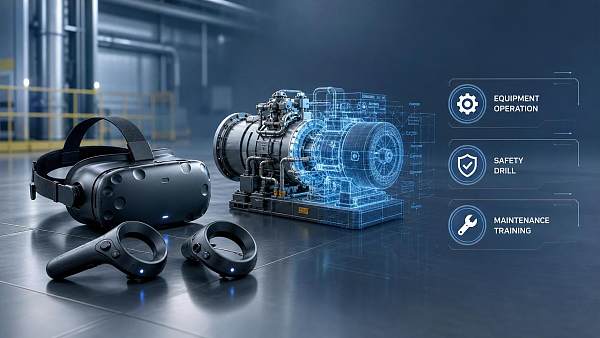
1. Equipment operation training
Virtual reality is highly effective for teaching machine startup, shutdown, calibration, and normal operating procedures.
Operators can practice on digital twins before touching expensive hardware.
This reduces beginner errors and protects production assets during onboarding.
2. Safety and emergency simulation
Some safety scenarios cannot be practiced live without unacceptable risk.
Virtual reality lets teams rehearse lockout-tagout, chemical exposure response, confined space entry, and evacuation routes.
The immersive format improves situational awareness under pressure.
3. Maintenance and repair instruction
Maintenance technicians often need to master rare but critical repair tasks.
Virtual reality allows step-by-step practice for disassembly, inspection, torque sequences, and component replacement.
That supports faster mean time to repair and better first-time fix rates.
4. Quality inspection and defect recognition
In electronics, automotive, and precision tooling, defect recognition is a skill built through repetition.
Virtual reality can simulate visual checks, dimensional review points, and response protocols for nonconforming parts.
This helps standardize judgment across inspectors and suppliers.
5. Cross-site collaboration and expert guidance
When specialist knowledge is concentrated in one region, scaling training becomes difficult.
Virtual reality supports shared simulations and guided practice across plants, suppliers, and technical teams.
That can reduce travel, speed up standard deployment, and improve knowledge continuity.
Cross-Sector Examples That Matter Now
From recent industry shifts, the most useful virtual reality programs are not limited to one vertical.
They work best when linked to real process complexity and measurable business outcomes.
Semiconductor and electronics
Virtual reality can train cleanroom behavior, ESD control, substrate handling, and inspection discipline.
That supports yield protection where minor handling mistakes can create costly downstream defects.
Automotive and mobility
For EV powertrains and advanced assembly lines, virtual reality helps workers rehearse battery handling, torque verification, and diagnostic routines.
This is especially relevant where model changes happen faster than traditional training cycles.
Smart agri-tech
Autonomous tractors, precision spraying systems, and sensor-integrated equipment require both mechanical and digital skills.
Virtual reality helps technicians practice system setup, remote diagnostics, and seasonal maintenance without field disruption.
Industrial ESG and infrastructure
Water treatment modules, filtration systems, and environmental assets often involve strict safety and compliance procedures.
Virtual reality supports training for inspection routes, maintenance tasks, and abnormal condition response.
Precision tooling
Tool setup, measurement discipline, and machine parameter control are difficult to master under production pressure.
Virtual reality gives apprentices and experienced operators a repeatable space to refine precision tasks.
How to Evaluate Virtual Reality Training for Business Value
A common mistake is treating virtual reality as a hardware purchase.
The better approach is to evaluate it as a process improvement tool.
That means selecting use cases where training outcomes can be measured against operational metrics.
Start with these questions
- Which tasks create the highest cost of human error?
- Where does training require scarce equipment or expert supervision?
- Which safety scenarios are important but hard to simulate live?
- Where do quality escapes or maintenance mistakes repeat across sites?
- What standards or audit demands require stronger training evidence?
Useful decision metrics
Implementation Risks to Address Early
Virtual reality can underperform when the rollout is driven by novelty rather than workflow need.
The stronger signal is whether the content reflects real operating conditions, not generic simulations.
Another issue is poor integration with qualification systems, maintenance records, or learning management platforms.
If virtual reality data stays isolated, leadership loses much of the strategic value.
Content governance also matters.
When work instructions change, simulations must be updated quickly to avoid training drift.
Practical safeguards
- Pilot one high-value use case before scaling.
- Build scenarios from actual SOPs and failure modes.
- Define ownership for content updates and version control.
- Connect virtual reality results to workforce and quality dashboards.
- Review learner feedback alongside operational performance data.
A Smarter Path Forward
Virtual reality is no longer just a compelling demo.
Used well, it improves training outcomes in ways that directly support quality, safety, and operational continuity.
The most effective programs begin with specific business problems, measurable training goals, and strong technical alignment.
That is especially important in complex manufacturing environments where process discipline and cross-site consistency are hard to maintain.
For teams navigating electronics, mobility, agri-tech, infrastructure, and tooling, virtual reality offers a scalable way to build capability with less guesswork.
With cross-sector benchmarking and verifiable technical data, Global Industrial Matrix can help organizations identify where virtual reality fits best.
The next step is simple: choose one training bottleneck, define success metrics, and test virtual reality where better outcomes matter most.

The Archive Newsletter
Critical industrial intelligence delivered every Tuesday. Peer-reviewed summaries of the week's most impactful logistics and market shifts.