Monday, May 22, 2024

Computer Parts Manufacturer: Cost vs Quality
by
Published
Views:
Choosing a computer parts manufacturer is no longer just a sourcing decision—it is a financial risk calculation. For budget approval, the real challenge is balancing unit price with quality, supply continuity, compliance, and lifecycle value. In global manufacturing, the cheapest quote can easily become the most expensive option once failure rates, warranty claims, delivery gaps, and redesign costs appear. Data-driven benchmarking makes supplier comparison more reliable and helps protect both margins and system performance.
Why a checklist matters when comparing a computer parts manufacturer
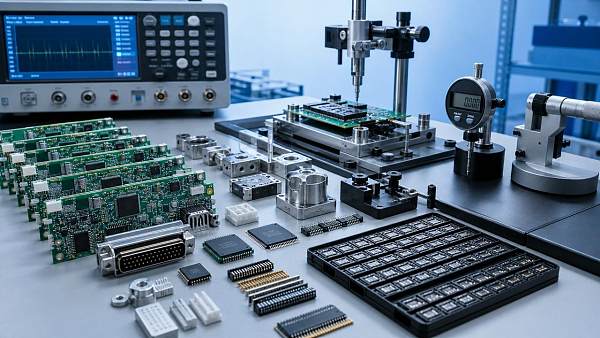
In electronics and cross-sector industrial systems, component decisions affect uptime, thermal stability, signal integrity, service life, and compliance exposure. A structured checklist prevents decisions based only on piece price.
This matters across integrated industries. The same computer parts manufacturer may support embedded controllers, edge devices, industrial PCs, automotive electronics, or smart agriculture systems. Different use cases require different quality thresholds.
A checklist also creates a common evaluation language. Instead of debating opinions, teams can compare test data, defect history, process capability, audit results, and total cost of ownership.
Core checklist: cost versus quality evaluation points
Use the following checklist to evaluate any computer parts manufacturer or component supplier before approving production volume or long-term contracts.
- Verify process capability first. Review Cp, Cpk, yield, and outgoing defect data to confirm the supplier can repeatedly meet dimensional, electrical, and thermal requirements.
- Compare total landed cost, not unit price alone. Include freight, tariffs, packaging loss, inspection time, rework, warranty reserves, and replacement cycle impact.
- Check material traceability. Confirm lot-level records for substrates, capacitors, connectors, metals, and plastics to reduce counterfeit and mixed-batch risks.
- Audit quality systems against relevant standards. Look for ISO 9001, IATF 16949 where applicable, IPC controls, ESD discipline, and documented corrective action routines.
- Test reliability under real conditions. Request thermal cycling, vibration, humidity, burn-in, salt mist, and power stability data matched to actual application stress.
- Review engineering change control. A dependable computer parts manufacturer should document PCN, ECN, revision history, and approval gates before any material substitution.
- Measure supply continuity. Assess lead times, buffer strategy, second-source planning, geographic concentration, and exposure to single-facility disruption or geopolitical constraints.
- Examine test coverage depth. Ask whether ICT, functional testing, AOI, X-ray, impedance validation, and final inspection are applied consistently by product type.
- Confirm compliance readiness. Validate RoHS, REACH, conflict minerals, UL, and sector-specific documentation before qualification, not after shipment problems emerge.
- Benchmark failure response speed. Track 8D closure time, root cause quality, containment actions, and willingness to fund sorting or field recovery.
- Assess manufacturing scalability. Ensure tooling, line balance, workforce training, and equipment redundancy can support ramp-up without degrading consistency or delivery performance.
- Score lifecycle support. Long-term availability, obsolescence planning, firmware maintenance, and spare-part commitments often separate strategic suppliers from low-cost vendors.
How the checklist changes by application scenario
Industrial control and edge computing
For industrial control systems, downtime cost usually outweighs purchase savings. A computer parts manufacturer serving this segment must prove endurance under dust, vibration, voltage fluctuation, and elevated ambient temperatures.
Priority metrics include MTBF estimates, connector retention strength, thermal management quality, and long-term component availability. Low-cost boards with weak revision control often create expensive service visits later.
Automotive and mobility electronics
In mobility applications, the evaluation threshold rises sharply. A computer parts manufacturer may need stronger traceability, PPAP discipline, environmental validation, and zero-defect culture aligned with safety-critical expectations.
Here, a small unit-price increase can be justified if it reduces field recall probability. Warranty exposure, brand risk, and compliance penalties can erase any short-term savings.
Smart agriculture and outdoor electronics
Outdoor systems face moisture, corrosion, mud, unstable power, and seasonal operating cycles. The right computer parts manufacturer should demonstrate sealing integrity, coating quality, and robust connector performance.
In this scenario, low-cost material substitutions are especially dangerous. A cheaper enclosure resin or plating choice may accelerate field failures long before laboratory tests reveal the weakness.
Data-intensive electronics and precision assemblies
For high-speed computing, signal integrity and thermal consistency become central. Evaluation should focus on PCB stack-up control, impedance tolerance, solder joint quality, heat dissipation design, and final validation discipline.
A capable computer parts manufacturer in this space often costs more because precision process controls are expensive. However, stable performance lowers integration risk and protects system reliability.
Commonly overlooked risks in supplier comparison
Hidden NPI costs: Low quotes may exclude tooling refinement, validation builds, fixture updates, and engineering communication time. These costs appear later and distort the original savings calculation.
Inconsistent sub-supplier control: A strong front-end factory can still fail if capacitor, laminate, or connector sources change without notice. Sub-tier governance matters as much as final assembly.
Weak documentation discipline: When reports are incomplete, quality claims are hard to verify. An effective computer parts manufacturer should provide data that withstands audit and customer review.
Freight and geography exposure: A cheap region-based quote can become unstable due to port delays, customs friction, or political disruption. Supply resilience must be priced into the decision.
Short lifecycle planning: Some suppliers optimize for current production only. Without obsolescence strategy, redesign pressure can arrive early and multiply validation costs.
Practical execution steps for better supplier decisions
- Build a weighted scorecard covering cost, quality, delivery, compliance, engineering support, and lifecycle resilience.
- Request the same data package from each computer parts manufacturer to ensure direct comparison.
- Run pilot orders before full award, then compare yield, response speed, and documentation accuracy.
- Perform site or remote process audits focused on traceability, test discipline, and change control.
- Model failure cost scenarios, including downtime, field returns, replacement freight, and reputation impact.
- Update the scorecard quarterly using actual performance, not only qualification-stage promises.
Benchmarking support for complex global manufacturing
Cross-sector benchmarking is increasingly important because electronics now sit inside mobility platforms, agricultural machines, infrastructure systems, and precision industrial tools. A computer parts manufacturer cannot be judged only by catalog breadth or basic pricing.
Global Industrial Matrix approaches this challenge through technical benchmarking across semiconductor and electronics, automotive and mobility, smart agri-tech, industrial ESG and infrastructure, and precision tooling. By comparing component performance against standards such as ISO, IATF, and IPC, the evaluation moves from assumption to evidence.
This wider perspective is valuable when supply chains overlap. A supplier that performs adequately in consumer-grade applications may not meet the reliability expectations of industrial, outdoor, or safety-linked systems.
Conclusion and next action
The right computer parts manufacturer is rarely the one with the lowest visible price. The better choice is the supplier that delivers repeatable quality, controlled change management, stable supply, and defensible lifecycle value.
Start with a checklist, convert qualitative claims into measurable criteria, and benchmark suppliers under real operating conditions. When cost is evaluated alongside risk and performance, sourcing decisions become more resilient and more profitable.
A practical next step is to create a side-by-side scorecard for each computer parts manufacturer under consideration, then validate the top candidates through pilot production and technical audit. That process reduces uncertainty before larger commitments are made.

The Archive Newsletter
Critical industrial intelligence delivered every Tuesday. Peer-reviewed summaries of the week's most impactful logistics and market shifts.