Monday, May 22, 2024

Computer Parts Manufacturer Quality Checks That Matter
by
Published
Views:
Choosing a reliable computer parts manufacturer now involves a broader technical judgment than it did even a few years ago. Price, lead time, and scale still matter, but they no longer explain whether a component will remain stable across global production environments shaped by tighter compliance rules, higher thermal loads, denser electronics, and more visible supply chain risk. What increasingly separates a dependable computer parts manufacturer from a risky one is the quality system behind each part: how materials are verified, how process drift is controlled, how failures are traced, and how performance is validated before the component reaches final assembly.
Across the broader industrial landscape, this shift is not limited to consumer computing. Electronics now interact with automotive control systems, industrial automation, smart agriculture platforms, edge devices, and environmental infrastructure. In this environment, a weak connector, unstable PCB layer, or poorly tested power module can create downstream cost far beyond the part itself. That is why quality checks from a computer parts manufacturer should be evaluated as strategic risk controls rather than routine factory paperwork.
Why quality checks from a computer parts manufacturer are becoming more decisive
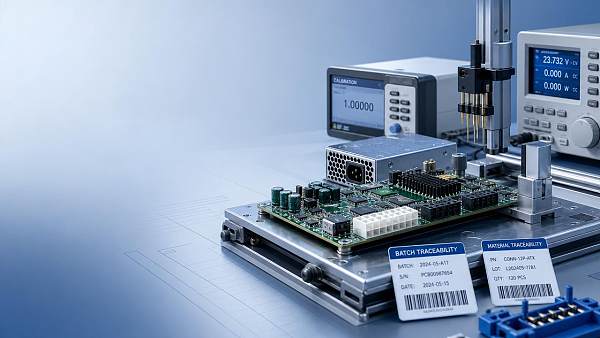
The current trend is clear: component qualification is moving upstream. Instead of waiting for assembly defects or field failures, companies are asking whether the computer parts manufacturer can prove consistency at the material, process, and validation level. This change reflects three realities. First, modern devices pack more performance into smaller thermal and mechanical envelopes. Second, international sourcing has widened the gap between nominal specification and actual production capability. Third, compliance expectations have expanded from simple dimensional acceptance to traceability, reliability, and environmental accountability.
As a result, supplier assessment increasingly resembles technical benchmarking. A capable computer parts manufacturer must show not only that a part works once, but that it will continue to perform across batches, operating cycles, shipping conditions, and changing application demands. This is especially relevant in cross-sector manufacturing, where the same electronics quality principles influence servers, vehicle control units, industrial sensors, agri-tech systems, and infrastructure monitoring devices.
The strongest trend signals behind stricter verification requirements
Several signals explain why quality assurance has become a central decision factor when evaluating a computer parts manufacturer. These signals do not operate in isolation; together they raise the cost of weak controls.
Which quality checks matter most when reviewing a computer parts manufacturer
Not all inspection claims have equal value. The most important checks are the ones that reveal whether a computer parts manufacturer can maintain repeatable quality under real production conditions, not just pass a one-time sample review.
1. Material traceability and incoming verification
Material quality is the base layer of component reliability. Metals, polymers, laminates, solders, plating chemicals, and silicon-related inputs should be traceable to batch level. Incoming quality control should verify certificates, dimensions, appearance, and critical properties rather than relying only on supplier declarations. For a computer parts manufacturer, this reduces the risk of mixed lots, counterfeit substitution, and hidden composition drift.
2. Process control at critical production steps
A strong computer parts manufacturer identifies critical process points such as soldering temperature windows, CNC tolerances, plating thickness, PCB lamination parameters, connector insertion force, or cleanroom handling requirements. Statistical process control, calibration discipline, and in-line monitoring are stronger indicators than final inspection alone. When process capability is visible, defect prevention improves.
3. Functional and electrical validation
Electrical continuity, impedance stability, current handling, signal integrity, power cycling, and thermal behavior should be tested against the intended application profile. This is where a computer parts manufacturer proves that the part performs under realistic load rather than only meeting static dimensional criteria.
4. Environmental and reliability stress testing
Thermal cycling, humidity exposure, vibration, salt spray where relevant, mechanical shock, and aging simulation reveal weaknesses that standard inspection may miss. For parts used across industrial or mobility-adjacent applications, a computer parts manufacturer that can present structured reliability data offers stronger long-term assurance.
5. Documentation integrity and change control
Engineering change notices, inspection records, control plans, PFMEA links, nonconformance handling, and corrective action records are often the hidden differentiators. A computer parts manufacturer may produce acceptable samples today but still create risk if process changes are undocumented or poorly communicated. Documentation quality directly affects audit readiness and root-cause resolution speed.
How these checks affect broader manufacturing performance
The impact of a qualified computer parts manufacturer extends beyond part acceptance. Strong verification reduces field returns, stabilizes assembly yields, supports warranty control, and protects brand reputation in technically sensitive markets. It also improves production planning because fewer emergency containment actions are needed when incoming lots are consistent and traceable.
In integrated sectors, the effect is amplified. A connector issue in an industrial control cabinet, a board-level defect in an EV support subsystem, or a power instability problem in agri-tech monitoring equipment can cause downtime, safety concerns, and service complexity. That is why quality checks from a computer parts manufacturer should be assessed in terms of system-level consequences, not just unit price.
- Better first-pass yield during assembly and integration
- Lower exposure to recalls, rework, and hidden logistics costs
- Faster root-cause analysis when failures do occur
- Stronger alignment with ISO, IPC, and sector-specific compliance expectations
- Higher resilience during supplier transitions or demand spikes
What deserves closer attention during supplier benchmarking now
Given current industry shifts, several review points deserve extra emphasis when comparing any computer parts manufacturer. These factors help distinguish robust operational discipline from surface-level claims.
- Traceability depth: Can raw material, process lot, operator record, and test result be linked quickly?
- Validation relevance: Are tests aligned to real use conditions such as thermal load, vibration, or humidity?
- Control of subcontracting: Is outsourced plating, molding, or assembly governed by the same quality discipline?
- Corrective action maturity: Are failures closed with root-cause evidence and preventive action, not temporary sorting only?
- Standards alignment: Does the computer parts manufacturer benchmark operations against applicable ISO, IPC, or IATF-inspired methods where relevant?
- Data transparency: Can reports be shared in a structured and audit-ready format?
A practical way to judge whether a computer parts manufacturer is future-ready
The next step is to turn quality review into a forward-looking decision tool. Instead of asking only whether a supplier passed yesterday’s requirement, ask whether the computer parts manufacturer can support tomorrow’s tighter specifications, compliance obligations, and cross-industry application demands.
A resilient sourcing strategy benefits from comparing suppliers through this lens. In many cases, the most dependable computer parts manufacturer is not the one offering the lowest initial quote, but the one able to prove stable process capability, transparent documentation, and disciplined validation across changing operating conditions.
For organizations working across electronics, mobility, infrastructure, and precision manufacturing, the smartest next step is to standardize a quality review checklist that links component verification to system-level risk. Use sample audits, test record reviews, traceability checks, and standards benchmarking to compare each computer parts manufacturer on evidence rather than assumption. In a market where technical complexity keeps rising, quality checks are no longer a background function. They are one of the clearest indicators of long-term supply reliability and operational resilience.
The Archive Newsletter
Critical industrial intelligence delivered every Tuesday. Peer-reviewed summaries of the week's most impactful logistics and market shifts.