Monday, May 22, 2024

How to Vet a Computer Parts Supplier in 2026
by
Published
Views:
Choosing a reliable computer parts supplier in 2026 requires more than comparing prices or lead times. For procurement professionals, the real question is whether a supplier can deliver consistent quality, verified traceability, predictable capacity, and commercial resilience under volatile market conditions.
The core search intent behind this topic is practical and evaluative. Buyers are not looking for a generic definition of a computer parts supplier. They want a clear way to assess risk, compare vendors, and avoid costly sourcing mistakes.
Procurement teams care most about five issues: part authenticity, quality control, supply continuity, compliance readiness, and total cost over time. They also need signals that help distinguish a stable partner from a price-driven trader with limited operational control.
The most useful content, therefore, is not broad industry commentary. It is a structured vetting framework: what to check, what documents to request, what warning signs to watch for, and how to make a defensible sourcing decision in 2026.
This guide focuses on those priorities. It emphasizes supplier qualification, technical validation, traceability, capacity, and long-term resilience, while avoiding generic procurement advice that does not materially improve supplier selection.
Why vetting a computer parts supplier is harder in 2026
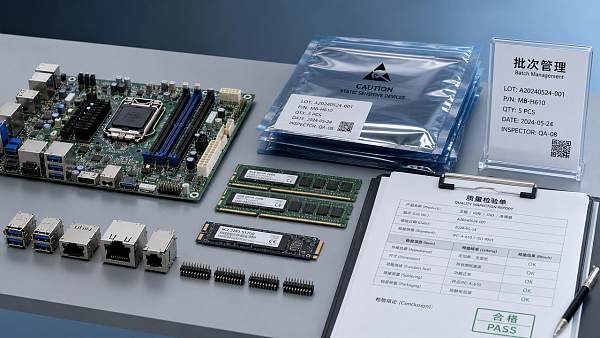
In 2026, sourcing computer components is more complex than it was a few years ago. Procurement teams face shorter product lifecycles, stricter compliance demands, regional trade uncertainty, and higher exposure to counterfeit or improperly handled inventory.
Even common categories such as motherboards, memory modules, power supplies, cooling systems, connectors, storage devices, and industrial embedded boards now carry broader risk profiles. A low quote may hide weak traceability, mixed lots, aging stock, or unstable sub-tier sourcing.
That is why vetting a computer parts supplier must go beyond commercial negotiation. Buyers need evidence that the supplier can maintain technical consistency, document origin, handle quality deviations, and keep supply flowing when market conditions shift.
For procurement professionals, the goal is simple: reduce disruption while protecting cost, product performance, and delivery commitments. The right supplier is not only competitive on price, but operationally dependable under pressure.
Start with the supplier’s business model, not the catalog
Before reviewing SKUs, start by understanding what kind of supplier you are evaluating. In the computer hardware market, the difference between a manufacturer, authorized distributor, independent distributor, and sourcing broker matters significantly.
A manufacturer offers the highest process visibility for its own products, but may have limited flexibility outside a narrow range. An authorized distributor provides stronger channel legitimacy and traceability, while an independent distributor may offer faster market access but with more verification burden.
Brokers can be useful in shortage conditions, yet they often add sourcing opacity. If a vendor cannot clearly explain its role in the supply chain, where it buys, how it stores inventory, and which quality controls it owns directly, that is a red flag.
Ask early: Are you buying from stock, from factory allocation, or from third-party market sourcing? A trustworthy computer parts supplier should answer this directly and provide supporting documentation without hesitation.
Verify quality systems and operational discipline
One of the first screening steps is confirming whether the supplier has a credible quality management system. ISO 9001 is a common baseline, but certification alone should not end the review. You need to understand how the system is actually used.
Ask for the supplier’s quality manual summary, incoming inspection procedures, nonconformance process, corrective action workflow, and ESD handling standards. For some categories, especially industrial or automotive-adjacent electronics, more rigorous process control may be necessary.
Look for discipline in basic operations: lot segregation, warehouse conditions, moisture-sensitive device handling, serial tracking, labeling consistency, and quarantine procedures. These details often reveal more than a certificate framed on the wall.
If possible, request recent audit results, internal KPIs, and examples of closed corrective actions. A capable supplier should be able to show how it identifies defects, investigates root causes, and prevents repeat issues.
When a vendor gives vague assurances such as “we always check quality” but cannot describe inspection criteria or failure escalation paths, procurement should assume the process maturity is weak until proven otherwise.
Traceability is now a procurement requirement, not a bonus
In 2026, traceability has become central to supplier vetting. Whether you are sourcing CPUs, GPUs, DRAM, SSDs, power modules, fans, cables, or connectors, you need to know where the part originated and how it moved through the chain.
At minimum, a qualified computer parts supplier should provide manufacturer name, part number accuracy, date code where applicable, lot information, country of origin, and chain-of-custody records. For higher-risk categories, deeper batch-level evidence may be necessary.
Traceability is especially important when dealing with excess stock, end-of-life parts, refurbished components, or constrained supply. Without documentation, buyers may inherit authenticity issues, warranty disputes, or field failures that are difficult to resolve later.
Ask a simple but effective question: If a quality issue appears six months after delivery, how quickly can the supplier identify affected lots, related shipments, and upstream source records? The answer tells you how controllable the risk really is.
Strong traceability also supports compliance, recall response, internal audits, and customer reporting. For procurement teams under pressure to justify vendor decisions, it is one of the clearest markers of supplier maturity.
Test authenticity controls and counterfeit prevention methods
Counterfeit prevention remains a serious issue in global electronics sourcing. Not every problem involves deliberate fraud. Some failures come from reclaimed parts, relabeled stock, poor storage, mixed-date-code inventory, or components sold outside their intended channel conditions.
This is why buyers should ask specifically how the supplier detects suspect parts. Do they perform visual inspection under magnification? X-ray or decapsulation through approved partners? Electrical testing? Packaging verification? Label and marking analysis?
The depth of testing should match the sourcing risk. Factory-direct procurement may need lighter verification. Open-market or shortage-driven purchases demand far more control. A supplier that treats all parts as equal is not managing risk intelligently.
Also ask how the vendor handles nonconforming or suspect inventory. Is there a documented hold process? Are returns segregated from sellable stock? Are failed lots reported and blocked from re-entry into available inventory?
If a supplier dismisses authenticity concerns or relies only on supplier reputation without physical or documentation-based verification, procurement should treat that as a warning sign, particularly for high-value semiconductors and memory products.
Assess engineering support and technical competence
A strong computer parts supplier should do more than move boxes. In many procurement environments, technical support directly affects sourcing success, especially when substitutions, lifecycle changes, or compatibility issues arise.
Evaluate whether the supplier can assist with cross-references, revision control, thermal considerations, interface compatibility, firmware dependencies, power requirements, and environmental specifications. This is particularly relevant for industrial computers, servers, and embedded systems.
Technical competence matters when supply disruptions force alternate sourcing. A supplier that understands the difference between “same form factor” and “true functional equivalence” can prevent costly mistakes during qualification or integration.
Ask who reviews technical questions. Is there an internal engineering team? Are field application specialists available? How are specification changes communicated? A vendor that cannot support basic technical review may create hidden downstream costs.
For procurement teams working with engineering, the best suppliers reduce friction between sourcing, quality, and design functions. That alignment is often worth more than a marginal unit-price difference.
Review capacity, lead-time reliability, and allocation risk
Lead time on paper is not the same as lead-time reliability in practice. A supplier may quote competitive delivery windows but depend on fragile upstream allocation, limited buffer stock, or a small number of sub-suppliers.
Ask how the supplier forecasts demand, reserves capacity, and manages constrained parts. Can they support blanket orders, safety stock programs, vendor-managed inventory, or bonded stock arrangements? Do they have alternate approved supply paths?
Procurement should also request historical performance data: on-time delivery rates, fill rates, backorder frequency, and lead-time variance. A serious supplier should be able to provide measurable service-level evidence, not just sales promises.
For critical programs, examine single-point dependencies. If one factory, one region, or one logistics channel fails, what happens? The best suppliers are transparent about these risks and can explain mitigation plans clearly.
Capacity review is especially important in 2026 because demand patterns remain uneven across semiconductors, AI hardware, industrial computing, and edge devices. Resilience matters more than optimistic quoting.
Check compliance, ESG, and documentation readiness
Modern procurement decisions increasingly include regulatory and sustainability filters. Depending on your market, a computer parts supplier may need to support RoHS, REACH, conflict minerals declarations, WEEE-related data, UL references, or export control documentation.
Do not assume compliance statements are current. Request document versions, issue dates, and part-family applicability. Suppliers should know how they collect declarations from upstream manufacturers and how often they refresh records.
ESG expectations are also rising in enterprise and industrial sourcing. Buyers may need information on labor policies, environmental practices, emissions reporting, packaging reduction, or due diligence across sub-tier partners.
You do not need every supplier to be perfect in every category. But you do need clarity. If a vendor struggles to provide basic compliance documents, delays disclosure, or gives inconsistent answers, procurement risk increases immediately.
Documentation readiness matters because compliance gaps often surface late, when products are already scheduled or shipments are pending. Good suppliers help prevent those last-minute delays.
Evaluate total cost, not just quoted price
Price remains important, but procurement should evaluate total cost of ownership. A cheaper supplier can become more expensive if defect rates rise, RMAs increase, engineering time is wasted, or deliveries slip during peak demand.
Build your assessment around a fuller cost model: unit price, logistics cost, customs exposure, inspection cost, return handling, quality incident impact, inventory carrying cost, and the business cost of downtime or delayed production.
Payment terms and warranty conditions also matter. Is there a clear returns policy? How are dead-on-arrival claims handled? Who pays freight on disputed lots? Are replacement timelines defined in writing?
Suppliers that appear expensive at first may reduce operational cost through better forecasting, stronger traceability, lower defect rates, and more consistent communication. Procurement should measure value where it actually shows up: continuity and control.
Use a structured supplier scorecard before approval
To make decisions defensible, convert your review into a weighted supplier scorecard. This helps teams compare vendors objectively and prevents overreliance on price or sales responsiveness.
Typical scoring categories include quality systems, traceability, authenticity controls, technical support, delivery performance, financial stability, compliance readiness, pricing, responsiveness, and business continuity planning. Weight each category according to sourcing criticality.
For example, a supplier for standard office peripherals may be evaluated differently from one supporting industrial motherboards or long-life embedded components. The more critical the application, the more heavily risk-control factors should weigh.
Use scorecards alongside a document checklist and a trial-order review. Start with lower-risk volumes if needed, then expand approved status only after the supplier demonstrates consistent performance across quality and delivery metrics.
This approach helps procurement standardize qualification, improve internal alignment, and justify sourcing decisions to quality teams, finance leaders, and operational stakeholders.
Red flags that should slow or stop supplier approval
Some warning signs should trigger immediate caution. These include inconsistent company identity across documents, refusal to share traceability records, unrealistic lead times, unusually low prices without explanation, and vague answers about stock origin.
Other concerns include poor response discipline, missing quality procedures, expired certifications, reluctance to discuss failure history, or heavy dependence on one salesperson who controls all information flows.
Be careful with suppliers that overpromise broad availability across every category. In the computer hardware market, specialization often indicates stronger process control than a claim to source everything equally well.
Financial instability is another critical issue. Procurement should review credit indicators, years in operation, major customer concentration, and any visible signs of distress. Operationally weak but cheap vendors often become expensive very quickly.
A practical vetting workflow for procurement teams
A workable process usually starts with prequalification. Screen the supplier’s business model, certifications, product scope, target markets, and sourcing channels. If the basics are acceptable, move to document review and capability assessment.
Next, request evidence: quality procedures, traceability samples, compliance files, service metrics, and references where appropriate. Conduct a structured interview covering authenticity control, lead-time risk, and escalation processes.
Then place a controlled pilot order. Track responsiveness, packing quality, documentation accuracy, delivery performance, and any incoming inspection findings. A supplier’s real operating standard often becomes visible during this stage.
Finally, assign approval status based on risk level. Some vendors may be suitable for noncritical buys only, while others can support strategic or long-term procurement programs. Approval should reflect evidence, not convenience.
In 2026, the best procurement teams treat supplier vetting as an ongoing discipline. Reassess key vendors periodically, especially when there are ownership changes, major market disruptions, repeated quality issues, or shifts in sourcing region.
Conclusion: choose the supplier that lowers uncertainty
The best computer parts supplier in 2026 is not simply the one with the lowest quote or the fastest promised lead time. It is the one that can prove control: control over quality, origin, documentation, capacity, and corrective action.
For procurement professionals, effective vetting means asking harder questions early and requiring evidence before commitment. That discipline reduces the chance of counterfeit exposure, compliance gaps, unstable delivery, and avoidable total cost inflation.
If you evaluate suppliers through business model clarity, quality systems, traceability, technical competence, resilience, and documented performance, you will make better sourcing decisions and build a more stable supply base.
In a market defined by tighter margins and higher uncertainty, supplier selection is no longer a routine purchasing task. It is a strategic risk-management decision, and the right vetting process is what turns that decision into a competitive advantage.

The Archive Newsletter
Critical industrial intelligence delivered every Tuesday. Peer-reviewed summaries of the week's most impactful logistics and market shifts.