Monday, May 22, 2024

Oscilloscopes Compared: Bandwidth, Sampling Rate, and Real Test Needs
by
Published
Views:
Choosing between oscilloscopes looks simple until real signals enter the picture. A higher bandwidth number or a faster sampling rate can help, but those figures alone do not guarantee better testing.
What matters in practice is how well the instrument matches the waveform, the trigger condition, the noise environment, and the reliability demands of the line or lab.
That question now matters across sectors. The same production network may involve motor drives, embedded controllers, power electronics, sensors, pumps, filtration systems, and communication links.
In that environment, oscilloscopes are no longer niche bench tools. They are part of everyday verification, fault isolation, maintenance, and benchmarking across modern manufacturing systems.
Why Scope Selection Has Become More Demanding
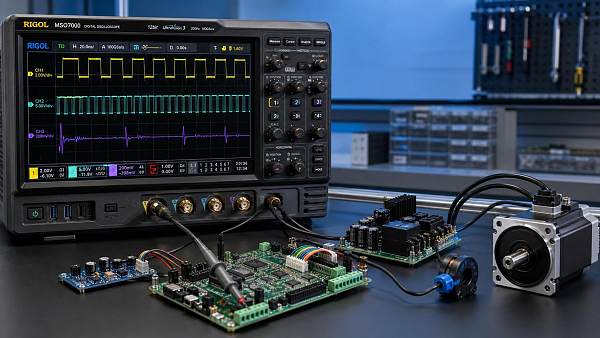
Industrial equipment now mixes fast digital edges with noisy power stages and distributed sensing. One test setup may include CAN signals, PWM control, switching transients, and low-level analog feedback.
That mix changes how oscilloscopes should be judged. A scope that works well for a clean logic board may struggle around inverters, long cable runs, or electrically harsh infrastructure.
This is where a benchmarking mindset becomes useful. Platforms such as Global Industrial Matrix, or GIM, frame test tools within broader system performance, standards alignment, and cross-sector comparability.
Instead of viewing oscilloscopes as isolated purchases, the better approach is to treat them as measurement assets tied to product quality, downtime risk, and repeatable technical decisions.
Bandwidth Is About Signal Fidelity, Not Just Headroom
Bandwidth defines the frequency range a scope can measure before amplitude starts to roll off. In simple terms, it affects how faithfully the instrument reproduces a fast-changing signal.
That matters even when the signal’s clock frequency seems modest. Square waves, switching edges, ringing, overshoot, and narrow glitches contain much higher frequency content than the base frequency suggests.
If bandwidth is too low, the waveform becomes rounded or understated. Rise time looks slower, peak behavior gets muted, and fault signatures may disappear into the instrument response.
For routine work, a common rule is to choose bandwidth at least five times the highest fundamental frequency. For edge-sensitive measurements, more margin is often necessary.
This is why comparing oscilloscopes by headline bandwidth alone can mislead. The useful question is whether the scope preserves the behavior you actually need to see.
Where bandwidth becomes critical
- Inspecting switching power supply edges and drain-source transitions
- Checking overshoot on automotive communication lines
- Verifying clock quality on embedded control boards
- Capturing short transients in industrial actuation circuits
Sampling Rate Decides How Much Detail You Actually Capture
Bandwidth tells part of the story. Sampling rate determines how many points the instrument collects per second, which shapes timing accuracy and waveform detail.
A scope may have enough bandwidth on paper but still miss events if the sampling rate is too low for the time scale being used.
This becomes important with narrow pulses, asynchronous glitches, burst communication, and intermittent faults. Sparse sampling can distort the signal or hide events entirely.
For many real measurements, ten samples per fastest event is a practical starting point. More is better when waveform shape matters, especially during debugging or formal validation.
Memory depth also matters here. High sampling rates lose value if record length is too short to capture enough time around the event.
Sampling rate and memory work together
A fast sample rate supports fine detail. Deep memory preserves that detail over longer observation windows. Good oscilloscopes balance both instead of overemphasizing one specification.
Real Test Needs Usually Extend Beyond the Main Specs
Many comparison guides stop at bandwidth and sampling rate. Day-to-day use is less forgiving. Triggering, probe integrity, noise floor, isolation, and interface speed often decide whether a test is productive.
Trigger performance is especially important. If the scope cannot reliably lock onto a fault condition, the rest of the specification sheet becomes secondary.
Probe selection also changes results more than many users expect. A high-quality oscilloscope paired with a poor probe can create inaccurate edge shapes, extra loading, and false conclusions.
In power electronics and industrial infrastructure, safety ratings matter as much as measurement quality. Differential probes, isolated channels, and correct CAT ratings are not optional details.
When oscilloscopes are used for recurring production checks, software matters too. Saving waveforms, recalling setups, exporting data, and documenting pass-fail conditions can shorten diagnostic cycles.
How Different Sectors Place Different Demands on Oscilloscopes
Cross-industry comparison reveals why one “best” scope rarely exists. The right choice depends on signal environment, compliance demands, and how often the instrument supports critical decisions.
Semiconductor and electronics
Higher bandwidth oscilloscopes are often needed for clock verification, signal integrity work, and transient capture on dense boards. Fast sampling and clean probes matter more than ruggedization.
Automotive and mobility
Mixed-signal visibility becomes valuable here. Motor drive behavior, sensor outputs, battery management, and vehicle buses require oscilloscopes that handle both power and communication diagnostics.
Smart agri-tech and heavy equipment
Field reliability shifts attention toward robustness, battery operation, and clear triggering on noisy electromechanical systems. Portability often matters more than extreme bandwidth.
Environmental infrastructure
Pumps, drives, control cabinets, and filtration systems call for safe measurement practices, long observation windows, and dependable capture of startup or fault conditions.
Precision tooling
Repeatability matters more than raw specification. Oscilloscopes used in calibration, actuator tuning, or machine verification must support consistent setups and traceable records.
A Practical Way to Compare Oscilloscopes
A useful comparison starts with the measurement, not the catalog. That means listing the fastest edges, longest capture windows, typical voltages, and the faults that most often waste time.
It also helps to separate routine observation from root-cause analysis. The best oscilloscopes for maintenance rounds are not always the same as those used for design validation.
- Define the actual signal families before comparing models
- Estimate the fastest event that must be seen clearly
- Check whether deep memory is needed for long captures
- Match probes and safety category to the test point
- Review trigger options for rare or conditional faults
- Consider reporting, storage, and repeatability requirements
This kind of structured comparison aligns with how GIM evaluates technical assets across sectors. A measurement tool is more valuable when its performance is judged against operational reality and standards-based expectations.
Where Better Choices Usually Come From
The best oscilloscopes are rarely the most extreme models in a lineup. They are the instruments that reduce ambiguity, capture the right fault evidence, and support repeatable decisions under real conditions.
In many cases, spending more on probes, isolation, trigger capability, or memory depth brings better results than simply chasing the next bandwidth tier.
A clear next step is to map current test tasks against missed events, uncertain readings, and recurring troubleshooting delays. That usually reveals whether the limitation sits in bandwidth, sampling, setup discipline, or scope architecture.
From there, comparing oscilloscopes becomes more concrete. The goal is not to own the largest specification sheet, but to build a measurement baseline that fits the systems being tested and the decisions that follow.

The Archive Newsletter
Critical industrial intelligence delivered every Tuesday. Peer-reviewed summaries of the week's most impactful logistics and market shifts.