Selecting wardrobe systems is no longer just a price comparison. It is a sourcing decision involving material integrity, lifecycle value, and supplier dependability.
For procurement teams, the best choice is rarely the cheapest quote. It is the system that performs reliably under expected load, use, and maintenance conditions.
This checklist helps buyers compare modular, built-in, and project-scale wardrobe systems through cost, durability, installation efficiency, and long-term replacement risk.
What Procurement Teams Are Really Trying to Decide
When buyers search for wardrobe systems, they usually need more than product inspiration. They need a defensible purchasing framework for comparing suppliers.
The core question is whether a wardrobe system will remain structurally stable, visually acceptable, and serviceable over its intended lifecycle.
This matters in hotels, apartments, staff housing, hospitals, schools, retail projects, and industrial changing facilities where repeated use accelerates wear.
Procurement teams are also balancing capital expenditure with operational expenditure. A lower unit cost can become expensive after repairs, complaints, or early replacement.
The practical objective is to identify which specifications truly influence durability, which costs are negotiable, and which savings introduce unacceptable risk.
Start With Application, Not Catalog Price
Before comparing quotations, define the application environment. A residential closet, hotel wardrobe, and factory locker-room system face very different usage patterns.
High-traffic spaces require stronger hinges, better edge protection, moisture-resistant boards, and hardware tested for frequent opening and closing cycles.
Low-traffic private spaces may justify lighter materials, provided the supplier still meets basic structural and safety requirements.
Procurement errors often begin when buyers request one generic wardrobe specification for every room, site, or user group.
A better approach is to segment usage into light, medium, and heavy-duty categories, then assign material and hardware standards accordingly.
The Cost Components Buyers Should Separate
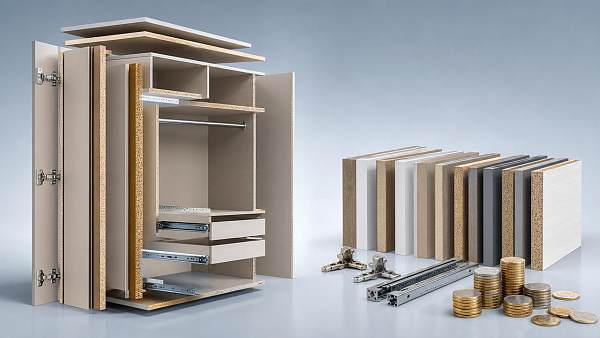
A wardrobe system quotation usually includes more than panels and doors. Buyers should separate materials, hardware, finishing, labor, delivery, and installation.
Material cost covers board type, metal framing, glass, laminates, veneers, or composite panels. This is often the most visible price driver.
Hardware cost includes hinges, runners, handles, connectors, hanging rails, locks, soft-close mechanisms, and adjustment fittings.
Installation cost depends on site complexity, wall conditions, floor leveling, access restrictions, and the number of customized adjustments required.
Hidden cost may appear through rework, missing accessories, damage during transport, unclear assembly instructions, or poor coordination with site contractors.
For large projects, buyers should request itemized pricing. This makes it easier to negotiate intelligently without weakening critical durability features.
Material Selection: Where Durability Begins
The body material determines how well wardrobe systems resist load, humidity, impact, and deformation. It should match the operating environment.
Particleboard is cost-effective for controlled indoor settings, but it depends heavily on density, edge sealing, and surface quality.
MDF offers smoother finishing and machining, though it may be vulnerable to moisture unless properly treated and sealed.
Plywood generally provides better screw-holding strength and dimensional stability, making it suitable for demanding or frequently used installations.
Metal wardrobe systems can outperform wood-based solutions in industrial or institutional environments where impact resistance and cleaning are priorities.
Buyers should not evaluate material names alone. Thickness, density, coating quality, formaldehyde class, and moisture resistance are equally important.
Hardware Is Often the Real Durability Test
Many wardrobe failures begin with hardware rather than panels. Hinges loosen, sliding tracks jam, handles break, or rails bend under weight.
For procurement teams, hardware specifications should include cycle testing, load rating, corrosion resistance, and availability of replacement parts.
Soft-close systems improve user experience, but poor-quality versions can fail quickly in high-frequency environments.
Sliding wardrobe systems need particular attention. Track alignment, roller quality, door weight tolerance, and anti-jump features affect long-term performance.
Hanging rails should be evaluated by span length and expected garment load. Unsupported long rails may sag even when panels remain intact.
A slightly higher hardware budget is often justified because repair labor and user disruption usually exceed the original component savings.
Finishes, Edges, and Moisture Protection
Surface finish affects both appearance and service life. Scratches, peeling, discoloration, and swelling create visible quality problems for end users.
Laminate, melamine, veneer, powder-coated metal, and painted finishes each offer different balances of cost, aesthetics, and resistance.
Edge banding deserves special inspection. Poorly sealed edges allow moisture penetration, especially near bathrooms, laundry zones, or humid climates.
In commercial projects, corners and exposed edges should resist chipping because impact damage quickly reduces perceived quality.
Ask suppliers how edges are bonded, whether PUR adhesive is available, and how panels are protected during transport and installation.
Moisture protection is not only about material choice. It also depends on ventilation gaps, floor clearance, sealing, and site humidity control.
Installation Quality Can Protect or Destroy Value
Even durable wardrobe systems can fail early when installation is rushed or poorly coordinated. Alignment, anchoring, and leveling directly affect performance.
Built-in systems require accurate site measurement. Small dimensional errors can create gaps, door friction, uneven loads, or expensive rework.
Modular systems reduce customization risk, but they still need clear assembly instructions and trained installers to ensure consistent results.
For multi-site procurement, installation repeatability is a major value factor. Standardized components help control labor time and quality variance.
Buyers should clarify whether installation is included, subcontracted, supervised, or excluded. Responsibility gaps often lead to disputes after delivery.
A pre-installation checklist should confirm wall strength, floor levelness, electrical conflicts, access paths, storage space, and protection of finished interiors.
Lifecycle Cost: The Metric Behind Smarter Purchasing
Lifecycle cost compares the total expense of ownership, not only the initial purchase price. It is essential for durable procurement decisions.
Key lifecycle factors include expected service years, maintenance frequency, repair cost, downtime impact, and residual value after refurbishment.
A cheaper wardrobe system may be acceptable for temporary use, short leases, or low-traffic environments with limited performance expectations.
For long-term assets, durability usually has stronger economic value because replacement disrupts operations, damages interiors, and consumes management time.
Procurement teams should model best, expected, and worst-case scenarios. This reveals whether a low bid remains competitive after realistic maintenance costs.
The most useful comparison is cost per service year. It converts different quotations into a measurable durability-adjusted purchasing metric.
A Practical Cost-versus-Durability Checklist
Use this checklist before final supplier selection. It helps separate visible price advantages from specifications that affect long-term performance.
- Define usage intensity: light residential, commercial, institutional, or industrial.
- Confirm board type, thickness, density, moisture resistance, and emission class.
- Check hinge, runner, rail, lock, and connector load ratings.
- Request cycle-test data for hinges, sliding systems, and soft-close mechanisms.
- Inspect edge banding quality, adhesive type, and exposed-edge protection.
- Confirm finish resistance against scratching, staining, humidity, and cleaning chemicals.
- Clarify installation responsibility, measurement method, and site acceptance criteria.
- Request spare parts availability and expected lead time for replacements.
- Compare warranty terms, exclusions, claim procedures, and response commitments.
- Calculate cost per service year instead of relying on initial unit price.
The checklist works best when used with samples, mockups, or pilot rooms. Physical inspection often reveals differences hidden in quotation sheets.
Supplier Evaluation Beyond the Product Sheet
Supplier reliability is a durability factor because consistent manufacturing reduces defects, delays, and mismatched replacement parts.
Buyers should evaluate production capacity, quality control procedures, packaging standards, project references, and ability to handle customization.
For international sourcing, documentation matters. Confirm technical drawings, material certificates, compliance data, inspection reports, and packaging specifications.
Factory audits or third-party inspections are especially useful for large orders. They reduce the risk of receiving inconsistent batches.
Procurement teams should also review communication quality. Slow responses during quotation often predict slower support during claims or installation problems.
A strong supplier can explain trade-offs transparently. A weak supplier simply lowers price without clarifying what specification has changed.
When Paying More Is Justified
A higher price is justified when it reduces measurable operational risk. This is especially true for projects with high occupancy or heavy use.
Premium hardware, moisture-resistant materials, stronger edging, and better installation control can reduce complaints and maintenance calls.
For hotels and serviced apartments, visible wardrobe damage can affect guest perception and brand quality more than buyers initially expect.
For hospitals, schools, dormitories, and worker housing, durability influences safety, hygiene, and the workload of facility teams.
For industrial environments, metal or reinforced systems may be preferable because they better withstand impact, cleaning, and security requirements.
The decision should be based on documented risk reduction, not vague premium positioning or aesthetic upgrades with limited operational value.
When Lower-Cost Wardrobe Systems Make Sense
Lower-cost wardrobe systems can be rational when the use case is temporary, controlled, or unlikely to experience heavy mechanical stress.
Examples include short-term accommodations, low-traffic offices, staging spaces, budget rental units, or projects with planned refurbishment cycles.
In these cases, buyers should still protect critical basics. Weak hinges, poor edge sealing, and unstable installation can create immediate failures.
The goal is not to avoid low-cost options. The goal is to know which specifications can be simplified without undermining function.
For value engineering, reduce decorative complexity before reducing structural integrity. Simpler finishes often save money with less durability impact.
Procurement teams should document any specification reductions. This prevents later disputes if performance expectations exceed the purchased quality level.
Red Flags in Wardrobe System Quotations
Some quotations look attractive because they omit important assumptions. Buyers should investigate unclear specifications before awarding a contract.
Red flags include missing board thickness, vague hardware brands, unclear installation scope, no load ratings, and unusually short warranty language.
Be cautious when suppliers avoid providing samples, drawings, packaging details, or previous project references for similar applications.
Another warning sign is a large price gap without a clear technical explanation. The lowest bid may have removed essential durability features.
Quotations should also state whether prices include taxes, freight, unloading, site handling, installation, protection, and post-installation adjustment.
Clear documentation protects both buyer and supplier. It reduces misunderstandings and makes performance expectations easier to enforce.
How to Build a Balanced Procurement Specification
A balanced specification should define performance requirements without overengineering every detail. This keeps competition open while protecting quality.
Start with intended service life, user intensity, environmental conditions, and maintenance expectations. Then translate these needs into measurable requirements.
Include minimum material thickness, moisture resistance, hardware load ratings, finish durability, installation tolerances, and spare parts availability.
Allow approved equivalents where appropriate, but require suppliers to disclose deviations from the baseline specification.
For larger projects, request a mockup before full production. This allows stakeholders to test usability, appearance, hardware feel, and installation method.
The final specification should support fair comparison. Every bidder should price the same functional outcome, not a different interpretation.
Final Takeaway for Procurement Decisions
Wardrobe systems should be evaluated as long-term functional assets, not standalone furniture purchases. Their real cost emerges through daily use.
The best procurement decision balances application, material strength, hardware quality, finish protection, installation reliability, and supplier accountability.
Buyers should avoid both extremes: overpaying for unnecessary features and underbuying systems that cannot survive the operating environment.
A structured cost-versus-durability checklist creates clearer comparisons, fewer disputes, and stronger lifecycle value across residential, commercial, and industrial projects.
When specifications are aligned with real use conditions, wardrobe systems become easier to source, easier to maintain, and more economical over time.