Monday, May 22, 2024

How to Compare Custom Injection Molds Without Overpaying
by
Published
Views:
Comparing custom injection molds should never mean guessing which quote hides the real cost. For procurement professionals, the right decision depends on balancing tooling quality, material compatibility, cycle life, lead time, and supplier transparency. This guide explains how to evaluate custom injection molds with a technical and commercial lens, helping you avoid overpaying while securing reliable performance across global manufacturing programs.
A checklist-based approach matters because mold quotations often look comparable on the surface while masking major differences in steel grade, cavity design, hot runner selection, surface treatment, maintenance assumptions, and validation scope. In cross-border sourcing, these gaps can multiply through delayed launches, unstable part quality, expensive engineering changes, and avoidable tool transfers. For buyers working across automotive, electronics, industrial equipment, and broader manufacturing, the smartest way to compare custom injection molds is to verify the few technical and commercial points that drive lifetime cost, not just purchase price.
Start with the right comparison logic before reviewing any quote
Before requesting or comparing prices for custom injection molds, procurement teams should confirm that every supplier is quoting against the same part data, production assumptions, and validation expectations. Without that alignment, the lower quote may simply exclude necessary work.
- Use the same 3D model, 2D drawing, resin specification, annual volume, and target geography for every RFQ.
- State whether the mold is for prototyping, bridge production, or full serial manufacturing.
- Define expected tool life in shots, not vague phrases like “production mold.”
- Specify quality documents required, such as FAI, mold flow, steel certificates, dimensional reports, and process capability data.
- Clarify whether the supplier is responsible for part molding trials only or full PPAP-style validation.
This first step is where many overpayments begin. If one supplier includes DFM support, cooling analysis, spare inserts, and pre-shipment sampling while another excludes them, the quote comparison is not valid. A disciplined sourcing team compares custom injection molds only after normalizing assumptions.
Core checklist: the technical factors that most affect total mold cost
When evaluating custom injection molds, these are the most important checkpoints. They directly influence durability, part consistency, cycle time, maintenance burden, and the real cost per molded part.
1. Mold steel and hardness must match resin, geometry, and expected life
Steel selection is one of the clearest reasons why quotes differ. P20 may be acceptable for lower-volume or less abrasive applications, while H13, S136, 1.2344, or hardened stainless grades may be better for high-volume production, corrosive resins, or tight cosmetic demands. Buyers should not ask only “what steel is used?” but also “what hardness and where?” Cavities, cores, inserts, sliders, and wear components may use different materials for good reason.
A lower-cost steel can be reasonable for short runs, but it becomes expensive if the tool must support glass-filled nylon, flame-retardant compounds, or high-cavitation output over a long life. In that case, cheap steel often means faster wear, flashing, unstable dimensions, and more downtime.
2. Cavity count should be justified by demand, not by marketing
More cavities do not automatically mean better economics. A multi-cavity mold can reduce piece cost, but it also raises tooling price, balancing complexity, sampling effort, and repair cost. Procurement should ask for a break-even view: annual volume, target cycle time, machine tonnage, scrap assumptions, and expected payback period.
For uncertain programs, a lower-cavity tool with room for future expansion may be smarter than overbuilding on day one. This is especially important for industrial products with volatile forecasts or phased launches across regions.
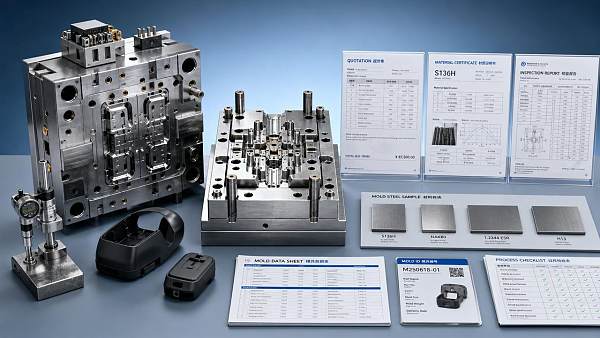
3. Gate and runner design strongly influence waste and cycle time
Cold runner and hot runner systems should be reviewed in commercial terms, not only technical terms. Hot runners increase initial tool cost, but they can lower material waste, reduce post-processing, and support better filling for complex geometries. For expensive engineering plastics, the material savings can justify the investment quickly. For simple commodity parts, a well-designed cold runner may still be the better choice.
Ask suppliers to explain why the gate location, gate type, and runner system fit the part. A quote for custom injection molds that does not document the molding concept leaves too much risk hidden.
4. Cooling design is a cost issue, not just a process issue
Cooling drives cycle time, warpage control, and output stability. Poor cooling may still produce acceptable trial samples, but at slower rates and with larger process windows. That means higher manufacturing cost later. Buyers should ask whether the tool design includes optimized cooling channels, baffles, bubblers, or special inserts where needed. For precision tooling decisions, cooling efficiency often separates a cheap quote from a cost-effective one.
5. Wear parts, venting, and maintenance access need explicit review
Custom injection molds should be assessed for maintainability. Replaceable inserts, standard components, easy cleaning access, and robust venting reduce future service cost. If a supplier cuts price by simplifying venting or using nonstandard components, the long-term penalty can be severe. This matters even more in global manufacturing programs where a mold may be maintained in more than one region.
Use a commercial comparison table, not just supplier promises
A structured comparison table helps procurement teams benchmark custom injection molds objectively. The goal is to see what is included, what is excluded, and where one quote shifts cost into the future.
Check different use cases because not all custom injection molds should be judged the same way
Procurement decisions improve when the mold is judged in the context of the part’s actual application. The right benchmark for consumer electronics may be wrong for automotive or industrial infrastructure components.
For tight-tolerance and technical parts
Prioritize dimensional repeatability, cooling performance, venting, process window stability, and corrective engineering support. Here, better toolmaking often lowers downstream inspection, scrap, and assembly issues.
For cosmetic or visible parts
Surface finish standards, gate witness visibility, texture consistency, weld line control, and packaging for sample approval become critical. A low quote can become expensive if repeated polishing or appearance rework is required.
For high-volume commodity parts
Focus on cycle time, automation compatibility, cavity balance, maintenance intervals, and spare component strategy. In this case, a slightly higher-cost mold may generate the lowest total landed cost over time.
For regulated or qualification-heavy programs
Document control, traceability, material certificates, revision history, and change management should be reviewed early. Overpaying often comes from late discovery that the supplier cannot support your compliance workflow.
Common hidden costs buyers miss when sourcing custom injection molds
- Engineering changes after steel cut because DFM concerns were not resolved upfront.
- Extra polishing, texture correction, or shutoff repair after weak initial tool design.
- Repeated sample shipments due to unclear acceptance criteria.
- Machine mismatch if the tool requires larger tonnage or different utilities than planned.
- High scrap rates caused by unstable filling, poor venting, or inconsistent cooling.
- No spare inserts or vulnerable wear parts for global production continuity.
- Tool transfer costs when ownership language, CAD data, or electrode files are incomplete.
These issues are especially relevant for procurement leaders seeking supply chain resilience. From a benchmarking perspective, the best source for custom injection molds is not simply the cheapest workshop, but the supplier whose tooling assumptions remain transparent under audit.
A practical execution plan for procurement teams
- Build a standard RFQ package with part files, resin data, annual demand, validation needs, and delivery milestones.
- Require every supplier to break down tooling scope, steel grades, runner system, included samples, and exclusions.
- Score custom injection molds using weighted criteria: durability, manufacturability, lead time, quality support, and commercial clarity.
- Review DFM and mold flow before placing the order, not after PO release.
- Confirm ownership terms, spare parts list, maintenance manual, and digital data handover requirements.
- Align internal engineering, quality, and operations teams on the award decision so the lowest bid does not win by default.
Organizations such as Global Industrial Matrix support this type of sourcing discipline by emphasizing cross-sector benchmarking, standards alignment, and technical transparency. For buyers comparing custom injection molds across suppliers and regions, that broader systems view is valuable because tooling cost is rarely an isolated number; it is connected to process capability, supplier maturity, and manufacturing risk across the full program lifecycle.
FAQ: quick answers buyers often need
Should I always choose hardened steel for custom injection molds?
No. Hardened steel is often right for long tool life, abrasive resins, or critical tolerances, but it is not always necessary for low-volume programs. Match the steel strategy to resin, geometry, expected shots, and quality risk.
Is a hot runner always worth the extra price?
Not always. It is usually more attractive for expensive materials, high-volume output, and parts where waste reduction or gate quality matters. For simpler runs, a cold runner can remain the better economic option.
What is the best way to prevent overpaying?
Normalize the RFQ, demand full scope transparency, and compare total lifecycle value rather than only tool price. The more clearly suppliers document their assumptions, the easier it becomes to identify real value in custom injection molds.
Final decision checklist before awarding the tool
Before issuing a purchase order, confirm five final points: the mold design matches part performance requirements, the quote includes the full validation scope, the expected tool life is documented, ownership and transfer rights are clear, and the supplier can support ongoing maintenance or regional production expansion. If any of these points remain vague, the quote may still be too expensive even if the number looks attractive.
If you need to move forward with custom injection molds, the best next step is to prepare a clean RFQ package and ask suppliers to respond to the same technical and commercial checklist. Prioritize discussion around steel selection, cavity strategy, resin compatibility, cycle life, trial scope, lead time, spare parts, and transfer terms. Those are the questions that reduce uncertainty, improve supplier comparability, and help procurement teams secure the right mold without overpaying.
The Archive Newsletter
Critical industrial intelligence delivered every Tuesday. Peer-reviewed summaries of the week's most impactful logistics and market shifts.