Monday, May 22, 2024

Injection Molding Exporter Lead Time Warning Signs
by
Published
Views:
For distributors, agents, and sourcing partners, choosing an injection molding exporter is not just about price—it is about delivery reliability, production visibility, and long-term supply stability.
Early lead time warning signs often reveal deeper issues in tooling capacity, quality control, or cross-border coordination. Understanding these signals helps buyers reduce risk and protect downstream commitments.
Why Lead Time Warnings Matter More Than Unit Price
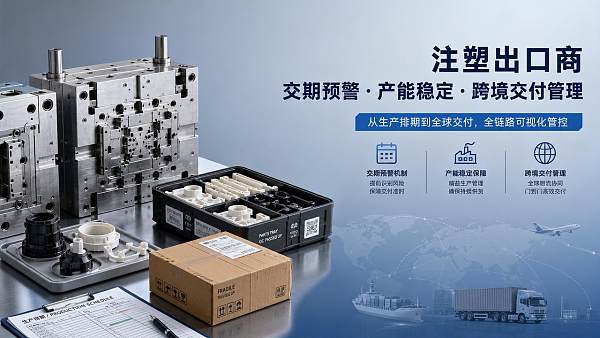
When buyers search for an injection molding exporter, they usually want one answer first: can this supplier deliver consistently without creating hidden operational risk?
For distributors and sourcing intermediaries, late molded parts can trigger missed customer launches, penalty exposure, excess expediting cost, and long-term damage to account trust.
That is why lead time should be treated as a risk indicator, not just a scheduling detail. It reflects production discipline, tooling readiness, planning maturity, and export execution.
If an exporter struggles to explain realistic timing, the issue is rarely isolated. It often points to deeper instability in mold maintenance, raw material planning, or factory coordination.
The practical takeaway is simple: a low quotation from an injection molding exporter loses value quickly when shipment dates keep moving and communication becomes reactive.
What Search Intent Really Looks Like for This Topic
The core search intent behind this topic is commercial risk evaluation. Readers are not looking for a textbook definition of injection molding or a generic supplier checklist.
They want to know how to detect warning signs early, how to qualify exporters before placing larger orders, and how to avoid supply disruptions after onboarding.
Target readers also want evidence-based ways to compare suppliers. They need signals they can use in RFQ reviews, audits, sample orders, and account planning discussions.
In other words, the value of this article lies in helping buyers judge exporter reliability before delays become expensive and visible to end customers.
What Distributors and Agents Usually Care About Most
Distributors and agents operate between factory promises and customer expectations. Their biggest concern is whether committed lead times will survive real production pressure.
They also care about visibility. A supplier that gives weekly updates with tooling status, material arrival dates, and inspection milestones is easier to manage than one that reports only after slippage.
Margin protection matters too. Delays create air freight, rework, split shipments, and emergency customer service workload. These hidden costs can erase a seemingly attractive purchase price.
Another major concern is scalability. Many exporters perform well on prototypes or trial runs but fail when volumes increase, molds multiply, or product mix becomes more complex.
Finally, readers want to know whether the exporter can support long-term business, not just the next purchase order. Stable process control matters more than short-term flexibility alone.
Early Lead Time Warning Signs You Should Not Ignore
The first warning sign is vague quoting language. If the exporter gives broad timing like “about four to six weeks” without separating tooling, sampling, and mass production, caution is justified.
A reliable injection molding exporter should specify lead times by stage: DFM review, mold fabrication, T1 sampling, correction cycles, production ramp, inspection, and export release.
The second warning sign is inconsistent answers from sales, engineering, and production teams. When each contact gives a different timeline, internal planning alignment is probably weak.
The third warning sign is overdependence on subcontractors without clear control points. Outsourced mold making, secondary operations, or packaging are not automatically bad, but unmanaged outsourcing adds uncertainty.
The fourth warning sign is poor tooling visibility. If the exporter cannot explain mold cavitation, preventive maintenance intervals, expected tool life, or backup plans, future delays are likely.
The fifth warning sign is unrealistic capacity claims. Some suppliers accept aggressive orders to win business, then juggle machines, labor, and molds later under production stress.
The sixth warning sign is repeated sample revision cycles without root-cause clarity. Frequent corrections can indicate weak DFM discipline, unstable processing, or weak communication with mold makers.
The seventh warning sign is material uncertainty. If resin grade sourcing, approval status, or color matching timelines are unclear, mass production dates may slip even when tooling is ready.
The eighth warning sign is weak export coordination. Packaging approval, labeling, customs documents, and freight booking can all delay shipment if not planned with manufacturing milestones.
How to Distinguish a Temporary Delay from a Structural Problem
Not every delay means a supplier is unsuitable. Tool steel shortages, resin allocation issues, and port congestion can affect even strong manufacturers.
The key is whether the exporter can explain the cause, quantify the impact, and present a recovery plan supported by real production data.
A temporary delay usually comes with traceable evidence: purchase order dates, mold progress photos, revised machine schedules, incoming material ETAs, and clear next checkpoints.
A structural problem looks different. Timelines change repeatedly, explanations remain generic, and no one can connect engineering, planning, and logistics into one credible schedule.
Buyers should pay attention to revision frequency. One adjusted milestone may be manageable. Multiple rolling delays across sample approval, mold correction, and shipment release indicate systemic weakness.
Questions That Expose Exporter Reliability Before You Commit
Strong qualification depends less on broad promises and more on precise questions. The right questions reveal whether a supplier truly understands its own process constraints.
Ask how lead time is built. Is quoted time based on actual machine loading, mold complexity, resin availability, and finishing requirements, or just a sales estimate?
Ask what percentage of orders ship on time over the last six to twelve months. A serious exporter should track delivery performance, not guess at it.
Ask how many molds are currently running per press family and per shift. This helps expose overloaded capacity hidden behind optimistic quotations.
Ask whether tooling is built in-house or externally and who owns corrective action if T1 or T2 samples fail. This is critical to schedule accountability.
Ask what triggers escalation. For example, at what point does the exporter notify customers if a mold correction, resin shortage, or quality issue threatens shipment?
Ask for a sample production timeline from a similar project. Real schedules are often more revealing than polished capability presentations.
Operational Signals Inside the Factory That Affect Lead Time
Lead time reliability is usually created on the shop floor, not in the sales office. Several operational signals deserve attention during qualification.
First, observe mold management. Organized tool storage, maintenance records, and quick traceability usually correlate with better schedule control and lower downtime risk.
Second, review changeover discipline. Long setup times, unclear line clearance, and weak parameter control reduce schedule flexibility and increase late-order risk.
Third, examine quality containment. If defects are detected late, machines and molds get tied up with sorting and reruns, pushing other orders behind plan.
Fourth, evaluate planning integration. A good exporter aligns purchasing, molding, secondary operations, packing, and shipping through one coordinated production plan.
Fifth, look at communication routines. Daily production boards, exception logs, and milestone reporting are practical signs that the factory manages time actively.
Why Tooling, Sampling, and Engineering Changes Often Cause Hidden Delays
Many buyers underestimate the role of tooling in exporter lead time. In reality, molds are often the main source of early scheduling distortion.
If DFM feedback is rushed or incomplete, the mold may require multiple corrections after T1. That creates additional machining, polishing, fitting, and resampling delays.
Engineering changes can also disrupt schedules if revision control is weak. Even small design updates can affect shrinkage behavior, gate position, cooling balance, or cosmetic acceptance.
For distributors handling multiple customers, this matters because technical change latency can spill into commercial commitments faster than expected.
A capable injection molding exporter should define who approves changes, how revisions are frozen, and what lead time impact each change may create before proceeding.
How Cross-Border Complexity Increases the Risk of Lead Time Slippage
Export supply chains involve more than molding. Label compliance, carton specifications, pallet rules, customs paperwork, and destination documentation can all affect final ship dates.
This is especially important for agents and distributors serving regulated sectors, branded consumer goods, or industrial assemblies with customer-specific packaging requirements.
Some exporters are technically strong in molding but weak in export execution. They produce finished parts on time, then lose days resolving documentation or packing errors.
To reduce this risk, buyers should confirm ownership for each handoff: production release, final inspection, packaging approval, booking request, customs file, and shipment confirmation.
Cross-border readiness is part of supplier capability. It should be evaluated with the same seriousness as machine tonnage, mold capacity, and resin processing expertise.
What a Strong Injection Molding Exporter Usually Does Differently
The best exporters are not perfect, but they are transparent, structured, and measurable. They make lead time visible instead of treating it as a sales commitment only.
They provide milestone-based schedules, not just one promised date. They explain assumptions, dependencies, and approval gates before production begins.
They also separate prototype timing from mass-production timing. This prevents buyers from assuming that successful samples automatically guarantee stable scale-up performance.
Strong exporters maintain discipline in mold maintenance, material qualification, process validation, and shipment preparation. These are the foundations of predictable delivery.
Most importantly, they communicate risk early. Buyers can usually manage bad news if it comes with facts and options; they cannot manage silence followed by surprise delays.
A Practical Qualification Framework for Buyers and Sourcing Partners
If you are screening a new supplier, use a simple four-part framework: quote clarity, process visibility, capacity realism, and escalation discipline.
Under quote clarity, confirm stage-by-stage timing and assumptions. Under process visibility, ask for milestone tracking and update frequency.
Under capacity realism, review machine loading, mold resources, labor stability, and subcontractor control. Under escalation discipline, test how the exporter reports and manages exceptions.
For higher-risk programs, start with a pilot order or controlled SKU family. Measure response speed, sample accuracy, and schedule adherence before expanding the relationship.
This approach helps distributors and agents qualify an injection molding exporter with evidence rather than relying on presentation quality or price advantage alone.
Conclusion: Treat Lead Time Signals as Strategic Risk Data
For distributors, agents, and sourcing intermediaries, lead time warning signs are rarely just timing issues. They are early indicators of process weakness, tooling instability, or poor coordination.
The most reliable injection molding exporter is not necessarily the one with the shortest quoted timeline. It is the one that can explain, control, and consistently achieve realistic milestones.
By focusing on operational transparency, tooling discipline, capacity truthfulness, and export readiness, buyers can reduce disruption and improve customer confidence.
In practical terms, the right decision comes from asking sharper questions earlier. When lead time is evaluated as strategic risk data, supplier selection becomes much stronger and more defensible.

The Archive Newsletter
Critical industrial intelligence delivered every Tuesday. Peer-reviewed summaries of the week's most impactful logistics and market shifts.