
Is injection molding suitable for chemically resistant parts? Yes—but reliable performance depends on matching the resin, part design, and molding process to the actual chemical exposure.
For engineers and procurement teams sourcing automotive fluid components, semiconductor handling equipment, or water-treatment hardware, an unsuitable material can cause swelling, cracking, leakage, and costly downtime.
Chemical concentration, operating temperature, mechanical stress, and exposure duration all influence material selection. Application-specific testing is essential before approving a resin or committing to production tooling.
The practical question is whether a specific molded component can retain its required strength, dimensions, cleanliness, and sealing performance throughout its intended service life under exposure.
What chemical exposure must the part actually withstand?
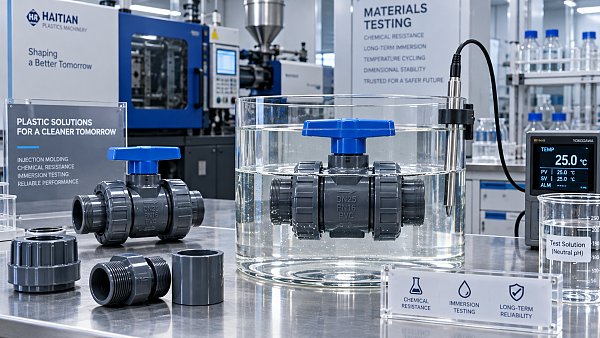
Start with a complete exposure specification. A description such as “acid-resistant housing” leaves too many uncertainties for meaningful material comparison, supplier qualification, or service-life assessment work.
Identify every chemical contacting the component, including process fluids, cleaners, disinfectants, lubricants, and accidental contaminants. Record their concentrations and whether those concentrations change during normal operation.
Include temperature ranges and realistic peaks. A resin that tolerates a chemical at room temperature may soften, degrade, or become more permeable under sustained elevated temperatures.
Distinguish continuous immersion from splashes, vapor exposure, and intermittent cleaning. Repeated wetting and drying can create conditions that a simple immersion result does not adequately represent.
Mixtures require particular care because compatibility with individual ingredients does not establish compatibility with the combined fluid. Additives and impurities can also change the failure mechanism.
Define mechanical conditions alongside chemistry: internal pressure, bolt preload, vibration, bending, and thermal cycling. Chemically exposed plastics may fail at stresses acceptable under dry operating conditions.
Finally, state what failure means for the application. Discoloration may be acceptable; leakage, particle release, dimensional drift, or loss of pressure capability may be entirely unacceptable.
This specification gives engineers and buyers a common basis for screening materials. It also prevents suppliers from answering a demanding application question with a generic compatibility chart.
Which injection-molding resins deserve consideration?
Chemical resistance belongs to a particular material formulation under particular conditions. Polymer-family names provide a starting point, but approval should identify the exact commercially available grade.
The following comparison supports initial screening. It does not establish suitability for a named chemical, concentration, temperature, pressure, or service duration without supporting application-specific qualification
