Monday, May 22, 2024

Precision Molds: Common Tolerance Mistakes That Cause Rework
by
Published
Views:
In precision molds, small tolerance mistakes can trigger costly rework, quality escapes, and compliance risks across the production chain. For quality control and safety management teams, understanding where these errors start is essential to protecting part consistency, tooling life, and delivery performance. This article examines the most common tolerance pitfalls and how to prevent them through better specification, inspection, and process control.
Why tolerance control matters in precision molds
Precision molds are the foundation of repeatable manufacturing in sectors as varied as automotive connectors, electronic housings, fluid control components, agricultural device assemblies, and environmental equipment. In these applications, a mold is not only a shaping tool; it is a controlled system that transfers dimensional intent into thousands or millions of parts. When tolerance logic is weak, the problem does not stay inside the tool room. It spreads into assembly instability, inspection failures, machine stoppages, customer complaints, and sometimes even field safety incidents.
For quality and safety teams, precision molds deserve special attention because tolerance errors often hide behind acceptable-looking first samples. A cavity may pass a basic dimensional check, yet still create flash, short shots, stress concentration, poor sealing, or unreliable fit under real production conditions. In global manufacturing environments governed by ISO, IATF, and customer-specific standards, these failures create direct rework cost and indirect risk through delayed qualification, line disruption, and audit exposure.
This is why the discussion around precision molds should move beyond “tight tolerances are better.” The real issue is whether tolerances are functional, measurable, process-capable, and clearly communicated across design, tooling, production, and inspection teams.
What tolerance means in the context of precision molds
In precision molds, tolerance defines the allowable dimensional variation of mold features and molded parts while still meeting performance requirements. That includes size, flatness, perpendicularity, concentricity, shut-off integrity, surface condition, and fit-related geometry. However, mold tolerance cannot be treated as a single number on a drawing. It is influenced by material shrinkage, thermal behavior, machine repeatability, wear rate, venting, gate balance, ejection force, and post-processing conditions.
A common mistake in cross-functional projects is to assign drawing tolerances without linking them to the actual molding process window. For example, a dimension may appear easy to machine into the mold, but become unstable in production because of resin variation, cooling imbalance, or insert movement. For this reason, precision molds must be evaluated as part geometry plus process behavior, not geometry alone.
Industry background: why tolerance mistakes are becoming more costly
Several manufacturing trends have increased the cost of tolerance mistakes in precision molds. First, product architectures are becoming more compact. In electronics and mobility systems, smaller interfaces leave less room for dimensional drift. Second, multi-material assemblies demand more precise alignment between molded, stamped, and machined parts. Third, supply chains are more globally distributed, which means data interpretation errors between design centers, toolmakers, and production plants happen more easily. Fourth, compliance expectations are rising, especially in industries where traceability and process validation matter.
Organizations such as Global Industrial Matrix emphasize cross-sector benchmarking because mold quality is rarely isolated within one factory or one discipline. A tolerance strategy that works for consumer parts may fail in automotive, agricultural, or water infrastructure applications where vibration, pressure, temperature cycling, and environmental exposure amplify minor dimensional errors. For quality control personnel, this means tolerance review should be treated as a system-level risk activity rather than a narrow drawing check.
Common tolerance mistakes that cause rework
1. Over-tolerancing non-critical features
One of the most frequent errors in precision molds is applying unnecessarily tight tolerances to features that do not affect fit, sealing, motion, or appearance. This increases machining time, polishing difficulty, inspection burden, and tool adjustment cycles. Worse, it diverts attention from truly critical dimensions. Quality teams should help define what is function-critical versus what is cosmetically or operationally secondary.
2. Underestimating material shrinkage variation
Shrinkage is often treated as a static design input, but in practice it changes with resin lot, filler orientation, wall thickness, gate location, cooling pattern, and machine settings. If mold design assumes ideal shrinkage only, the resulting part may drift outside target after process transfer. This is especially important in precision molds used for engineering plastics, fiber-filled materials, and parts with asymmetric geometry.
3. Poor datum selection
Rework often starts with datums that are easy to inspect but irrelevant to actual assembly behavior. If the datum structure does not match how the part locates in downstream use, measurements can appear acceptable while the product still fails during fitting. In precision molds, datum alignment should reflect real contact surfaces, fastening points, and functional interfaces.
4. Ignoring stack-up across tool, part, and assembly
A single cavity dimension may be within tolerance, yet the final assembly fails because multiple permissible deviations accumulate. Stack-up analysis is essential when precision molds feed into multi-component systems such as connector shells, valve bodies, battery module supports, sensor carriers, or filtration housings. Without stack-up discipline, teams chase symptoms by adjusting the mold after production has already started.
5. Confusing machining capability with molding capability
Toolmakers may achieve excellent precision on inserts, cores, and slides, but the molded part still varies because process capability is lower than machining capability. This mistake appears when teams validate precision molds using tool dimensions alone, without proving repeatable molded output across shifts, machines, and environmental conditions.
6. Inadequate control of wear-prone features
Shut-offs, slides, lifters, pins, gates, and vent edges can wear quickly in high-volume production. If tolerance plans focus only on the initial tool condition, rework becomes inevitable as the mold ages. Quality and safety managers should ensure that preventive maintenance intervals are tied to wear-sensitive tolerances, not just total shot count.
7. Inconsistent inspection methods
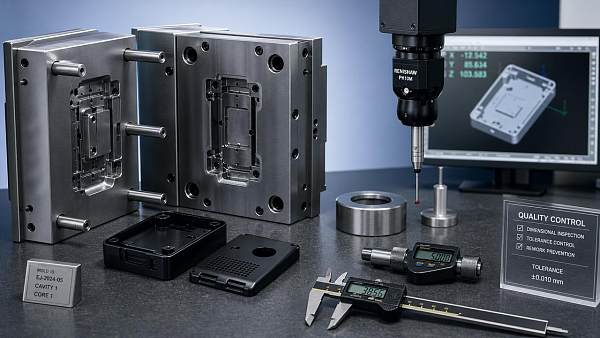
Different inspection setups can produce different results on the same feature. Contact CMM measurement, optical scanning, pin gauges, and fixture-based checks may not agree unless measurement conditions are standardized. In precision molds, this inconsistency creates unnecessary rework because teams modify tools to solve what is actually a measurement system problem.
8. Missing links between tolerance and safety risk
Some dimensions are not only quality-related but safety-relevant. Examples include sealing surfaces, locking interfaces, insulation barriers, pressure-retaining features, and structural snap-fits. If these are treated like ordinary dimensions, organizations may underestimate the severity of drift. Precision molds serving regulated or safety-sensitive products need risk ranking that connects dimensional deviation with failure mode consequences.
A practical overview of where tolerance failures typically originate
The table below helps quality control and safety management teams map common tolerance issues in precision molds to their likely source and operational effect.
Where precision molds create the most value when tolerances are right
Well-controlled precision molds deliver value far beyond dimensional compliance. They stabilize cycle performance, reduce corrective polishing and fitting, improve first-pass yield, and protect interchangeability across production sites. For organizations operating in multiple industries, this consistency supports more reliable sourcing, faster qualification, and stronger confidence during audits.
For quality teams, good tolerance control means fewer recurring deviations and clearer root-cause separation between tool, process, and material. For safety managers, it improves confidence that critical features will remain within validated limits throughout the tool life. For procurement and operations leaders, it reduces hidden cost from line stoppages, sorting, expedited tooling modifications, and customer-facing containment actions.
Typical control priorities by application type
Not all precision molds carry the same tolerance priorities. Control plans should reflect the functional role of the molded part.
Practical recommendations to reduce rework in precision molds
First, build tolerances around function. Every tight callout should answer a specific assembly, sealing, motion, electrical, or safety requirement. Second, validate mold design with stack-up analysis and realistic process assumptions, not nominal geometry only. Third, standardize datums between design, tooling, and final inspection so that all teams are evaluating the same part behavior.
Fourth, connect dimensional control to process capability studies. Precision molds should be approved based on stable molded-part output across defined operating conditions. Fifth, strengthen measurement system analysis for critical features, especially where optical and tactile methods may disagree. Sixth, create maintenance triggers for wear-prone mold areas before drift becomes visible in finished parts.
It is also wise to classify dimensions by criticality. A practical tiered approach often includes safety-critical, function-critical, assembly-critical, and cosmetic dimensions. This helps quality control teams prioritize sampling, escalation, and reaction plans. In high-volume programs, digital traceability of cavity performance can further identify which mold zones are drifting before broad rework is required.
How quality and safety teams should frame their review
When reviewing precision molds, do not ask only whether a dimension is in tolerance. Ask whether the tolerance is function-based, whether the inspection method is repeatable, whether the process can hold it over time, and whether drift could create a safety or compliance issue. This broader review model is especially important in global operations where multiple plants, suppliers, and auditors rely on the same technical definition.
A disciplined review process reduces conflict between design intent and manufacturing reality. It also supports better decision-making when deviations occur, because teams can distinguish between acceptable process variation, emerging tool wear, and urgent nonconformance that threatens customer performance.
Conclusion
Tolerance mistakes in precision molds rarely begin as dramatic failures. More often, they start as small disconnects between design, process, inspection, and maintenance. Yet those small gaps can lead to recurring rework, unstable output, and elevated safety risk. For organizations seeking resilient manufacturing performance, the strongest approach is to treat precision molds as a system requiring aligned specifications, validated measurement, and ongoing process control.
If your team is evaluating precision molds across suppliers or production regions, use a cross-functional tolerance review that combines tooling knowledge, quality evidence, and application risk. That is the most reliable path to fewer corrections, stronger compliance, and better long-term manufacturing confidence.

The Archive Newsletter
Critical industrial intelligence delivered every Tuesday. Peer-reviewed summaries of the week's most impactful logistics and market shifts.