Monday, May 22, 2024

CNC Milling Machines Price: New vs Used Cost Breakdown
by
Published
Views:
Understanding CNC milling machines price is central to capital planning across modern manufacturing, repair, prototyping, and industrial infrastructure projects.
A machine’s sticker price rarely reflects its full economic impact. Control generation, spindle hours, tooling condition, retrofit potential, and serviceability often matter more than the first invoice.
This guide compares new and used equipment costs in a practical way. It helps evaluate budget exposure, production fit, maintenance risk, and long-term return before committing funds.
CNC milling machines price fundamentals
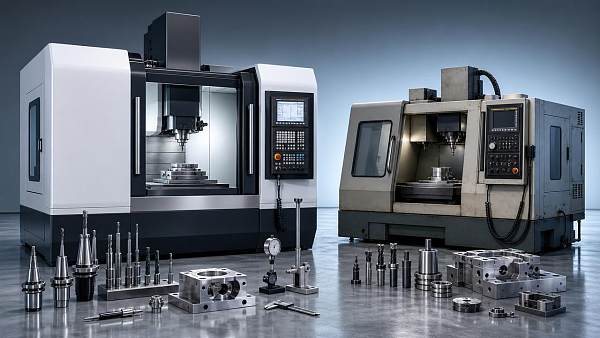
The term CNC milling machines price covers far more than base machine cost. It includes motion accuracy, control software, axis configuration, enclosure design, and installation requirements.
A compact 3-axis vertical machining center may cost a fraction of a 5-axis platform. However, part complexity and labor savings can reverse that comparison over time.
In broad market terms, entry-level new machines often start near USD 25,000 to 60,000. Mid-range industrial units commonly span USD 60,000 to 180,000.
High-precision, multi-axis, or automation-ready systems can exceed USD 250,000. Premium aerospace or medical configurations may move well beyond USD 500,000.
Used machine pricing is wider and less predictable. A serviceable older VMC may fall between USD 12,000 and 45,000, while late-model used equipment can remain above USD 100,000.
The real comparison depends on application, tolerance, uptime target, and support expectations. That is why CNC milling machines price should be reviewed as a lifecycle decision.
Primary cost drivers
- Axis count, travel range, and table load capacity
- Spindle power, speed, taper type, and thermal stability
- Controller brand, software licenses, and upgrade path
- Tool changer size, probing, coolant, and chip management
- Machine age, service records, geometry condition, and brand reputation
New versus used cost breakdown
Comparing new and used equipment requires separating purchase cost from operating cost. Lower entry price does not automatically mean lower total ownership cost.
A new machine generally offers better energy efficiency, documentation, and process consistency. It also simplifies qualification when parts must meet strict traceability or international benchmark standards.
Used equipment can create strong value when geometry is verified, controls remain supported, and replacement parts are still available. In many cases, this is the fastest route to extra capacity.
Typical hidden costs
- Rigging, freight, customs, and site preparation
- Voltage conversion and compressed air upgrades
- Tool holders, vises, probes, and CAM post edits
- Operator training and initial process validation
- Unexpected spindle, ballscrew, or servo repairs
Industry signals shaping CNC milling machines price
Across integrated industries, demand for tighter tolerances and shorter lead times is influencing CNC milling machines price at every machine tier.
Electronics production needs stable machining for fixtures, heat sinks, and precision housings. Automotive programs require repeatability, faster cycle times, and scalable setups.
Agri-tech and environmental equipment also rely on machined manifolds, pump components, brackets, and structural parts. These applications increase interest in versatile, durable machining platforms.
This broader context explains why CNC milling machines price is no longer a simple commodity question. It is tied to resilience, digital readiness, and output consistency.
Business value and ownership economics
The best machine choice supports part mix, expected utilization, and service continuity. That is the basis for a meaningful cost comparison.
A lower-cost used machine may deliver excellent payback for simple aluminum parts, fixture work, or secondary operations with moderate tolerance bands.
A new machine often performs better when unattended operation, difficult materials, or frequent model changes are expected. Higher precision can reduce scrap and rework.
For many operations, the true value sits in uptime. A machine that misses deliveries or requires repeated service can quickly erase any apparent purchase savings.
Useful ownership metrics
- Cost per productive spindle hour
- Scrap reduction potential
- Setup time savings
- Annual maintenance forecast
- Residual value after three to five years
Common machine categories and expected price ranges
The following ranges are indicative only. Brand, region, and specification can shift actual CNC milling machines price significantly.
These ranges show why the phrase CNC milling machines price must always be linked to capability, not just machine type.
Practical evaluation points before purchase
A structured review reduces financial surprises and improves selection accuracy. This is especially important when comparing newer imported platforms with established used brands.
- Verify spindle runout, backlash, and axis repeatability
- Request maintenance logs and alarm history
- Confirm software compatibility with current CAD/CAM workflows
- Check local parts support and field service access
- Assess tooling package value separately from machine value
- Model power consumption, downtime risk, and training effort
When used equipment is under consideration, an inspection with laser calibration or ballbar testing adds strong decision value. It can reveal wear not visible during a basic demo.
For new machines, focus on service response time, software support, commissioning scope, and future automation options. These factors influence total ownership more than brochure features.
Action path for a better investment decision
A sound decision starts with parts, tolerances, materials, and annual volume. That baseline should define the acceptable CNC milling machines price range.
Next, compare three scenarios: new entry-level, late-model used, and premium new. Build each case around uptime, financing, tooling, and expected revenue contribution.
Then score each option using measurable criteria. Include precision stability, supportability, operating cost, resale outlook, and integration with existing production systems.
For organizations working across electronics, mobility, agri-tech, infrastructure, and precision tooling, cross-sector benchmarking adds useful context. It clarifies whether a machine fits immediate jobs and future demand.
The most effective purchase is not always the cheapest machine. It is the option that balances acquisition cost with dependable output, manageable risk, and durable asset value.

The Archive Newsletter
Critical industrial intelligence delivered every Tuesday. Peer-reviewed summaries of the week's most impactful logistics and market shifts.