Monday, May 22, 2024

How to Choose the Right High-Speed Machining Spindle Range
by
Published
Views:
How to Choose the Right High-Speed Machining Spindle Range
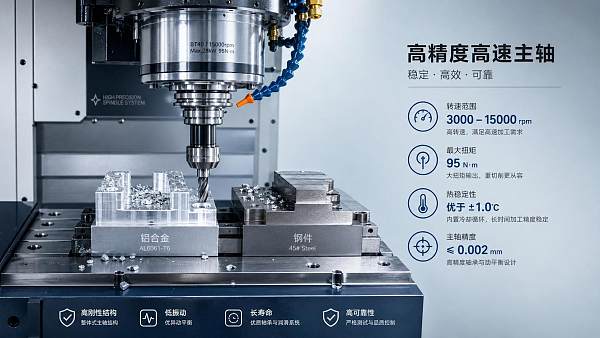
Choosing the right high-speed machining spindle range shapes accuracy, cycle time, tool life, and machine stability.
It also affects thermal control, maintenance planning, and the way production performance is benchmarked across sites.
That matters even more in mixed manufacturing environments, where materials, tolerances, and batch profiles keep changing.
A practical spindle decision starts with process reality, not catalog speed alone.
The best high-speed machining spindle range is the one that keeps cutting conditions stable across actual workloads.
For technical benchmarking teams, that means looking at power curves, bearing limits, material behavior, and operating risk together.
This guide breaks down the key criteria that make spindle range selection clearer and more defensible.
Start with the Process Window, Not the Peak RPM
Many teams begin with the highest advertised speed. That is usually the wrong first step.
A high-speed machining spindle range should match the actual cutting window used most often on the shop floor.
Look at average spindle load, cutter diameter, feed strategy, and expected surface finish.
For aluminum parts, the useful range may sit higher. For hardened steel, torque in the midrange often matters more.
This is where spindle selection becomes a process engineering task, not a simple speed comparison.
In practical terms, collect production data from representative programs before comparing spindle options.
- Identify the dominant materials and hardness levels.
- Map the common tool diameters and flute counts.
- Record the normal RPM band, not only the maximum RPM reached.
- Note whether finishing, roughing, drilling, or micro-machining drives spindle demand.
Once those patterns are clear, the right high-speed machining spindle range becomes easier to define.
Match Spindle Range to Material and Tooling Behavior
Material response is one of the strongest filters in spindle range evaluation.
Nonferrous alloys usually reward higher cutting speeds, lighter chip loads, and faster acceleration.
Titanium and high-strength steels demand a different balance, especially when heat buildup becomes the limiting factor.
That also means toolholder style, balance grade, and runout control cannot be treated as secondary details.
A wide high-speed machining spindle range looks attractive, but its value drops if the tool system cannot support it.
Recent manufacturing shifts make this more visible. Shops increasingly handle short runs across different materials on shared platforms.
So the decision should reflect flexibility as well as peak capability.
- For aluminum and composites, prioritize high RPM stability and low vibration.
- For steel and cast iron, confirm torque retention in the working speed band.
- For precision finishing, check runout limits and thermal drift performance.
- For mixed-material production, evaluate changeover efficiency and bearing durability.
This approach makes spindle range selection more realistic and lowers the risk of overbuying speed that never gets used.
Read the Power and Torque Curve Carefully
A spindle is not defined by RPM alone. Its usable performance sits inside the power and torque curve.
This is often where an attractive specification sheet becomes less convincing.
If the selected high-speed machining spindle range delivers weak torque where heavy cuts happen, process efficiency will suffer.
If power falls sharply at finishing speeds, surface quality may become inconsistent.
In actual business cases, teams often miss this because they compare maximum values instead of continuous output behavior.
A better method is to overlay spindle curves against the operating ranges of core machining programs.
That comparison usually reveals whether a spindle range is genuinely suitable or simply impressive on paper.
Thermal Stability and Bearing Design Decide Real Precision
A high-speed machining spindle range only delivers value if precision remains stable after hours of operation.
Thermal growth, preload shifts, and lubrication strategy directly influence that outcome.
More obvious signals appear during long finishing cycles, tight-tolerance bores, and repeated part families.
If spindle temperature drifts, the machine may still run, but process capability can slowly degrade.
This is why bearing architecture deserves close attention during spindle range selection.
Hybrid ceramic bearings, oil-air systems, and controlled cooling loops often improve high-speed consistency.
Still, the right choice depends on duty cycle, maintenance discipline, and contamination exposure.
- Review warm-up time before tolerance-critical operations.
- Check radial and axial growth under continuous load.
- Confirm lubrication intervals and filtration requirements.
- Ask for measured vibration and thermal drift data, not generic claims.
For benchmarking platforms such as GIM, these indicators help compare spindle technologies across sectors with a common technical lens.
Consider Machine Integration, Standards, and Lifecycle Cost
The right high-speed machining spindle range must fit the whole machine ecosystem.
That includes drive compatibility, tool interface, cooling capacity, control logic, and sensor feedback.
A spindle that looks strong in isolation can create hidden integration cost after installation.
This also means compliance and benchmarking standards should stay in view from the start.
In global manufacturing, alignment with ISO, IATF, IPC, and internal qualification protocols supports cleaner approval decisions.
More importantly, it reduces the chance of buying a spindle range that performs well in trials but poorly in long-term production economics.
Lifecycle cost should include uptime, spare parts, balancing needs, bearing replacement intervals, and energy consumption.
- Verify taper or interface compatibility with current tooling assets.
- Check cooling and air quality requirements against plant infrastructure.
- Evaluate sensor readiness for predictive maintenance.
- Estimate total cost over service life, not purchase price alone.
When these factors are addressed early, spindle range selection becomes more robust and easier to justify internally.
A Practical Decision Framework for High-Speed Machining Spindle Range Selection
A structured review process keeps spindle decisions focused and comparable.
It also helps separate essential performance needs from attractive but low-value extras.
Use the following sequence when defining the right high-speed machining spindle range.
- Define the dominant part mix and tolerance targets.
- Map the required RPM band, power demand, and torque demand.
- Review toolholder balance, runout, and cutter size constraints.
- Check thermal control, lubrication method, and bearing design.
- Validate machine integration, standards alignment, and lifecycle cost.
- Benchmark shortlisted spindle options using real production scenarios.
This framework works especially well in cross-sector environments, where electronics, automotive, tooling, and infrastructure projects share equipment strategy.
At that level, the right spindle range supports not only machining quality, but also supply chain resilience and operational consistency.
In the end, the best high-speed machining spindle range is defined by stable output, measurable fit, and long-term manufacturing control.
Use process data, test against real workloads, and compare options through a full-system lens before making the final decision.
The Archive Newsletter
Critical industrial intelligence delivered every Tuesday. Peer-reviewed summaries of the week's most impactful logistics and market shifts.