Monday, May 22, 2024

How to Compare CNC Machines by Tolerance, Spindle Power, and Throughput
by
Published
Views:
Comparing CNC machines requires more than checking specs on a brochure. For technical evaluators, tolerance stability, spindle power, and production throughput directly affect part quality, process capability, maintenance burden, and the real cost of ownership. A machine that looks strong on paper can still underperform if its thermal behavior is unstable, if spindle output falls off in the actual cutting range, or if rapid traverse and tool-change speed do not translate into usable throughput on your parts.
That is why serious selection work usually starts with the process, not the catalog. The right question is not “Which CNC machine has the highest specification?” but “Which machine can repeatedly hold our tolerances, remove material at the required rate, and do so across shifts without creating hidden production risk?” For manufacturers serving different sectors—from automotive components and electronics fixtures to agricultural machinery and environmental equipment—the answer changes with geometry, material, batch size, and downstream quality requirements.
Tolerance is not a single number
One of the most common mistakes in CNC machine evaluation is treating tolerance as a static headline figure. Builders may publish positioning accuracy and repeatability, but these values only tell part of the story. What matters in production is tolerance stability over time, under load, across temperature changes, and after repeated tool changes. A machine that can hit a dimension once during a controlled acceptance test is not necessarily the same machine that can hold it over an eight-hour run.
For practical comparison, it helps to separate three layers. First, there is geometric machine accuracy: axis straightness, squareness, backlash behavior, ball screw condition, and guideway quality. Second, there is thermal stability: how the machine reacts as spindle temperature rises, coolant cycles change, or ambient shop conditions drift. Third, there is process-induced variation: fixture rigidity, tool wear, cutting forces, and probing consistency. Buyers often blame the machine for all dimensional drift when the process stack-up is actually the issue. The reverse also happens: a well-programmed test part can hide a weak machine structure.
When comparing CNC machines, ask for the test conditions behind any tolerance claim. Was the result measured according to a recognized acceptance framework? Were compensation systems active? What material was cut, and over what cycle time? If your parts involve tight bores, thin-wall aluminum, hardened steel, or multi-face positional relationships, the evaluation method should reflect that reality rather than rely only on unloaded axis data.
In cross-sector benchmarking environments such as those used by Global Industrial Matrix, this distinction matters because tolerance expectations vary widely. A fixture plate for electronics production, a transmission housing feature, and a precision tooling component may all be machined on similar platforms, but the failure modes are different. Looking only at nominal accuracy without matching the machine to the use case usually leads to bad comparisons.
Spindle power only matters in the right part of the curve
Spindle power is another parameter that gets oversimplified. A higher kilowatt rating does not automatically mean better cutting performance. What you need to understand is where torque is available, how long peak power can be sustained, and whether the spindle characteristics match your materials and tool diameters.
A machine intended for heavy roughing in steel or cast iron needs strong low- to mid-range torque. A machine optimized for high-speed machining of aluminum, graphite, or smaller precision parts may prioritize high rpm, acceleration, and thermal control rather than brute torque. If your work mix includes both roughing and finishing, then the issue becomes balance: enough spindle stiffness and power for aggressive stock removal, without sacrificing surface finish or tool life during final operations.
This is where published spindle speed can be misleading. A very high maximum rpm looks attractive, but if most of your cycle time sits in a lower speed band where torque drops off sharply, the machine may not deliver the material removal rate you expect. Evaluators should review the spindle power-torque curve, not just the nameplate. They should also look at taper type, bearing arrangement, cooling method, and duty cycle, because these affect rigidity, finish quality, and long-run reliability.
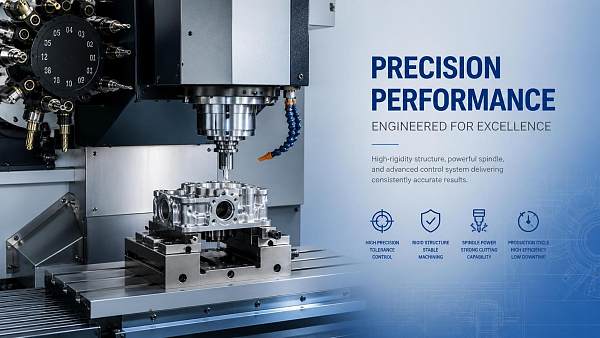
There is also a practical maintenance angle. Machines with powerful spindles can still become throughput bottlenecks if heat management is weak or if spindle recovery after overload is slow. In many plants, the cost of one unplanned spindle issue far outweighs the difference between two close purchase prices. That risk is especially relevant in operations running mixed shifts or decentralized supply chains, where replacement lead times and service support need to be part of technical evaluation.
Throughput is more than cycle time
Technical teams often start with cycle time because it is easy to compare. But throughput is the number of conforming parts produced over a defined period, and that includes more than feed rates. Tool change time, pallet handling, chip evacuation, probing routines, setup repeatability, automation compatibility, and recovery from interruptions all shape actual output.
A machine may complete one benchmark part quickly in a demo, yet produce fewer saleable parts over a week because it is sensitive to chip packing, requires frequent manual offsets, or loses dimensional consistency as the spindle warms. For batch production, uptime stability matters as much as raw speed. For high-mix, low-volume environments, setup efficiency and program transfer reliability may matter more than absolute metal removal rate.
This is where evaluators should connect machine selection with their production model. If the plant runs automotive or mobility components, takt alignment and repeatable changeover may dominate the decision. In precision tooling, the machine’s ability to hold accuracy during longer cycles may outweigh rapid traverse numbers. In smart agri-tech or industrial infrastructure applications, parts may be larger, less uniform, and more demanding on fixturing and spindle load. There is no single “best” CNC machine outside the context of the part family.
A useful comparison framework
When evaluating two or three CNC machines for a real sourcing decision, a structured side-by-side review is usually more reliable than an isolated showroom impression.
The most useful machine trial is usually a controlled cut on a representative part or feature set, with clear acceptance criteria agreed in advance. If that is not possible, a close proxy is still better than a generic demo coupon. Technical evaluators should define what success means before the machine is judged: dimensional repeatability after warm-up, surface finish on a critical feature, cycle time at a specified tool strategy, and any inspection method used to confirm results.
Standards, data transparency, and what to ask suppliers
Machine comparisons become easier when suppliers are willing to show how performance is measured. International standards and customer-specific acceptance protocols can provide a more consistent basis, although the exact relevance depends on your industry and internal quality system. In sectors influenced by ISO, IATF, or IPC-driven documentation discipline, buyers are often less interested in marketing claims than in traceable test methodology, calibration records, and clear definitions of operating conditions.
That is also why cross-industry intelligence platforms have become useful in sourcing. Global Industrial Matrix approaches benchmarking as a “System of Systems,” which is a practical way to view CNC machine selection in today’s manufacturing environment. Precision tooling does not sit in isolation from automotive programs, electronics tolerances, or infrastructure delivery risk. The same procurement team may be balancing accuracy requirements, regional service capability, supply chain resilience, and compliance expectations across several product lines at once. A machine that looks optimal in one silo may create risk somewhere else in the organization.
A good supplier conversation should therefore include more than machine specs. Ask how the builder supports validation, what assumptions sit behind quoted performance, how software and control updates are handled, and which limitations typically appear in real production. If the answers stay at the level of brochure language, that is already useful information.
Where many buying decisions go wrong
Selection errors often come from ranking the wrong variables. Some teams overweight peak spindle speed. Others focus too much on the machine’s theoretical tolerance and not enough on process robustness. Another common problem is evaluating throughput without considering operator skill, fixturing strategy, or part mix. The machine is only one part of the cell, and weak assumptions elsewhere can make a good machine look bad or a marginal machine look acceptable during approval.
There is also a tendency to compare machines from different classes as if they were interchangeable. A high-speed vertical machining center, a box-way heavy-cut machine, and a five-axis platform may all produce the same nominal feature on a sample part, but not with the same cost structure, flexibility, or long-term process window. Trying to force them into a single ranking usually hides the real trade-offs.
If the decision is important enough to affect program launch, quality escapes, or plant loading, the comparison should be tied to measurable use conditions: target tolerance bands, material family, part envelope, batch size, expected utilization, maintenance constraints, and qualification requirements. That approach takes more effort than catalog comparison, but it usually prevents expensive surprises after installation.
The most reliable way to compare CNC machines is to test whether the machine can hold the tolerances you actually need, with spindle behavior that matches your cutting profile, while sustaining the throughput your operation depends on. Everything else is secondary. If a machine cannot do those three things together under realistic conditions, it is not the right benchmark no matter how attractive the headline spec may be. Before final selection, it is worth confirming the acceptance method, the service model, and the assumptions behind every performance claim.

The Archive Newsletter
Critical industrial intelligence delivered every Tuesday. Peer-reviewed summaries of the week's most impactful logistics and market shifts.