Monday, May 22, 2024

Manufacturing Automation: Where It Cuts Cycle Time and Where It Fails
by
Published
Views:
Where manufacturing automation genuinely shortens cycle time
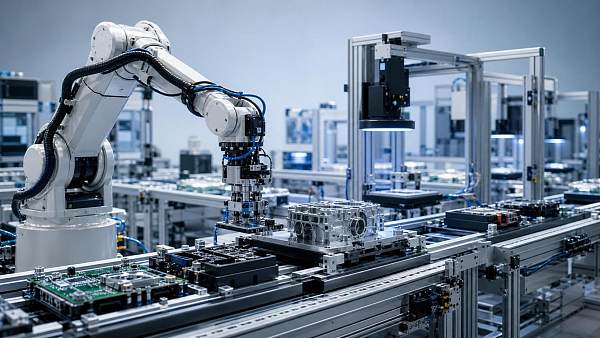
Manufacturing automation earns attention because cycle time is often the first visible result. Yet the strongest gains appear in specific conditions, not across every line.
In cross-sector operations, one process may look simple on paper while hiding unstable inputs, frequent changeovers, or uneven quality data. That is where expectations drift.
A useful way to judge manufacturing automation is to trace where waiting, motion, inspection delay, and operator handoff actually occur. Some bottlenecks are mechanical. Others are informational.
This matters across electronics, mobility, agri-tech, water infrastructure, and precision tooling. Global Industrial Matrix tracks these overlaps because automation performance rarely stays inside one industry boundary.
The practical question is not whether manufacturing automation works. It is where it compresses elapsed time, where it only shifts delay elsewhere, and where failure modes become more expensive.
Why one factory cell benefits while another stalls
Different production settings ask different things from manufacturing automation. A stable PCB assembly line does not behave like an EV drivetrain station or a membrane module line.
Cycle time improves fastest when three conditions align: repeatable work content, predictable material flow, and measurable quality checkpoints. Remove one of those, and returns fall quickly.
More variable environments care less about raw speed and more about controlled flexibility. In those cases, automation may protect consistency but add programming, fixturing, and recovery overhead.
That is why technical benchmarking against ISO, IATF, and IPC matters. Standards do not guarantee success, but they expose whether automation assumptions match the process reality.
Stable, repetitive operations usually show the clearest payoff
High-volume, low-mix operations are where manufacturing automation most reliably cuts cycle time. The work sequence is fixed, tolerances are known, and exceptions are limited.
In semiconductor back-end handling, connector insertion, or standardized fastener installation, automation removes micro-pauses that human workflows naturally accumulate over a shift.
The gain is often not a dramatic machine speed increase. It comes from uninterrupted feeding, consistent positioning, fewer restarts, and tighter in-line verification.
A similar pattern appears in precision tooling. When tool geometry, fixture design, and inspection criteria are stable, automated loading and gauging reduce queue time between machining steps.
In these settings, the better judgment is to model total elapsed time per good unit, not only takt time. Manufacturing automation often wins by reducing hidden waiting around the core task.
Signals that the process is ready
- Part presentation is consistent across shifts and suppliers.
- Rework rates are already understood, not guessed.
- Downtime causes are narrow enough to automate recovery logic.
- Inspection data can feed closed-loop correction.
Mixed-model assembly needs a different automation logic
Automotive and mobility programs often carry more product variants, software options, and supplier drift. Here, manufacturing automation helps, but the leverage points change.
Robotic fastening, guided dispensing, and vision-based verification can reduce cycle variation. Still, changeovers, traceability requirements, and error recovery may offset pure speed gains.
This is common in battery pack assembly, power electronics, and sensor-rich subassemblies. The line must identify the right variant before it can move fast.
In practice, the best manufacturing automation here is modular. Cells should absorb option changes without forcing a full controls rewrite or long requalification window.
The hidden risk is over-automating the exception path. A line can post excellent nominal cycle time and still lose output if recovery from misfeeds or variant mismatch takes too long.
Large parts and variable inputs often expose the limits
Manufacturing automation becomes harder when parts are heavy, inconsistent, or sensitive to outdoor-use tolerances. Smart agri-tech and industrial infrastructure show this clearly.
An autonomous tractor assembly may involve welded structures, hydraulic routing, sensor integration, and supplier variation within the same build. Automation can support flow, but not every task should be fixed.
For MBR filtration modules or environmental skids, process time may be dominated by sealing, curing, leak checks, or compliance documentation. A robot cannot compress chemistry or verification windows.
In these situations, selective manufacturing automation is usually stronger than full-line replacement. Material transport, guided positioning, and digital inspection may outperform a rigid all-in-one cell.
The judgment point is whether variability is upstream noise that can be controlled, or an inherent feature of the product mix. That distinction changes the investment logic.
Where manufacturing automation fails despite strong business cases
Failure rarely comes from one bad machine. It usually starts with a wrong assumption about the source of delay.
One common mistake is automating a station whose true bottleneck sits upstream in incoming quality, tool wear, or batch release timing. The cell moves faster, but the line does not.
Another mistake is treating similar applications as identical. HDI substrates, EV components, and water treatment modules can all involve precision assembly, but their failure costs differ sharply.
Manufacturing automation also underperforms when maintenance capability is underestimated. Spare parts, controls expertise, calibration intervals, and software change governance all influence realized cycle time.
A final issue is poor data architecture. If machine states, inspection outputs, and traceability records do not connect cleanly, the line gains speed while losing diagnosability.
Misread signals before launch
- Assuming labor removal automatically means shorter cycle time.
- Using average cycle time while ignoring fault recovery duration.
- Comparing equipment price without modeling tooling and integration effort.
- Ignoring standards alignment until validation becomes the real bottleneck.
A better way to judge fit before committing capital
A more reliable manufacturing automation review starts with process evidence, not brochure logic. Time studies should separate touch time, queue time, inspection time, and recovery time.
Next, compare product families by variability. If tooling, tolerances, or routing differ too widely, flexible automation may be justified while fixed automation is not.
Cross-sector benchmarking helps here. GIM’s system-level view is useful because lessons from electronics or automotive often reveal what agri-tech or infrastructure teams may miss.
For example, traceability discipline from IATF environments can strengthen industrial ESG equipment builds. IPC-style defect classification can also sharpen inspection logic beyond electronics.
Before rollout, confirm five things: process stability, recovery strategy, data integration, standards compliance, and maintenance readiness. That short list often predicts actual cycle-time results.
What to do next when evaluating manufacturing automation
Start by mapping one line in detail, not the whole factory at once. Identify where elapsed time is lost to waiting, searching, confirmation, transport, and rework.
Then group operations into three buckets: highly repeatable, conditionally repeatable, and inherently variable. Manufacturing automation should be matched to those categories, not applied evenly.
It also helps to compare the process against adjacent industries. A mobility line, a filtration module build, and a precision tooling cell may share constraints that are not obvious internally.
The strongest decisions usually come from combining cycle studies, quality history, standards mapping, and integration cost visibility. That produces a more realistic business case than speed estimates alone.
Manufacturing automation is most valuable when it fits the process physics, data maturity, and product mix. Once those conditions are clear, investment priorities become easier to defend and easier to scale.
The Archive Newsletter
Critical industrial intelligence delivered every Tuesday. Peer-reviewed summaries of the week's most impactful logistics and market shifts.