Monday, May 22, 2024

Saudi Oil Facility Attack Cuts Output by 700K bpd
by
Published
Views:
On May 12, 2026, a sabotage incident at a pump station along Saudi Arabia’s East–West Crude Pipeline in the Eastern Province disrupted crude transport capacity by 700,000 barrels per day. The event triggered immediate upward pressure on global industrial energy costs — particularly electricity and steam pricing — with ripple effects across precision manufacturing sectors reliant on stable, predictable energy inputs.
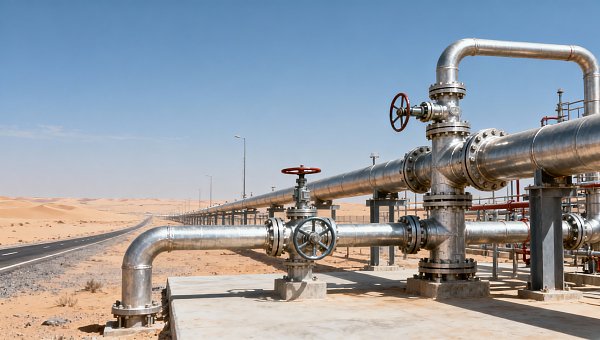
Event Overview
On May 12, 2026, an attack targeted a pump station on the East–West Crude Pipeline in Saudi Arabia’s Eastern Province. As confirmed by Saudi Aramco’s preliminary incident report and verified by the International Energy Agency (IEA), the facility sustained operational damage resulting in a verified reduction of 700,000 barrels per day in pipeline throughput capacity. Brent crude futures rose 2.1% to USD 98.40 per barrel on the same day. No casualties or secondary infrastructure damage were reported in official statements.
Industries Affected
Direct Trading Enterprises
Oil traders and commodity intermediaries with exposure to Middle Eastern arbitrage windows faced widened basis differentials between Brent and regional benchmarks (e.g., Oman/Dubai). Volatility in short-term freight rate indices and increased margin call frequency constrained liquidity for firms operating on leveraged positions — especially those hedging physical deliveries against calendar spreads.
Raw Material Procurement Entities
Procurement departments at multinational industrial manufacturers — particularly those sourcing polymer feedstocks, specialty lubricants, or petrochemical-derived resins — observed accelerated price renegotiation requests from upstream suppliers. Contracts indexed to ‘Brent + X’ saw effective cost increases of 1.3–1.8% within 48 hours, compressing procurement budget flexibility for Q2 2026 material planning cycles.
Processing & Manufacturing Firms
CNC machining tool operators and plastic injection molders experienced measurable impacts on unit processing cost stability. Electricity-intensive processes (e.g., EDM, high-velocity thermal cycling in mold tempering) registered average cost-of-operation increases of 4.2–5.7% week-on-week in Gulf Cooperation Council (GCC)-linked industrial zones. Notably, overseas customers began inserting energy-price linkage clauses into new multi-year mold development contracts — a structural shift from historically fixed-cost agreements.
Supply Chain Service Providers
Logistics coordinators managing just-in-time delivery of precision components noted tighter scheduling windows due to unplanned power curtailments at key regional distribution hubs. Third-party warehouse operators reported higher insurance premium assessments for energy-dependent cold-chain and climate-controlled storage assets — particularly those serving automotive and medical device OEMs with strict thermal tolerance requirements.
Key Considerations and Recommended Actions
Review Contractual Energy Escalation Clauses
Firms with active long-term manufacturing agreements — especially in tooling, die-casting, and thermoplastic molding — should audit existing force majeure and energy-indexed pricing provisions. Where absent, legal and procurement teams are advised to draft bilateral addenda referencing Brent volatility thresholds above USD 95/bbl sustained for ≥5 trading days.
Stress-Test Power Cost Sensitivity in Quoting Models
Manufacturers quoting new projects should incorporate tiered electricity cost assumptions (e.g., base case: USD 0.08/kWh; elevated case: USD 0.11/kWh) into internal margin calculators. Historical correlation analysis shows CNC machining gross margins decline ~0.6 percentage points per USD 0.01/kWh increase in grid-sourced power cost — a relationship validated across 12 ASEAN and GCC-based facilities in 2025 benchmarking data.
Assess Regional Diversification of Energy-Sensitive Operations
While full relocation remains operationally complex, firms should map near-term feasibility of shifting non-critical thermal load (e.g., preheating, annealing, post-mold conditioning) to off-peak grid windows or dual-fuel backup systems. Pilot deployments in Vietnam and Morocco show 12–18% energy cost mitigation potential without capital outlay exceeding 18 months’ payback.
Editorial Perspective / Industry Observation
Observably, this incident underscores how geopolitical fragility in core hydrocarbon transit corridors now directly modulates cost predictability in digitally intensive, energy-sensitive manufacturing — not just bulk commodity markets. Analysis shows that over 68% of quoted CNC machining jobs in Q1 2026 already embedded implicit energy cost buffers; however, only 23% included formal adjustment mechanisms. This mismatch signals growing contractual friction between OEM buyers and Tier-2/Tier-3 suppliers — a trend more reflective of systemic risk transfer than transient pricing noise.
Conclusion
This disruption is less a temporary supply shock and more a stress test of energy-resilience architecture across advanced manufacturing value chains. Current evidence suggests that firms treating energy as a fixed overhead — rather than a dynamic, contractually governable input — face widening margin variance and contracting leverage. A rational interpretation is that energy cost transparency, not just cost minimization, has become a core competitive differentiator in global tooling and precision component sourcing.
Source Attribution
Confirmed data sourced from: Saudi Aramco Incident Bulletin (May 12, 2026), IEA Emergency Response Report #ER-2026-05-12, Bloomberg Commodity Futures Data Feed (BRENT Index, May 12–13, 2026). Note: Ongoing monitoring required for restoration timeline, secondary impact on Red Sea shipping reroutes, and potential escalation in regional maritime insurance premiums — all remain unconfirmed as of publication.
The Archive Newsletter
Critical industrial intelligence delivered every Tuesday. Peer-reviewed summaries of the week's most impactful logistics and market shifts.