Monday, May 22, 2024

Which industrial equipment information standards apply to CNC manuals?
by
Published
Views:
Which industrial equipment information standards apply to CNC manuals?
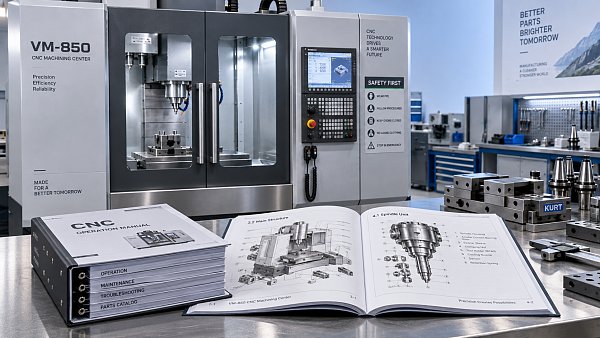
A CNC manual is more than an operating guide: it is a critical source of evidence for safety reviews, procurement decisions, and technical acceptance. But which industrial equipment information standards should evaluators use to assess its completeness and reliability? IEC/IEEE 82079-1 and ISO 20607 provide key guidance for instructions, while machine-specific safety standards may impose additional documentation requirements. The right assessment connects these frameworks to the actual machine, its installed options, and its destination market.
The practical answer is not one universal standard. CNC documentation sits at the intersection of information quality, machinery safety, electrical documentation, and legal requirements. A well-written manual can still omit essential safety information. Conversely, a technically detailed document may be unusable when an operator needs to recover from an interrupted machining cycle.
Start with the standards that govern instructions
IEC/IEEE 82079-1:2019, Preparation of information for use of products — Part 1: Principles and general requirements, provides a broad framework for developing information for use. It applies across product categories rather than exclusively to CNC equipment. Its value lies in treating instructions as an engineered deliverable: intended users, task coverage, information management, clarity, and evaluation all matter.
For a CNC manual, this means checking whether information supports the people performing each task. An operator, electrical technician, and maintenance engineer need different levels of detail. Clear navigation and readable warnings are useful, but they do not compensate for missing prerequisites or ambiguous procedures.
ISO 20607:2019, Safety of machinery — Instruction handbook — General drafting principles, addresses machinery instruction handbooks more specifically. It focuses on safety-relevant content, structure, and presentation across the machine’s life cycle. It is therefore particularly relevant when reviewing installation, operation, cleaning, maintenance, troubleshooting, and dismantling instructions.
These standards overlap, but they are not interchangeable. IEC/IEEE 82079-1 provides the wider information-development framework; ISO 20607 brings machinery-specific drafting principles. Neither establishes that a CNC machine itself is safe, and neither replaces the applicable machine safety standard or legislation.
Machine type determines the next layer
“CNC” describes a control approach, not a single equipment category. A turning machine, machining centre, grinding machine, and laser-processing system can all be numerically controlled, yet present different hazards. Selecting standards solely because a machine has a CNC controller is a weak starting point.
Machine-specific standards, commonly called Type-C standards, can contain more precise requirements than general machinery safety standards. Where their provisions differ from Type-A or Type-B standards, the Type-C provisions take precedence for machines designed and built within their scope. Evaluators should therefore examine the applicable information-for-use clauses, not merely collect standard numbers from a supplier’s brochure.
Use the relevant published edition, national or regional adoption, and contractual baseline. The latest international edition and the edition recognized for a particular regulatory purpose are not necessarily identical.
The manual must match the delivered system
A controller programming guide explains commands and software functions. It does not, by itself, describe the safe operation of the complete machine. The machine builder’s instructions must address the installed mechanics, safeguards, operating modes, and foreseeable interactions between subsystems.
Consider a turning centre supplied with a bar feeder, powered chuck, chip conveyor, and mist extraction unit. Each component may have its own documentation, but the overall instructions still need to explain interfaces: startup sequencing, access restrictions, isolation boundaries, and recovery after a fault. Separate manuals are acceptable only when their relationship is clear and system-level information is not left between them.
A useful documentation map links the machine model and configuration to the main handbook, controller guide, electrical drawings, pneumatic or hydraulic diagrams, and accessory instructions. It should also identify software versions where they affect procedures or safety-related behaviour.
For an integrated robotic loading cell, the assessment extends beyond the standalone CNC machine. Responsibility for cell-level instructions, shared safeguards, and recovery procedures should be explicit. A collection of component manuals is not automatically a complete instruction package for the integrated assembly.
Destination-market rules are a separate check
Standards provide technical frameworks; legislation determines mandatory obligations. For machinery placed on the EU market, the Machinery Directive 2006/42/EC contains instruction requirements, including language provisions. Regulation (EU) 2023/1230 generally applies from 20 January 2027, making the placing-on-the-market timeline relevant to documentation planning.
Do not assume a PDF-only delivery is acceptable in every situation. The applicable regime, user category, accessibility arrangements, and paper-copy provisions need checking. Likewise, an English-language manual may support an international technical review without satisfying the delivery-language requirements of the destination country.
In the EU, using a harmonised standard can support a presumption of conformity for the requirements it covers, subject to its cited status and any restrictions. An ISO or IEC designation alone does not establish that status. Verify the relevant official listing rather than treating every international standard as a legal safe harbour.
Other markets require their own review. Local electrical requirements, workplace safety obligations, and contractual specifications may affect documentation acceptance. ISO 9001 or IATF 16949 certification is not a substitute for this assessment: management-system certification does not establish the completeness of an individual CNC manual.
Benchmark procedures through real tasks, not page counts
A long manual can conceal serious omissions. A more revealing review follows tasks that expose the machine’s hazards and operational dependencies. Select procedures spanning normal production, setup, intervention, and maintenance, then test whether the documentation supports safe execution.
- Workholding and setup: Check for machine-specific limits and instructions covering compatible chucks or fixtures, clamping verification, tool retention, and relevant speed restrictions. Do not infer safe limits from the spindle’s maximum rating alone.
- Operating modes: Confirm that automatic operation, setup, and permitted intervention modes are distinguished, including safeguard behaviour and user responsibilities.
- Fault recovery: Look for instructions addressing interrupted cycles, trapped tools, workpiece release, and unexpected restart risks—not just an alarm-code list.
- Energy isolation: Require identification of relevant energy sources and stored-energy hazards. An emergency stop is not equivalent to electrical, pneumatic, or hydraulic isolation.
- Maintenance: Check intervals, prerequisites, access methods, consumable specifications, and checks needed before returning the machine to service.
A useful procedure states who may perform the task, the required machine condition, the actions, and the expected result. Where sequence matters, it should be explicit. “Clear the obstruction and restart” is inadequate if the task involves entering a hazardous area or releasing stored pressure.
Risk communication needs the same scrutiny. A warning should identify the hazard and explain avoidance measures at the point where the reader needs them. Repeating “use caution” throughout the handbook does little to clarify exposure to rotating components, ejected workpieces, sharp chips, or hazardous substances.
Where applicable standards or legislation require emission information, such as noise data, verify the stated operating conditions and measurement basis. A bare value without context may be unsuitable for comparison or workplace assessment.
Turn the review into traceable acceptance evidence
Ask for a requirements-to-document matrix rather than a blanket statement that the manual “meets international standards.” Each relevant requirement should point to a document, revision, and section. Record gaps separately from questions about applicability; an excluded requirement needs a reason, not an empty cell.
Then verify a sample against the delivered equipment. Do isolator labels match the drawings? Are referenced controls present? Does the illustrated guard arrangement match the installed option? This catches a common weakness in documentation packages: technically credible content copied from another configuration.
Some missing information should block acceptance, particularly absent isolation procedures or unresolved safety-critical configuration differences. Minor editorial defects can often be managed through a correction schedule. Treating both categories alike either delays delivery unnecessarily or allows serious omissions to disappear into a general punch list.
This evidence-led approach fits Global Industrial Matrix’s cross-sector benchmarking focus. Across precision tooling, automotive, electronics, agri-tech, and environmental infrastructure, the useful comparison is not which supplier cites the most standards. It is whether the documentation demonstrates an applicable, configuration-specific basis for operation and maintenance. Cross-sector intelligence helps identify interface gaps, but cannot replace machine-specific technical review.
Before accepting a CNC documentation package, confirm three things: the applicable standards and market requirements, the match between instructions and delivered configuration, and the completeness of safety-critical tasks. If any remains unresolved, request targeted evidence or corrected instructions—not simply a larger manual.
The Archive Newsletter
Critical industrial intelligence delivered every Tuesday. Peer-reviewed summaries of the week's most impactful logistics and market shifts.