Monday, May 22, 2024

How to Choose Office Supplies That Cut Waste and Cost
by
Published
Views:
Choosing office supplies with care has become a practical cost-control decision, not a routine admin task. In complex operating environments, every pen, toner cartridge, label, folder, and cleaning consumable affects spend visibility, waste volume, and workflow reliability.
That matters even more when procurement is judged by efficiency, resilience, and sustainability at the same time. The right office supplies can lower replacement frequency, reduce excess inventory, and support cleaner reporting across multi-site operations.
Seen through the wider lens of Global Industrial Matrix, this is not a minor purchasing category. It reflects the same discipline used in larger sourcing decisions: benchmark performance, compare lifecycle value, and reduce risk before waste becomes a hidden operating cost.
Why office supplies deserve closer attention
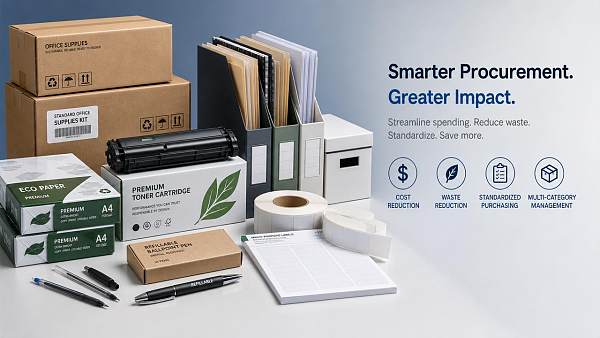
Office supplies are often treated as low-value items because unit prices look small. In reality, repeated purchases, fragmented ordering, and poor-fit products can create measurable waste across the year.
A cheap marker that dries quickly, a stapler that jams, or paper that causes printer downtime usually costs more than its invoice price suggests. The loss appears in labor time, reorders, service calls, and discarded stock.
For distributed businesses, the issue grows fast. Different sites may buy similar office supplies from multiple vendors, using inconsistent specifications and packaging formats. That weakens spend control and makes data comparison harder.
Cross-sector procurement teams already understand this logic in production materials. GIM applies the same systems view: a category becomes strategic when its performance influences process stability, reporting accuracy, and resource efficiency.
What better office supplies selection actually means
Selecting office supplies well is not only about choosing premium brands. It means matching product function, usage intensity, and supplier consistency with the real operating context.
In practice, the best option is often the item with the lowest total cost of use. That includes purchase price, expected lifespan, storage burden, breakage rates, and disposal impact.
A durable desktop organizer may outperform a cheaper alternative if it avoids frequent replacement. Refillable pens may beat disposable models where usage is high and collection is manageable. Multipurpose paper may simplify inventory if print quality remains stable.
This approach turns office supplies into a category that can be standardized, measured, and improved, much like tooling, components, or maintenance items in industrial environments.
The shift from unit price to lifecycle value
Lifecycle thinking is especially useful when comparing products that seem equivalent on paper. Two items may share size, color, and list price, yet differ sharply in yield, reliability, and waste generation.
That is why benchmarking matters. GIM’s broader methodology across electronics, mobility, agri-tech, and infrastructure shows that comparable specifications do not always deliver comparable operational results.
Where waste usually hides
Waste in office supplies rarely appears as one large failure. It usually builds through small, repeated leaks in the purchasing and usage process.
When these signals are tracked together, it becomes easier to see which office supplies categories deserve immediate review. Paper, toner, labels, binders, batteries, and breakroom consumables often lead the list.
How to evaluate office supplies more effectively
A more disciplined evaluation process does not need to be complicated. It needs clear criteria that connect product choice with measurable outcomes.
Start with usage patterns
Look at what is consumed frequently, what sits unused, and what creates repeat complaints. High-volume office supplies should receive more attention than occasional purchases.
Usage data also helps separate critical items from convenient extras. That distinction prevents catalog sprawl and reduces the temptation to approve too many similar products.
Check performance, not just features
For paper, that may mean jam rates and duplex performance. For writing tools, it may mean usable lifespan and refill options. For toner, the key issue is actual page yield and device compatibility.
Performance benchmarking is where industrial thinking adds value. The same mindset used for ISO, IATF, or IPC-aligned comparisons can improve even routine office supplies decisions.
Review packaging and replenishment logic
Some office supplies are wasteful because pack sizes do not match demand. Oversized cartons increase storage pressure and can lead to damage or obsolescence before use.
Smarter replenishment often means fewer SKUs, better order frequency, and supplier agreements that support predictable consumption rather than volume for its own sake.
What matters across different operating environments
Not every workplace uses office supplies in the same way. The right choice depends on whether the environment is administrative, technical, mobile, or site-based.
- Head office settings usually benefit from standardized, refillable, and easy-to-track office supplies with broad compatibility.
- Engineering or lab-adjacent spaces may need labels, notebooks, and storage items with better durability and legibility.
- Field or service teams often need portable office supplies that resist moisture, impact, or irregular handling.
- Multi-site operations gain more from supplier harmonization than from chasing the lowest local unit price.
This is where a cross-sector perspective becomes useful. Organizations working near manufacturing, mobility, infrastructure, or agri-tech rarely operate in neat silos. Administrative categories still need the same logic of fit, traceability, and resilience.
The supplier side of the equation
Even well-chosen office supplies can fail to deliver savings if supplier performance is inconsistent. Stockouts, substitutions, weak product data, and unclear sustainability claims all reduce confidence.
A reliable supplier should provide consistent specifications, transparent lead times, and sensible alternatives when items are discontinued. Better vendors also support catalog rationalization instead of expanding it without control.
From a GIM-style benchmarking perspective, supplier comparison should include more than price. Data quality, service reliability, packaging efficiency, and standards alignment often matter just as much.
Useful questions during supplier review
- Are the same office supplies available across locations with stable specifications?
- Can usage, spend, and substitution data be reported clearly?
- Do sustainability claims have verifiable backing rather than generic marketing language?
- Are there refill, return, or lower-waste packaging options that work in practice?
A practical framework for reducing cost and waste
Most improvements come from a few disciplined changes, not from a complete reset. The goal is to tighten control while keeping daily work smooth.
This kind of framework is especially effective when office supplies are reviewed alongside broader operational data. That creates a more accurate picture of where purchasing discipline can support ESG targets and reduce hidden process loss.
Where to look next
A strong next step is to map the top office supplies categories by annual spend, usage frequency, and disposal volume. That quickly shows where effort will return the most value.
After that, compare a small set of alternatives using consistent criteria: price, durability, compatibility, packaging, and supplier reliability. A short pilot often reveals more than a long assumptions list.
For organizations already using cross-functional benchmarks in other categories, office supplies should follow the same discipline. Better data, fewer unnecessary variants, and practical product standards usually cut waste without disrupting daily work.
When the category is viewed through performance and not habit, office supplies become easier to control, easier to justify, and far more useful as part of a broader efficiency strategy.

The Archive Newsletter
Critical industrial intelligence delivered every Tuesday. Peer-reviewed summaries of the week's most impactful logistics and market shifts.