Monday, May 22, 2024

Mixing Systems Comparison for Industrial Process Control
by
Published
Views:
Mixing Systems Comparison for Industrial Process Control
Selecting the right mixing technology shapes output stability, energy use, and long-term control performance.
This industrial solution comparison for mixing systems focuses on practical differences that affect process control.
In actual operations, the best mixer is rarely the strongest or fastest option.
It is the one that fits material behavior, control logic, cleaning needs, and expansion plans.
That also means a solid industrial solution comparison for mixing systems must go beyond equipment brochures.
It should connect fluid mechanics, automation response, maintenance burden, and compliance requirements.
From recent industry shifts, one clearer signal stands out.
Manufacturers now expect mixers to work as controlled process assets, not isolated mechanical tools.
This article helps structure decisions around performance, integration risk, and lifecycle value.
Why Mixing System Selection Now Requires a Control-Centered View
Mixing quality directly affects temperature distribution, concentration uniformity, reaction speed, and batch repeatability.
When those variables drift, downstream systems absorb the instability through extra corrections and lost efficiency.
A useful industrial solution comparison for mixing systems therefore starts with process objectives.
Are you blending low-viscosity liquids, dispersing powders, suspending solids, or supporting shear-sensitive materials?
Each duty changes the value of speed, torque, impeller design, and sensor feedback.
Control architecture matters just as much.
Variable frequency drives, PLC timing, SCADA visibility, and closed-loop feedback determine whether mixing stays predictable.
This is especially true in cross-sector manufacturing environments tracked by Global Industrial Matrix.
Semiconductor chemicals, EV materials, agri-inputs, and water treatment media all demand different control tolerances.
Core Mixing Configurations in an Industrial Solution Comparison for Mixing Systems
Most industrial evaluations compare several proven configurations rather than searching for a universal machine.
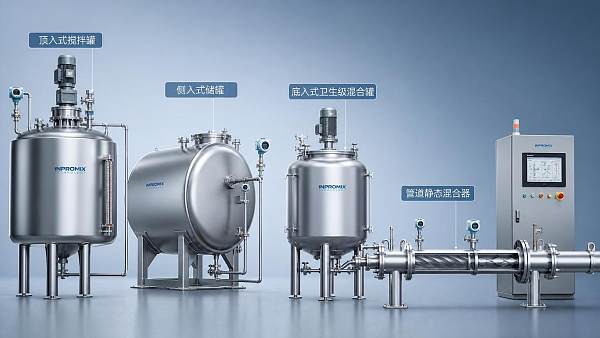
Top-entry agitators
These are widely used for general blending, liquid-liquid mixing, and moderate solid suspension.
They offer broad vessel compatibility and straightforward motor access.
However, shaft length, seal wear, and vortex formation can raise control and maintenance concerns.
Side-entry mixers
These often support large storage tanks, especially where gentle circulation is enough.
They reduce structural height requirements but may deliver less uniformity in complex rheology.
Bottom-entry mixers
These fit sanitary and high-drain applications where full vessel emptying matters.
They can improve cleanability, though seal design becomes more critical.
High-shear mixers
These are preferred for emulsification, dispersion, and rapid particle size reduction.
In an industrial solution comparison for mixing systems, they usually score high on throughput intensity.
Still, they may overprocess sensitive materials and increase heat load.
Static mixers
These have no moving parts and work well in continuous flow systems.
They simplify mechanical maintenance but depend heavily on pressure drop and flow consistency.
Decision Factors That Matter Most in Process Control
A credible industrial solution comparison for mixing systems should translate equipment features into control outcomes.
- Viscosity range: determines motor sizing, startup torque, and speed flexibility.
- Shear sensitivity: protects polymers, biological inputs, coatings, and specialty slurries.
- Residence time: shapes mixing uniformity and affects reaction or dosing windows.
- Tank geometry: influences dead zones, baffle design, and circulation patterns.
- Instrumentation fit: supports torque, temperature, pH, conductivity, and level feedback.
- Cleaning method: changes downtime, contamination risk, and seal selection.
- Energy demand: affects lifecycle cost more than initial motor efficiency alone.
More importantly, these factors interact.
A high-shear mixer may solve dispersion speed but create temperature control problems.
A low-energy static mixer may lower maintenance but struggle during feed variability.
Comparison Table for Technical Evaluators
This table should not replace testing.
It helps narrow the field before pilot work and control-loop validation.
Integration Risks Often Missed During Equipment Selection
Many projects fail after purchase because the industrial solution comparison for mixing systems stayed too mechanical.
The hidden risks usually appear in integration.
- Control latency between sensors, PLC logic, and variable speed adjustment.
- Material changes that shift viscosity outside the original motor design window.
- Cleaning cycles that shorten seal life or disrupt calibration reliability.
- Poor interoperability with MES, SCADA, or predictive maintenance platforms.
- Compliance gaps against ISO, IATF, IPC, or internal validation protocols.
This is where benchmarking discipline matters.
GIM’s cross-sector view is useful because similar control failures often appear across different manufacturing domains.
A Practical Evaluation Framework for Final Selection
A stronger industrial solution comparison for mixing systems follows a staged decision process.
- Define the material window, including viscosity, solids content, and shear limits.
- Map control targets such as blend uniformity, cycle time, and response tolerance.
- Screen candidate systems against vessel geometry and upstream or downstream constraints.
- Run pilot tests using realistic temperatures, feed patterns, and instrumentation.
- Compare maintenance intervals, spare part exposure, and digital integration readiness.
- Score total value using performance, risk, compliance, and energy metrics together.
This approach keeps the decision grounded in actual process control needs.
It also reduces the chance of choosing a system that performs well only under ideal factory test conditions.
Conclusion: Turning Comparison into a Better Control Decision
A useful industrial solution comparison for mixing systems is really a process control decision framework.
The right choice balances mixing performance, automation fit, compliance demands, and lifecycle resilience.
In practical terms, selection improves when teams compare real operating windows instead of nominal equipment ratings.
That is especially important in complex manufacturing networks where reliability and traceable benchmarking drive procurement decisions.
Start with process behavior, validate with pilot data, and finalize only after integration risks are visible.
That sequence turns an industrial solution comparison for mixing systems into a more defensible investment decision.
The Archive Newsletter
Critical industrial intelligence delivered every Tuesday. Peer-reviewed summaries of the week's most impactful logistics and market shifts.