Monday, May 22, 2024

Tooling Analysis: Cost Drivers and Lead Time Risks
by
Published
Views:
In global manufacturing, tooling analysis is essential for understanding where costs escalate and lead times break down. For business evaluation across complex supply chains, it clarifies not only quoted price, but also engineering maturity, production readiness, and execution risk. A disciplined tooling analysis helps compare suppliers, expose hidden assumptions, and improve confidence in sourcing decisions across electronics, mobility, agri-tech, infrastructure, and precision tooling programs.
What Tooling Analysis Means in Cross-Industry Manufacturing
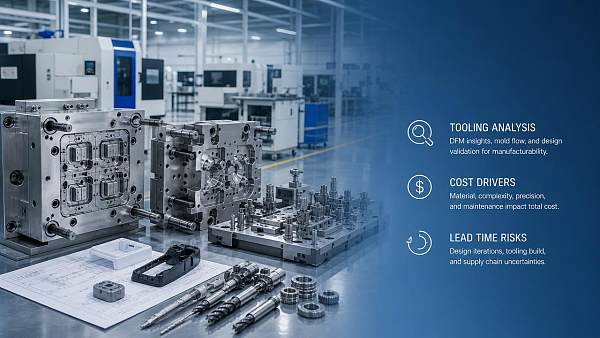
Tooling analysis is the structured review of tool design, build cost, manufacturing complexity, qualification path, and schedule sensitivity. It applies to molds, dies, fixtures, jigs, gauges, cutters, and specialized assembly tools.
The goal is not limited to estimating spend. Strong tooling analysis also reveals how design choices affect durability, cycle time, quality stability, maintenance frequency, and ramp-up timing.
In integrated industrial programs, one delayed tool can disrupt pilot builds, validation tests, and serial production. That is why tooling analysis often sits near the center of technical benchmarking.
Across GIM’s sectors, the same logic applies. A high-cavitation plastic mold, a stamping die, an MBR module fixture, or an HDI drilling tool all carry cost drivers and lead time risks that must be measured early.
Core elements typically reviewed
- Part geometry, tolerance stack, and material behavior
- Tool steel grade, heat treatment, and coating strategy
- Cavitation, automation level, and target throughput
- Supplier process capability and validation requirements
- Maintenance access, spare strategy, and expected tool life
Cost Drivers Behind Tooling Performance
A reliable tooling analysis breaks cost into specific technical contributors. This prevents oversimplified price comparisons and highlights where a low quote may hide downstream exposure.
1. Product design complexity
Complex geometry increases machining time, electrode count, polishing effort, and inspection load. Tight tolerances also raise the need for higher precision equipment and more iterative adjustment.
2. Material selection
Tool material affects wear resistance, thermal stability, repairability, and lifespan. Premium steels or coated inserts cost more upfront, but may reduce scrap, rework, and maintenance interruptions.
3. Production volume and life expectation
A tool built for prototype output differs greatly from one intended for millions of cycles. Tooling analysis must align hardness, cooling design, insert architecture, and automation with expected volume.
4. Quality and compliance requirements
Programs governed by ISO, IATF, or IPC often require stronger documentation, traceability, capability studies, and qualification samples. These add cost, but they also improve launch discipline.
5. Tool architecture and changeover design
Modular tools, interchangeable inserts, and service-friendly layouts can increase initial cost. However, they often improve uptime, shorten maintenance windows, and support future engineering changes.
Lead Time Risks That Distort Program Schedules
Lead time is often treated as a single promise. Effective tooling analysis separates it into design release, material procurement, machining, assembly, tryout, correction, and approval milestones.
This matters because the biggest delays usually happen after nominal completion. Rework loops, sample failures, and interface changes can consume more time than base manufacturing itself.
Frequent lead time risk sources
- Late design freeze or unstable CAD release
- Long steel, component, or hot runner procurement cycles
- Supplier overbooking and limited machine capacity
- Insufficient DFM review before cutting steel
- Multiple tryout rounds caused by shrinkage or warpage issues
- Delayed metrology, PPAP, FAI, or capability approval
Tooling analysis should therefore test quoted lead time against actual process steps. A fast promise without buffer logic, quality gates, or contingency planning is a warning signal.
Current Industry Signals Across Major Manufacturing Segments
Cross-sector benchmarking shows that tooling risk patterns differ by application, yet several themes are recurring globally: tighter launch windows, more material volatility, and increasing qualification demands.
Why Tooling Analysis Matters for Business Evaluation
A mature tooling analysis improves more than technical visibility. It strengthens commercial negotiation, supplier benchmarking, and program governance across diverse manufacturing categories.
First, it separates strategic cost from avoidable cost. Some expense is necessary for tool life, process stability, and compliance. Other expense comes from preventable redesign, weak review discipline, or underdeveloped planning.
Second, tooling analysis sharpens lead time realism. It allows schedule comparison based on critical path evidence rather than optimistic commitments.
Third, it reduces lifecycle surprises. Tools that seem economical at award stage may later drive downtime, excessive maintenance, poor repeatability, or slow engineering changes.
Decision value created by tooling analysis
- More accurate total cost comparison
- Better visibility into launch risk
- Stronger basis for dual-source planning
- Clearer alignment between design intent and factory reality
- Faster issue escalation using measurable criteria
Typical Tooling Analysis Scenarios and Object Categories
The same tooling analysis framework can be adapted to many object types. What changes is the dominant risk profile, not the need for structured review.
Practical Recommendations for More Reliable Tooling Analysis
Effective tooling analysis is most useful when applied before supplier award and updated through launch. Static review is not enough in fast-moving industrial programs.
Recommended practices
- Request cost breakdown by design, material, machining, assembly, tryout, and qualification
- Map lead time by milestone instead of relying on one delivery date
- Confirm assumptions behind cycle life, maintenance intervals, and spare insert strategy
- Review DFM, tolerance criticality, and measurement feasibility before tool release
- Benchmark supplier capacity, past correction rates, and engineering change responsiveness
- Link tooling analysis with quality planning and production ramp scenarios
It is also useful to score each tool against cost volatility, schedule confidence, complexity, and validation burden. This creates a comparable risk index across suppliers and sectors.
Next-Step Framework for Data-Driven Tooling Decisions
A disciplined tooling analysis turns fragmented technical details into decision-ready intelligence. It connects cost structure, schedule exposure, and manufacturing readiness in one consistent view.
For cross-industry programs, the most effective next step is to standardize tooling analysis criteria across sourcing reviews, supplier audits, and launch checkpoints. That enables stronger benchmarking and fewer preventable delays.
Using a platform approach such as GIM, organizations can compare tooling analysis outcomes across electronics, automotive, agri-tech, infrastructure, and precision hardware environments. The result is clearer risk visibility and more resilient execution.
When tooling analysis is embedded early, cost discussions become more accurate, lead times become more credible, and industrial strategy becomes easier to defend with verifiable data.
The Archive Newsletter
Critical industrial intelligence delivered every Tuesday. Peer-reviewed summaries of the week's most impactful logistics and market shifts.