Monday, May 22, 2024

26th South China Magnetics Summit Launches Direct OEM Demand Matching
by
Published
Views:
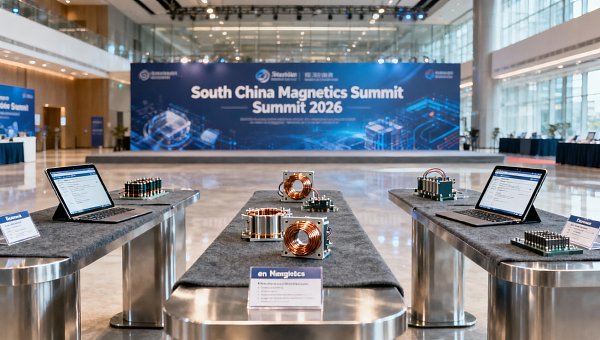
On May 29, 2026, the 26th South China Magnetics Summit opened in Dongguan, introducing a first-time ‘Direct OEM Demand Matching’ session. This initiative targets enterprises in new energy vehicles, leading energy storage system integrators, and major server power supply manufacturers — inviting their R&D and procurement representatives to present technical and procurement requirements on-site. Magnetic component and materials suppliers responded immediately. The move shifts away from conventional sales-driven outreach and supports overseas OEMs/ODMs in identifying highly compatible Chinese suppliers, potentially shortening technical validation and sample integration timelines. Stakeholders in power electronics, EV drivetrain systems, and datacenter infrastructure should monitor this development closely — as it signals an operational shift in how demand is communicated and fulfilled across the magnetics supply chain.
Event Overview
The 26th (South China) Magnetics Industry Chain Summit commenced on May 29, 2026, in Dongguan. For the first time, the summit included a dedicated ‘Direct OEM Demand Matching’ segment. Confirmed participants included R&D and procurement representatives from new energy vehicle manufacturers, top-tier energy storage system integrators, and large-scale server power supply producers. These buyers presented specific technical and volume requirements live; magnetic component and materials suppliers engaged in real-time response and preliminary alignment. No further details on participating companies, scope of requirements, or follow-up mechanisms have been publicly disclosed.
Impact on Specific Industry Segments
Original Equipment Manufacturers (OEMs) and Original Design Manufacturers (ODMs)
OEMs/ODMs — especially those headquartered outside China and sourcing magnetics for automotive, energy storage, or server applications — face reduced search friction when identifying qualified Chinese suppliers. The direct matching format lowers information asymmetry and may compress early-stage supplier qualification cycles.
Magnetic Component Manufacturers (Domestic)
Chinese manufacturers of inductors, transformers, and custom magnetics gain structured access to high-intent, application-specific demand — bypassing generic trade-show lead generation. Impact manifests most directly in faster feedback loops during technical feasibility assessment and sample iteration phases.
Materials Suppliers (e.g., Ferrite, Amorphous Alloy Producers)
Upstream material suppliers may experience downstream demand signals with greater specificity — e.g., requests tied to thermal performance under EV traction conditions or high-frequency stability for AI server PSUs. However, current public information does not indicate whether material-level requirements were explicitly surfaced in the session.
Supply Chain & Technical Sourcing Service Providers
Firms offering technical vetting, sample coordination, or compliance documentation support may see increased engagement from both sides — OEMs seeking faster validation pathways and suppliers needing turnkey support to meet stringent application benchmarks. Their role could evolve toward facilitating pre-qualified handoffs rather than broad-spectrum supplier discovery.
What Relevant Enterprises or Practitioners Should Focus On Now
Track official updates on participant criteria and post-event outcomes
The summit organizers have not yet published eligibility rules for future demand-matching sessions, nor confirmed whether outcomes (e.g., matched pairs, timeline milestones) will be shared transparently. Companies planning participation in 2027 should monitor announcements for formalized application windows and technical submission guidelines.
Prepare application-ready technical documentation aligned to priority end markets
Suppliers intending to respond to EV, energy storage, or server PSU requirements should ensure datasheets, test reports (e.g., thermal cycling, partial discharge), and AEC-Q200 or IEC 62368-1 compliance evidence are standardized and readily deployable — not just internally archived. Real-time matching relies on rapid verification capacity.
Distinguish between pilot activity and scalable process
This is the inaugural implementation of direct demand matching at the summit. Observably, its structure resembles a controlled pilot rather than an institutionalized procurement channel. Companies should treat initial engagements as relationship- and reference-building opportunities — not as immediate procurement commitments.
Align internal cross-functional readiness ahead of next cycle
Effective participation requires coordination across R&D (for technical responsiveness), sales (for commercial framing), and quality (for compliance articulation). Teams should conduct internal dry-runs using representative OEM requirement templates — even if no formal call-for-participation has launched.
Editorial Perspective / Industry Observation
Analysis shows this initiative is best understood as a procedural signal — not yet an established transactional mechanism. It reflects growing pressure on both sides of the magnetics value chain: OEMs seek faster, lower-risk paths to qualified suppliers amid tightening product development schedules, while Chinese suppliers aim to move beyond cost-based competition into application-specific solution partnerships. The absence of third-party verification, contractual frameworks, or post-event reporting suggests the model remains experimental. Continued observation is warranted — particularly whether similar formats appear at other regional magnetics or passive components events in 2026–2027.
In summary, the launch of direct OEM demand matching at the 26th South China Magnetics Summit marks a structural refinement in how technical procurement intent flows from end-product developers to component suppliers. Its near-term significance lies less in immediate order volume and more in signaling a shift toward outcome-oriented, application-aligned engagement — one that rewards technical transparency and responsiveness over traditional exhibition-based visibility. For now, it is more accurately interpreted as an evolving coordination experiment than a fully formed market mechanism.
Source: Official announcement of the 26th (South China) Magnetics Industry Chain Summit, held on May 29, 2026, in Dongguan. No additional sources or third-party verification cited. The scope and sustainability of the ‘Direct OEM Demand Matching’ format remain subject to ongoing observation.

The Archive Newsletter
Critical industrial intelligence delivered every Tuesday. Peer-reviewed summaries of the week's most impactful logistics and market shifts.