Monday, May 22, 2024

Agricultural Insights: Signals That Point to Smarter Investment
by
Published
Views:
Agricultural insights are becoming essential for researchers and decision-makers seeking smarter investment signals in a rapidly evolving global market. As sustainable agriculture increasingly intersects with manufacturing, mobility, and environmental infrastructure, understanding verified data, technical benchmarks, and supply chain dynamics is key to identifying resilient opportunities. This article explores the indicators that help information seekers evaluate agricultural value with greater clarity and confidence.
What do agricultural insights really reveal in cross-industry investment analysis?
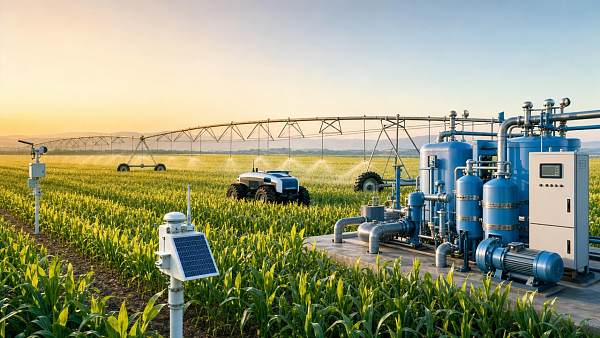
For information researchers, agricultural insights are no longer limited to crop yield, seasonal demand, or land use trends. They now sit inside a wider industrial map that includes sensor electronics, autonomous mobility, water treatment systems, precision tooling, and compliance-driven supply chains.
That shift matters because investment quality in agriculture increasingly depends on what happens upstream and downstream. A smart irrigation platform is not only an agricultural asset. It is also an electronics procurement question, an infrastructure reliability question, and often an ESG reporting question.
This is where a platform such as Global Industrial Matrix (GIM) creates practical value. Instead of viewing smart agriculture in isolation, GIM connects benchmark data across Semiconductor & Electronics, Automotive & Mobility, Smart Agri-Tech, Industrial ESG & Infrastructure, and Precision Tooling.
- It helps researchers identify whether an agricultural technology depends on fragile components or diversified supply sources.
- It allows procurement teams to compare technical claims against recognized standards such as ISO, IATF, and IPC where relevant.
- It supports smarter investment screening by linking mechanical performance, digital integration, and environmental resilience.
In practical terms, agricultural insights become more actionable when they answer a broader question: can this asset, supplier, or technology remain reliable under real industrial conditions?
Which signals point to smarter investment rather than short-term excitement?
Many promising agri-tech concepts attract attention early, but not all of them become durable investment opportunities. Strong agricultural insights focus on signals that can be checked, compared, and stress-tested across the value chain.
Core signals worth tracking
- Component traceability: Can the system’s core electronics, actuators, membranes, or tooling inputs be sourced from stable channels?
- Benchmark alignment: Are claims supported by comparison to accepted technical standards rather than marketing language alone?
- Operational fit: Does the solution work under actual field conditions including dust, vibration, water quality variation, and maintenance limitations?
- Lifecycle economics: Is the value based on total operating performance, or only on an attractive initial purchase price?
- Infrastructure dependency: Does performance rely on power stability, digital connectivity, filtration quality, or regional servicing capacity?
Researchers often miss the last point. An investment can look efficient on paper yet remain vulnerable if it depends on fragile logistics, hard-to-replace modules, or weak maintenance ecosystems.
The following table shows how agricultural insights can be translated into decision signals for cross-sector evaluation.
The main lesson is simple: better agricultural insights come from linking field performance with industrial verification. That is especially useful when screening opportunities in a market shaped by both sustainability pressure and manufacturing complexity.
How should information researchers compare agricultural opportunities across different scenarios?
Not every agricultural asset should be judged by the same metrics. A precision spraying system, a greenhouse automation package, and a wastewater recovery solution all create value differently. Researchers need a scenario-based comparison model.
Three common evaluation scenarios
- Mechanization expansion: Focus on mobility integration, equipment uptime, drivetrain component sourcing, and maintenance support.
- Digital farm infrastructure: Focus on sensors, connectivity hardware, PCB reliability, environmental sealing, and interoperability.
- Water and environmental systems: Focus on membrane durability, filtration consistency, energy demand, and compliance documentation.
When researchers compare these opportunities through only one lens, they tend to overvalue surface innovation and undervalue implementation risk. Agricultural insights become sharper when they include operational context.
The table below helps compare investment priorities across smart agriculture applications that connect directly with industrial manufacturing and infrastructure systems.
This kind of comparison is valuable because it gives information seekers a way to rank opportunities by technical fit, not by narrative momentum alone. That is one of the strongest uses of agricultural insights in modern investment screening.
Why do standards, benchmarks, and supply chain data matter so much?
In blended sectors such as smart agriculture, performance claims often involve multiple engineering domains. A single solution can include electronic assemblies, structural components, rotating parts, software interfaces, and water-contact materials. Without benchmarks, comparisons become subjective.
What researchers should look for
- Whether testing language is specific enough to understand field readiness rather than lab-only conditions.
- Whether documentation maps to recognized industrial standards where applicable.
- Whether suppliers can explain component substitution risk and lead-time exposure.
- Whether the system architecture allows maintenance without complete replacement.
GIM’s cross-sector benchmarking model is particularly relevant here because it helps decode how agricultural systems depend on wider industrial ecosystems. A water recovery module may be influenced by membrane sourcing. An autonomous tractor may be constrained by semiconductor supply and precision tooling quality.
For procurement-led research, agricultural insights become far more credible when they connect technical qualification with sourcing resilience. This reduces the gap between a promising concept and a workable investment thesis.
Procurement guide: what should you check before treating a signal as investment-grade?
Information researchers are often asked to support internal decisions before formal sourcing begins. At this stage, the biggest risk is treating early data as decision-ready data. A structured screening checklist helps prevent that mistake.
Preliminary review checklist
- Confirm the operating environment, including temperature range, water quality, vibration, and maintenance access.
- Review critical component categories, especially electronics, motion systems, filtration media, and machined parts.
- Ask how performance is benchmarked and what documentation supports the claim.
- Estimate service dependency, including spare parts path, technical support needs, and operator training load.
- Separate capital cost from lifecycle cost before ranking options.
Agricultural insights are most useful when they lead to better questions. Researchers do not need to act as design engineers, but they do need enough technical structure to identify weak signals early.
Common selection mistakes
- Assuming smart features automatically justify a premium without checking integration cost.
- Ignoring consumables, replacement cycles, or cleaning requirements in water-related systems.
- Treating pilot success as proof of scalable supply reliability.
- Comparing only product specs while overlooking manufacturing maturity and documentation quality.
Cost, alternatives, and timing: how do smarter decisions balance value and risk?
In many projects, the best option is not the most advanced platform. It is the one that matches operating conditions, budget discipline, and available technical support. That is why agricultural insights should include cost and timing trade-offs, not only technical ambition.
A lower-cost system may be acceptable if service parts are available locally, documentation is complete, and environmental exposure is moderate. A higher-spec system may be justified where uptime, compliance, or water efficiency carry larger financial consequences.
Researchers should also compare alternatives by deployment speed. Long lead times in electronics, specialized membranes, or precision-machined components can delay implementation and distort return assumptions.
- Choose robust but simpler architectures when local maintenance capacity is limited.
- Favor modular systems when upgrade paths are uncertain.
- Account for qualification time if standards review or buyer approval gates are strict.
This balanced approach supports better investment logic. It also aligns well with GIM’s role as a technical benchmarking platform for organizations that need evidence before commitment.
FAQ: practical questions researchers ask when reviewing agricultural insights
How do agricultural insights help with early-stage investment screening?
They help separate attention-driven trends from investable systems by checking technical readiness, supply resilience, compliance visibility, and lifecycle economics. Early screening improves when the analysis includes both field performance and industrial dependencies.
Which scenarios benefit most from cross-sector benchmarking?
The strongest examples are autonomous machinery, sensor-heavy farm automation, water reuse systems, and controlled environment agriculture. These areas depend on multiple technical domains, so agricultural insights are more reliable when electronics, tooling, infrastructure, and standards are assessed together.
What should I prioritize if budget is limited?
Prioritize total operability over feature count. Check maintenance frequency, spare parts path, environmental tolerance, and implementation complexity. A less sophisticated system can create better value if it is easier to support and less exposed to supply disruption.
How important are standards such as ISO, IATF, or IPC in agricultural research?
They matter when the solution includes manufactured hardware, quality-sensitive assemblies, or procurement qualification requirements. These frameworks do not replace field validation, but they improve consistency when comparing suppliers and technical claims.
How long does it take to validate an agricultural opportunity properly?
The timing varies by complexity. A basic desk review may be quick, but a meaningful assessment often requires checking documentation depth, component dependency, standards alignment, and likely lead-time exposure. The more the opportunity touches electronics, automation, or environmental infrastructure, the more structured the review should be.
Why choose us for deeper agricultural insights and technical benchmarking?
If your team needs more than high-level market commentary, GIM provides a stronger foundation for decision support. Our advantage is not limited to one vertical. We connect Smart Agri-Tech with semiconductor sourcing, mobility systems, industrial ESG infrastructure, and precision tooling realities.
That means your agricultural insights can be tested against the factors that often decide real outcomes: component availability, standards relevance, hardware reliability, documentation quality, and deployment practicality.
You can contact us for specific support on parameter confirmation, product selection logic, lead-time evaluation, customized benchmarking scope, standards and certification review, sample support planning, and quotation-stage technical comparison.
When investment decisions depend on verified data rather than assumptions, cross-sector visibility becomes a strategic advantage. That is the role GIM is built to serve.
The Archive Newsletter
Critical industrial intelligence delivered every Tuesday. Peer-reviewed summaries of the week's most impactful logistics and market shifts.