Monday, May 22, 2024

What Determines Battery Cage Prices for Layer Farms in Nigeria?
by
Published
Views:
A layer-cage quotation can look straightforward until the buyer compares two offers that appear similar but differ sharply in total cost, delivery scope, material quality, and expected service life. For Nigerian layer farms, the purchase decision is rarely about the cage frame alone. It is a capital-equipment decision tied to flock size, building design, power reliability, labour availability, manure handling, water supply, and the practical cost of keeping hens productive over several laying cycles.
The quoted price of a battery cage system is therefore only a starting point. Business evaluators need to separate the equipment price from the landed, installed, and operating cost. A lower initial quotation may exclude freight, unloading, civil works, drinker connections, electrical components, installation support, or replacement parts. Conversely, a higher-priced system may include heavier wire, better corrosion protection, more complete feeding and watering equipment, or a layout that reduces daily labour requirements.
Why price comparisons often fail
Comparing cage prices by the number of compartments or birds advertised can produce misleading results. Capacity figures may be based on a supplier’s stated stocking arrangement, while the actual usable capacity depends on cage dimensions, bird breed and weight, climate, ventilation, welfare expectations, and farm management practices. A system designed around aggressive stocking density can show a lower cost per bird place while creating more operational pressure on egg collection, water access, airflow, and flock monitoring.
For commercial evaluation, the more useful question is: What is included in the cost per usable bird place, and what conditions must be met for the system to perform as intended? That question changes the procurement discussion from a catalogue comparison into an investment assessment.
When reviewing a published guide to battery cage for layers price in nigeria, buyers should still request a configuration-specific quotation. Price lists can help establish a reference point, but they cannot account for the farm’s building width, number of tiers, local transport route, feed delivery method, exchange-rate exposure, or the accessories required for a working house.
The equipment specification behind the quotation
Wire quality and protective coating are among the largest reasons two cage systems can carry different prices. Layer cages operate in a humid, dusty, ammonia-exposed environment. Manure decomposition releases ammonia, and poor ventilation can increase moisture and corrosive conditions around lower tiers and manure collection areas. The cage may remain structurally usable while rusted joints, weakened floor wire, damaged doors, or corroded drinker lines create recurring repair work.
Buyers should ask for a written description of the wire diameter by component rather than accepting a general statement such as “high-quality galvanized wire.” The floor, front panel, side mesh, support legs, feed trough supports, and cross-bracing do not necessarily use the same gauge. A quotation should also specify whether galvanizing occurred before welding or after fabrication, because the treatment and coverage of welded points can affect corrosion resistance in service.
There is no single coating choice that fits every farm. A building with open sidewalls, strong wind-driven rain exposure, and inconsistent manure removal may need a more conservative corrosion strategy than a well-managed enclosed house with controlled airflow. The buyer should compare the stated coating process, the warranty terms, the maintenance assumptions, and the supplier’s treatment of cut ends and welded connections.
Cage geometry affects more than bird capacity
The physical layout influences both the system price and the farm’s ability to manage hens. Wider feed troughs, reliable trough supports, appropriate floor slope, access doors that can be opened without stressing adjacent birds, and suitably positioned nipple drinkers all add material and fabrication cost. They can also reduce routine disruption when staff inspect birds, remove a weak hen, clean a blocked drinker, or collect eggs that do not roll correctly.
Floor slope deserves close attention. If it is too shallow, eggs may remain in the cage and be dirtied or cracked. If it is too steep, egg impact and rolling speed may rise, particularly where collection trays or belts are poorly aligned. Buyers should request the specified floor gradient and understand how the egg collection system is supported across the length of the house.
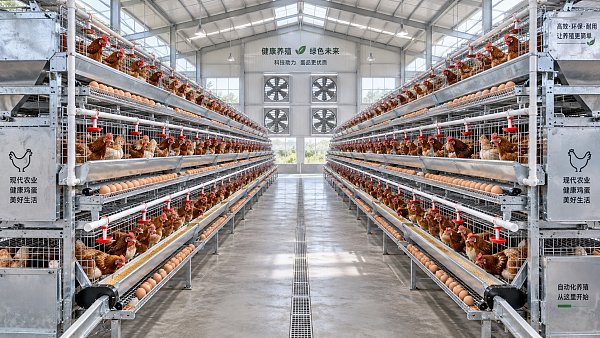
Tier count is another price driver. Three-tier and four-tier arrangements are often easier to inspect and service than denser multi-tier systems, but they use building volume differently. More tiers can reduce the structural cost allocated to each bird place in a suitable high-roof building, yet the arrangement may demand stronger supports, more careful water-pressure control, better lighting distribution, and practical access for staff. The right choice depends on the existing building and management capacity, not simply the lowest quoted cost per hen.
Feeding, drinking, and manure systems change the real project value
A bare cage frame is not a complete production system. Feed troughs, feed carts or chain feeders, hopper arrangements, nipple drinker lines, pressure regulators, header tanks, filters, flushing points, manure boards, scrapers, belts, and egg collection components can each be priced separately. Procurement teams should map every quoted item against the farm process, from feed arrival through egg dispatch and manure removal.
Automation should be assessed against the farm’s actual operating conditions. A mechanised feeding or manure system can reduce repetitive labour and improve consistency when it is properly installed, maintained, and supported with dependable power. It can also introduce motors, gearboxes, controls, and parts that require planned maintenance. For locations with unstable electricity, the evaluation should include generator capacity, fuel use, power protection, and the consequences of a stoppage during feeding, watering, or manure removal.
Water quality is often overlooked during cage procurement. Sediment, mineral scale, or microbiological contamination may affect nipple-drinker performance and flushing requirements. The World Organisation for Animal Health (WOAH) identifies water quality, cleaning, and pest control as relevant elements of farm biosecurity planning. A buyer should consider filtration and line-cleaning provisions as part of the installed system rather than treating them as optional accessories after birds arrive. [1]
Nigeria-specific cost exposure: currency, logistics, and site readiness
Imported equipment can be affected by foreign-exchange movement between quotation, deposit, shipment, and final payment. This does not mean an imported system is automatically more expensive or less suitable; it means the commercial offer needs clear terms. Buyers should establish the quotation currency, validity period, payment milestones, Incoterm, freight responsibility, port and clearance assumptions, inland transport scope, and the party responsible for damage discovered at delivery.
Freight is also shaped by how efficiently the system is packed. Nested wire panels and clearly bundled components can reduce container space and simplify counting, but compact packing is only beneficial if every part is traceable during unloading. A packing list should identify cages, legs, braces, troughs, nipple lines, fasteners, motors, control components, and installation tools where supplied. Mixed, unlabeled hardware can turn a low freight quote into an expensive installation delay.
Site readiness can be an even larger hidden cost. Before issuing a purchase order, farms should confirm building dimensions, concrete floor condition, drainage, roof clearance, access doors, aisle width, water storage, electrical routing, manure discharge space, and the route available for moving materials into the house. A cage system that fits on a drawing may still be impractical if columns interrupt rows, floor levels vary, or service aisles are too narrow for workers and equipment.
Installation quality is part of the equipment decision
A well-manufactured cage can underperform if installed out of level, incorrectly braced, connected to unfiltered water, or operated before feed and drinker lines are tested. Installation quotations should state whether they include supervision, local labour, travel, accommodation, tools, commissioning, and training. These elements are frequently treated as separate commercial items, so their absence should not be interpreted as a supplier failure; it is a scope issue that must be resolved before contracting.
Acceptance should be based on observable checks rather than a general statement that the house is “completed.” Before flock placement, the farm can verify row alignment, anchor security, door latches, sharp edges, cage-floor continuity, trough stability, nipple operation, leaks, line pressure, feeder movement, electrical protection, and egg-roll clearance. A practical commissioning record also gives management a baseline for identifying faults later.
Biosecurity should be reflected in the installation sequence. Equipment brought into a poultry house can carry dirt, packaging debris, or contamination from transport and storage. WOAH’s terrestrial guidance describes biosecurity as a set of management and physical measures intended to reduce animal disease risk, including controls related to access, cleaning, and hygiene. The exact farm protocol should be determined with its veterinary and operational advisers, but cage installation should not be treated as separate from house-cleaning and flock-entry planning. [2]
How to compare quotations on a like-for-like basis
A structured bid sheet is more reliable than comparing headline totals. Each bidder should respond to the same bird capacity, house dimensions, tier arrangement, feeding method, drinking arrangement, manure system, egg collection method, delivery point, and installation scope. If suppliers propose different layouts, the differences should be visible rather than hidden in a single lump-sum figure.
- Define usable capacity: Record the number of bird places, cage dimensions, tiers, rows, and stated birds per compartment.
- Separate supply from installation: Show equipment, freight, clearance, inland delivery, civil works, installation, commissioning, and taxes as distinct lines where possible.
- Request material detail: Include wire diameters, coating process, trough material, pipe specification, structural supports, and fastener treatment.
- Examine operating dependencies: Identify electricity demand, water-pressure requirements, generator interface, cleaning needs, and routine maintenance tasks.
- Confirm parts availability: Ask which wear items are expected to be replaced, how they are identified, and how long they may take to obtain.
- Document exclusions: A short list of exclusions can be more valuable than vague assurances about what the quoted price “covers.”
Warranty language also needs interpretation. A warranty is meaningful only when it identifies the covered components, duration, exclusions, claim process, evidence required, transport responsibility, and remedy offered. It should not substitute for incoming inspection. Farms that discover missing components or visible transit damage after installation has started may face greater disruption than farms that count and inspect goods immediately after delivery.
A lower purchase price can carry a higher operating cost
The lowest offer may be appropriate when the farm has a short planning horizon, a simple manually managed house, ready access to skilled repair labour, and a clear plan for maintenance. It may be unsuitable where downtime is costly, corrosion exposure is high, labour is constrained, or replacement parts are difficult to source. The inverse is also true: a complex system is not automatically better if the farm cannot maintain it, power it, or operate it consistently.
The most defensible purchasing decision links equipment specification to the farm’s production model. A buyer should identify which failures would be most disruptive: water interruption, feed distribution problems, manure accumulation, egg breakage, structural corrosion, or delayed repairs. The selected cage package should address those risks at a cost the farm can support through its expected operating life.
For Nigerian layer projects, the useful price is not the first number on a supplier’s sheet. It is the documented cost of a complete, installable, maintainable system that fits the building, the flock plan, the utility conditions, and the farm’s ability to manage it day after day.
Sources
[1] World Organisation for Animal Health (WOAH), Terrestrial Animal Health Code, chapter on biosecurity procedures in poultry production.
[2] World Organisation for Animal Health (WOAH), Terrestrial Animal Health Code, general principles of biosecurity.
The Archive Newsletter
Critical industrial intelligence delivered every Tuesday. Peer-reviewed summaries of the week's most impactful logistics and market shifts.