Monday, May 22, 2024

How food processing equipment selection affects product consistency
by
Published
Views:
Product consistency is not created at the final inspection point. It is built into the process path: how ingredients are received, metered, mixed, heated, transferred, filled, cooled, and cleaned between runs. Equipment that meets a nominal throughput requirement can still produce unacceptable variation if it cannot control the process variables that matter to a specific formulation.
In food processing, the central selection question is therefore not “Which machine has the highest capacity?” but “Which equipment can hold the critical process conditions within the required operating window, under normal production conditions and across the full product range?” That distinction affects texture, viscosity, particle distribution, moisture, fill weight, color, microbial stability, shelf life, and sensory performance.
A line may be mechanically reliable yet deliver inconsistent product because its pumps induce excess shear, its heat exchanger has uneven residence time, its filler cannot handle viscosity changes, or its clean-in-place system leaves residues in difficult-to-clean zones. Selection must connect equipment design to the mechanisms that create variation.
Consistency begins with defining the product’s critical attributes
Equipment cannot be assessed meaningfully until the required product outcome is expressed as measurable process and quality attributes. A sauce, dairy beverage, meat emulsion, baked filling, frozen product, and dry powder may all be described as “food processing” applications, but the sources of inconsistency are fundamentally different.
For a liquid or semi-liquid product, relevant attributes may include viscosity at a stated temperature and shear rate, solids content, pH, particle size, emulsion stability, suspended-particle distribution, fill mass, and microbiological status. For powders, the more decisive variables may be moisture, particle segregation, bulk density, flowability, agglomeration, and dosing repeatability. In thermal processes, the target is rarely just a setpoint temperature; it may include the complete temperature-time history of every unit of product.
These attributes should be translated into a practical acceptance envelope before comparing suppliers. A target average alone is insufficient. If a filling operation requires 500 g packs, the evaluation must also define acceptable fill variation, how often the system is expected to verify weight, and what happens when upstream viscosity or product temperature drifts. If an emulsion must remain stable during its intended shelf life, the equipment review needs to examine droplet-size control, thermal exposure, air incorporation, and transfer conditions—not simply whether the mixer reaches a stated rpm.
The useful specification is process-specific. It identifies the variable, its allowable range, where it is measured, and which part of the equipment controls it.
Ingredient handling and dosing set the variability entering the line
Many consistency issues originate before the main processing unit. Variations in particle size, powder moisture, bulk density, ingredient temperature, or lot characteristics can propagate through the entire line. Equipment selection determines whether the process absorbs this normal raw-material variation or amplifies it.
Consider dry ingredient addition. A basic screw feeder may deliver acceptable average mass flow but struggle when powder bulk density changes. A loss-in-weight feeder can compensate for changing density by controlling actual mass loss, yet it still depends on stable refill behavior, appropriate hopper geometry, agitation where necessary, and a feeding mechanism suited to the material. Poor flow at the hopper outlet can cause bridging, ratholing, pulsation, or intermittent discharge; no downstream mixer can fully correct a recipe that is intermittently fed.
Liquid dosing has similar limitations. Pump selection must reflect viscosity, entrained air, temperature, particulate content, and the required turndown ratio. A pump sized for peak flow may operate too close to its lower control limit during smaller batches or start-up, producing unstable dosing. Positive-displacement pumps can provide controlled transfer for viscous products, but their suitability depends on internal clearances, pressure conditions, cleaning requirements, and the product’s sensitivity to shear. Centrifugal pumps may be appropriate for low-viscosity fluids but can be a poor fit where accurate low-flow dosing, solids handling, or gentle transfer is required.
Ingredient systems should also be assessed for traceability and containment. A process cannot reliably reproduce a formulation if actual additions cannot be reconciled against the batch record, or if dust, residue, or accidental carryover creates uncontrolled changes between products.
Mixing performance is about process outcome, not motor power
Mixers are often compared through vessel volume, installed kW, agitator speed, and batch cycle time. Those figures have limited value unless they are connected to fluid behavior and product structure. Two vessels with similar capacities can produce materially different results because impeller geometry, tank proportions, baffle arrangement, blade clearance, feed point location, and operating sequence differ.
For low-viscosity liquid blending, the main concern may be circulation and the elimination of concentration gradients. For high-viscosity fillings, pastes, or dough-like materials, the relevant question becomes whether the agitator can move material from the wall and vessel bottom into the active mixing zone without excessive local heating or dead zones. For dispersing powders into liquids, the challenge is often wet-out and deagglomeration. Adding powder into a poorly designed vortex can create persistent lumps, while overly aggressive high-shear treatment may alter texture or incorporate unwanted air.
The distinction between blending, dispersion, emulsification, and homogenization should remain explicit during equipment selection. A batch agitator may blend ingredients adequately but not produce a stable emulsion. An inline rotor-stator device can reduce agglomerates but may not provide the residence time or recirculation pattern needed for complete batch uniformity. A homogenizer may improve emulsion stability, but its pressure, valve condition, and upstream feed stability become critical to repeatable results.
Recipe flexibility complicates the decision. A system selected solely around the most fluid product may fail on the highest-viscosity formulation. A system designed for the heaviest product may damage a delicate suspension or make low-volume runs impractical. The equipment envelope should be evaluated against the full product matrix, including minimum batch size, maximum viscosity, particle size range, temperature range, and changeover frequency.
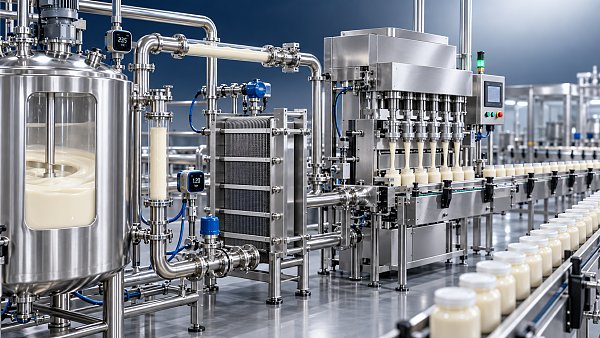
Thermal equipment controls more than temperature
Heating, cooling, pasteurization, cooking, and hot-fill operations have a direct effect on safety and shelf-life performance, but consistency depends on much more than the displayed temperature. The actual treatment received by the product is shaped by heat-transfer area, flow regime, residence-time distribution, fouling behavior, control response, and the relationship between product temperature and utility temperature.
A heat exchanger can achieve the required outlet temperature while still exposing portions of product to different thermal histories. In continuous systems, variations in flow rate or hold-tube behavior can change the minimum residence time. In batch vessels, inadequate agitation can create temperature gradients, particularly with viscous products. If heating surfaces foul during a run, the thermal response can shift: more utility input may be required, localized overheating can become more likely, and the process may no longer match the conditions established during commissioning.
Equipment geometry matters. Plate heat exchangers can offer efficient heat transfer for suitable products but require careful consideration of particulates, viscosity, pressure drop, gasket compatibility, and cleanability. Tubular designs may be more suitable for products with fibers, particulates, or higher viscosity, though the relevant selection questions include tube diameter, flow velocity, pressure loss, and the risk of product build-up. Scraped-surface heat exchangers are used where viscous or fouling products demand continual surface renewal, but their mechanical complexity, wear components, and sanitation validation requirements must be reflected in the operating plan.
Control architecture is equally important. A temperature loop with a slow sensor response or poorly positioned measurement point can mask meaningful deviations. Product temperature should be measured where it represents the controlled condition, not merely where installation is convenient. If a thermal process has a safety-critical function, the instrumentation, recording, alarms, diversion logic, and validation approach must be designed around the applicable regulatory framework and the site’s hazard-control plan.
Transfer systems can change the product after it has been made
Once a product leaves the mixer or thermal unit, it is often assumed to be finished. In reality, transfer through piping, valves, pumps, bends, elevation changes, and buffer tanks can alter the product before filling. This is especially relevant for emulsions, aerated products, suspensions, products containing particulates, and shear-sensitive structures.
Long recirculation loops can increase shear exposure and residence time. Dead legs can retain product, create quality risks, and complicate cleaning. Oversized pipes may reduce velocity below the level required to maintain particles in suspension; undersized pipes can increase pressure drop and shear. A poorly designed buffer tank can allow phase separation, temperature loss, foaming, or product stratification. The result may appear as inconsistent fill weights, variable particle counts per pack, or differences in texture between the beginning and end of a run.
Valve selection deserves the same scrutiny as major equipment selection. Seat arrangement, internal cavities, drainability, switching sequence, and compatibility with cleaning chemistry affect both product protection and hygienic performance. For multi-product lines, valve matrices must be evaluated not only for routing flexibility but also for the risk of unintended product mixing during changeover or recovery operations.
Filling equipment reveals upstream instability—and can create its own
Filling is where product variation becomes visible and measurable, but a filler should not be expected to compensate for uncontrolled upstream conditions. Changes in product temperature, viscosity, aeration, pressure, particle distribution, and head pressure can all affect fill accuracy. A dosing technology that performs well with a homogeneous liquid may be unsuitable for a particulate sauce or a foaming dairy product.
Volumetric filling can be effective where product density and flow behavior remain stable. Net-weight filling provides direct control of delivered mass, but its practical performance depends on scale dynamics, product cut-off behavior, vibration isolation, and the speed required by the line. Time-pressure systems are sensitive to pressure and viscosity variation. Piston fillers can provide controlled dosing for viscous products but must be assessed for particle handling, seal wear, cleanability, and the impact of product compressibility or entrained air.
Container handling also affects apparent consistency. Misalignment at the nozzle, unstable conveyor motion, inconsistent container geometry, or inadequate anti-drip control can create weight losses, contamination, and poor pack appearance even when the dose calculation is correct. The evaluation should examine performance during starts, stops, short interruptions, and end-of-run recovery—not only under steady-state demonstration conditions.
Hygienic design protects repeatability between production runs
A line that is difficult to clean does not only present a food-safety concern; it also undermines product consistency. Residual product can alter flavor, color, allergen status, solids concentration, or microbiological condition in the next run. The effect may be subtle enough to escape immediate detection while still causing preventable batch variation.
Hygienic design assessment should look beyond a statement that equipment is “sanitary.” Product-contact materials, surface finish, weld quality, gasket design, drainability, accessibility, spray-device coverage, and the elimination of product traps all influence cleanability. Equipment must also be compatible with the actual cleaning regime: chemical concentration, temperature, flow conditions, cycle duration, and any required disassembly.
For systems designed for clean-in-place operation, the cleaning circuit should be considered as an engineered process. A vessel or pipework section may be nominally connected to CIP yet receive insufficient flow velocity, poor chemical impingement, or uneven temperature. Complex equipment with valves, fillers, heat exchangers, and parallel branches requires a documented approach to cleaning validation appropriate to its risk profile. Standards and guidance such as hygienic design principles from 3-A Sanitary Standards, EHEDG, and applicable local food regulations can inform the review, but conformance claims should be tied to the actual configuration rather than treated as blanket proof of hygienic performance.
Automation improves consistency only when measurements are meaningful
Automation reduces dependence on manual timing and judgment, but it cannot correct an uncontrolled process or an unreliable measurement. A recipe system can reproduce setpoints precisely while the product remains variable because the underlying sensors are poorly located, insufficiently accurate, or not maintained.
The most valuable measurements are those directly linked to product outcomes: ingredient mass, flow, temperature, pressure, conductivity, pH, viscosity where feasible, fill weight, and relevant in-line quality indicators. Their value depends on calibration, response time, process placement, and how the control system acts on deviations. A flow meter installed after a pulsating pump may require signal treatment and suitable control logic. A temperature sensor in a stagnant branch does not represent the temperature of the flowing product. A level measurement in a buffer vessel may support inventory control without indicating whether the product has separated.
Data should make variation diagnosable. Batch records and trend data are most useful when they show the relationship between raw-material inputs, equipment states, process conditions, alarms, interventions, and finished-product results. A system that records thousands of tags without connecting them to critical quality attributes can create data volume without decision value.
Evaluate equipment at operating boundaries, not only at design point
Supplier demonstrations commonly focus on ideal conditions: a stable product, a clean system, a single recipe, trained operators, and continuous production near nominal capacity. Selection decisions should test the boundaries where variation is most likely to emerge.
Relevant evaluation conditions include the lowest and highest planned throughput, minimum and maximum batch size, cold start-up, product temperature excursions, viscosity changes, maximum particulate load, expected utility variation, extended run duration, changeover, cleaning, and restart after interruption. These conditions reveal whether the equipment has adequate control authority and hygienic resilience, rather than merely acceptable performance under one favorable condition.
A useful factory or site acceptance protocol should contain product-representative tests wherever feasible, defined acceptance criteria, instrument verification, and a clear distinction between demonstrated capability and assumed capability. Water trials remain valuable for mechanical checks, but they do not establish performance for shear-sensitive, viscous, particulate, or fouling products. Where real product trials cannot be conducted, the remaining uncertainty should be explicitly recognized in the design review and commissioning plan.
The selection decision should follow the dominant source of variation
There is no universally “best” food processing equipment configuration. The appropriate system is the one that controls the variables most likely to disrupt the intended product. For one line, that may mean gravimetric dosing and robust powder induction. For another, it may mean narrow residence-time control, gentle low-shear transfer, or a filler designed around changing rheology. For a multi-product facility, cleanability and changeover discipline may be more decisive than maximum nominal output.
Consistency is achieved when equipment capability, product behavior, process controls, sanitation design, and operating range are treated as one system. Selecting each machine on isolated specifications can create a line in which every component is individually acceptable but the combined process remains unstable. The stronger technical decision is to trace each critical quality attribute back to the equipment, measurement, and operating condition that governs it—and then verify that control under the conditions the line will actually face.

The Archive Newsletter
Critical industrial intelligence delivered every Tuesday. Peer-reviewed summaries of the week's most impactful logistics and market shifts.